

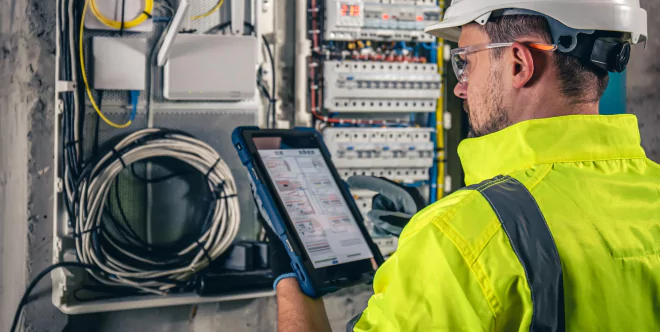



IoT-based predictive maintenance is what happens when a plant stops guessing and starts measuring. Instead of servicing a motor on a fixed schedule or waiting for it to seize, connected sensors continuously track its vibration and temperature, and a model flags the drift weeks before it becomes a failure.
That shift, from calendar-based upkeep to condition-based prediction, is why plant leaders, fleet operators, and equipment manufacturers are moving budget toward it now. IoT for predictive maintenance has moved from a pilot-stage curiosity to a standard line item in that same budget conversation, because predictive maintenance and IoT are, in practice, inseparable at this point. This guide covers what IoT predictive maintenance actually is, the architecture underneath it, where it delivers the fastest return by industry, what it costs to build, and how to launch a pilot without betting the whole maintenance budget on the outcome.
This guide is created for the people who have to make that call: plant and operations leaders, reliability engineers, and the CTOs and VPs of engineering deciding what to build, what to buy, and who to build it with.
What is IoT predictive maintenance?
“Predictive maintenance” describes the strategy: anticipate when equipment is likely to fail and perform maintenance before it does. “IoT-based predictive maintenance” describes how that strategy gets its data. The Internet of Things is the sensing and connectivity layer, the network of devices that captures vibration, temperature, pressure, and current readings and moves them off the machine. Without it, a predictive model has no continuous signal to learn from. The two terms are often used interchangeably because, in practice, almost no modern predictive maintenance system operates without an IoT layer underneath it.
Predictive vs. preventive vs. reactive vs. prescriptive maintenance
Four strategies compete for the same maintenance budget, and most plants run a mix of all four depending on the asset. The comparison readers ask about most is predictive maintenance vs. preventive maintenance, since those two sit closest together on the cost curve, but choosing among these four maintenance strategies, and landing on the appropriate maintenance approach for each asset, is the first real decision you have to make.
Predictive maintenance wins for most industrial equipment because it is a fundamentally different approach to equipment upkeep. It allows for proactive maintenance instead of reactive firefighting or a calendar-driven preventative maintenance routine, and responds to how an asset is actually being used rather than an average assumption about it. Prescriptive maintenance, the newest of the four, goes one step further by recommending the specific fix, not just the failure window. However, it depends on having predictive maintenance in place first: you cannot prescribe an action from a forecast you do not yet have.
How IoT predictive maintenance works: architecture end to end
Predictive maintenance using IoT runs the same five-stage pipeline in every industry: sense, transmit, process at the edge, store and analyze in the cloud, and act. Here is what each stage actually does.

Sensors: what gets measured
Sensors turn physical signs of wear in machine components into digital data that predictive maintenance models can analyze. Effective monitoring starts with choosing sensors that match the specific equipment issues you need to detect, rather than installing every available sensor type. Six types of sensing devices cover most IoT-based predictive maintenance deployments:
- vibration sensors and accelerometers (bearing and shaft wear)
- temperature probes (overheating and friction)
- pressure transducers (hydraulic and pneumatic systems)
- acoustic sensors (leaks, cavitation, and arcing)
- humidity sensors (corrosion risk in enclosures)
- and current transformers (motor load and electrical faults).
Most assets need two or three of these, not all six. The right mix depends on the dominant failure mode.
Gateways and connectivity
Raw sensor data has to leave the machine before anything can analyze it. Gateways handle that handoff, translating sensor and PLC protocols and publishing readings over:
- MQTT, a lightweight messaging protocol built for constrained devices
- LoRaWAN for long-range, low-power sensor networks spread across a large facility, or
- Private 5G where latency and bandwidth both matter, increasingly common on new factory floors.
This is also where legacy equipment gets folded in: a gateway can translate Modbus or OPC-UA from a decades-old PLC into the same pipeline as a brand-new sensor.
Edge computing and edge AI
Not every decision can wait for a round trip to the cloud. Edge computing processes data on or near the machine, which matters when an alert needs to trigger a shutdown in milliseconds rather than seconds. See our deeper look at what edge computing in IoT actually does for the underlying tradeoffs. TinyML, ML models small enough to run on a microcontroller, is what makes edge AI practical on cheap, low-power hardware instead of requiring a full edge server at every asset.
Firmware reliability matters as much as model accuracy at this layer, which is why more mission-critical edge deployments are written in Rust rather than legacy C or C++. Google’s own data shows Rust code carries roughly a one-thousand-times lower density of memory-safety vulnerabilities than comparable C or C++ code, a difference that matters directly on a gateway that has to run unattended on a factory floor for years.
Cloud platform, data pipeline, and dashboards
Once real-time data reaches the cloud, it lands in a time-series database alongside historical maintenance and work-order records. It is the same combination that lets a model learn what “normal” actually looks like for a specific asset rather than a generic one. This is where sensors and data analysis actually meet: raw readings on one side, years of maintenance history on the other. Explore our breakdown of IIoT data management and analytics for how that pipeline is typically structured.
Dashboards then surface condition scores, anomaly alerts, and forecasts to the people who act on them: operators, reliability engineers, and plant managers, each with a different view of the same data.
AI and ML models: from raw data to a prediction
The role of IoT in predictive maintenance is simple to state even though the engineering behind it is not: supply the continuous data these models need. The model layer itself does three distinct jobs, built on predictive maintenance IoT sensors and artificial intelligence working together rather than the algorithm alone.
Supervised learning models, a form of AI based predictive maintenance trained on labeled historical failures, predict remaining useful life once enough failure data exists, in effect learning to predict when a machine is likely to fail rather than just noticing something is already wrong. Unsupervised models, which need no labeled failures at all, flag anomalies by learning an asset’s normal operating pattern and scoring deviations from it, catching potential failures from day one, before any failure has been recorded.Together, these predictive analytics outputs answer the “how it works” question in one labeled sequence: sense condition, transmit the reading, process it at the edge if latency demands it, store and model it in the cloud, then act on the result.
Need the pipeline between sensor and dashboard built end to end?
Our IoT analytics team owns the predictive maintenance IoT analytics stack end to end: data integration, real-time condition scoring, and predictive maintenance models trained on your own asset history.
Key components and metrics to monitor
Raw equipment readings only become useful when they are translated into metrics that maintenance teams can interpret and act on. Each metric answers a different question, from “Is this machine behaving normally?” to “Is our maintenance program actually improving reliability?”
The six key metrics in IoT predictive maintenance fall into two groups.
Asset-level metrics — condition indicator, anomaly score, remaining useful life (RUL), and operational threshold — describe the current or expected state of an individual machine. They are continuously calculated or updated as new equipment data arrives.
Program-level metrics, MTBF and MTTR, show how the maintenance operation performs over time. Instead of coming directly from live equipment data, they are calculated from historical records of failures, repairs, and operating hours.
Both groups matter. An accurate predictive model can identify equipment deterioration early, yet MTBF may remain unchanged if alerts do not reach technicians in time or maintenance is not scheduled effectively. Tracking asset health alongside maintenance performance shows whether predictions are actually translating into better operational outcomes.
Key metrics in IoT predictive maintenance
How MTBF and MTTR work
MTBF and MTTR are straightforward to calculate, but their accuracy depends heavily on the quality of maintenance records.
MTBF = total operating time ÷ number of failures
For example, if a pump operates for 4,000 hours and experiences four failures, its MTBF is 1,000 hours.
MTTR = total repair time ÷ number of repairs
If those four repairs require 32 hours in total, the MTTR is eight hours.
The calculations are simple. Getting reliable input data is harder. Missing failure records, inconsistent definitions of downtime, or incorrectly logged repair durations can distort both metrics. That is why improving failure and repair logging is often an important early step in a predictive maintenance rollout, before adding more connected equipment or data sources.
How these metrics work together
Consider a conveyor motor whose health index falls from 92 to 78 over three weeks. At the same time, its anomaly score rises above the operational threshold for that motor class. The RUL model, using the motor’s vibration and current-draw history, estimates that the bearing has around 19 days of useful operation remaining.
Instead of waiting for a breakdown, the maintenance team schedules a bearing replacement during a planned outage 12 days later. The asset-level metrics have done their job: they identified deterioration, quantified its severity, and provided enough lead time to act.
The maintenance event then becomes part of the program-level data. The team can track whether interventions like this reduce actual failures and extend MTBF across the motor fleet. Repair duration and return-to-service data can also inform maintainability metrics and help the team identify opportunities to shorten future interventions.
At scale, the same cycle runs across hundreds or thousands of assets:
Equipment data → condition and anomaly detection → threshold crossing → RUL forecast → maintenance action → reliability and maintenance metrics
This is why an effective predictive maintenance system needs more than accurate models. Dashboards, alerts, maintenance workflows, and reliable event logging are what turn model outputs into measurable improvements in equipment reliability and availability.
Types of predictive maintenance techniques
The techniques below capture the signals that matter, then turn them into early, actionable insights.
Modern programs rely on IoT for predictive maintenance to collect this data cleanly and in real time, straight from the machine rather than from a clipboard inspection. That is the practical case for using IoT for predictive maintenance instead of manual rounds. With Internet of Things predictive maintenance, that approach scales across sites and assets in a way manual inspection never could.
That is the real power of IoT in predictive maintenance: it turns a technique that only ever worked asset by asset into one that works across an entire fleet or factory floor.
Combining these techniques with analytics is what turns raw signals into predictive maintenance in manufacturing that actually reduces unplanned downtime and maintenance costs. The same approach drives value in automotive predictive maintenance, energy, and logistics, industries where a missed failure is just as expensive as it is on a factory floor.
Below are eight techniques used in industrial predictive maintenance programs today. Most organizations combine several of them, tied together by IoT and predictive maintenance platforms that turn separate readings into one picture of asset health.

The role of AI, machine learning, and digital twins
Machine learning predictive maintenance is what turns sensor history into a forecast, and it does that job in two distinct modes. Supervised models learn from labeled examples of past failures, which makes them accurate once enough failure history exists but useless before then. Unsupervised models need no failure history at all. They learn what normal looks like for a specific asset and flag deviations, which is why most AI predictive maintenance deployments start with unsupervised anomaly detection and add supervised remaining-useful-life forecasting once enough real failures have been recorded to train on.
Both approaches improve with continuous learning: analytics and machine learning algorithms retrained on new sensor and maintenance data get more accurate the longer a system runs, rather than plateauing at whatever machine learning and algorithms mix they shipped with.
Digital twins add a third capability: simulation. A digital twin is a live virtual model of a physical asset, updated continuously from its sensor data, that lets engineers test how a change in load, schedule, or configuration would affect wear before making that change in the real world. Discover how digital twins are solving real business problems across manufacturing, logistics, and pharma for concrete examples. Paired with predictive maintenance, a digital twin turns “the model predicts this bearing fails in three weeks” into “here is what happens to the rest of the line if we wait two of those three weeks to replace it.”
Want to simulate a maintenance decision before you commit budget to it?
We build digital twins that combine live sensor data with simulation, so you can test a schedule change, a load increase, or a retrofit before it touches the physical asset.
Use cases of IoT-based predictive maintenance
The internet of things predictive maintenance examples below span five industries, and the architecture above stays the same in every one of them; what changes is which sensors matter, which failure modes are most expensive, and how quickly the payback shows up. Think of them as the use cases of IoT-based predictive maintenance in practice, not theoretical scenarios.
Predictive maintenance for manufacturing
Manufacturing is where industrial IoT predictive maintenance programs mature fastest, because CNC machines, robotics, conveyors, motors, and pumps produce continuous, well-understood signals.
Industry 4.0 predictive maintenance is put into practice by letting connected equipment continuously report its condition instead of relying on scheduled inspections. Among predictive maintenance industrial applications, this is the one with the deepest track record.
A widely cited pattern of predictive maintenance in manufacturing: monitoring the health of hundreds of low- and high-voltage motors across a large industrial facility, Tenaris-style, catching a failing water pump days before it would have stopped a production line, the kind of save that pays for the sensor network many times over in a single incident.
It is also a clear picture of what smart manufacturing predictive maintenance looks like once sensors, a model, and an alert someone actually acts on all come together.
That pattern held in our own work with a United States agricultural machinery manufacturer that wanted to cut both downtime and energy waste. We instrumented its production equipment with Hall effect sensors, current transformers, and ESP32-based gateways feeding a monitoring platform with ML-based predictive maintenance built in. The result was a 30% cut in energy consumption and 25% lower energy costs inside six months, with faster anomaly detection reducing downtime along the way.
We have seen the same edge-AI payoff show up as a safety number too: a steel manufacturer running our edge AI monitoring system with sub-fifty-millisecond alerts recorded a 0% accident rate over twelve months.
For a deeper look at where predictive maintenance fits alongside quality control, energy efficiency, and supply chain use cases, see how IoT is transforming manufacturing.
Connecting hundreds of motors and pumps across a factory floor?
We design and instrument industrial IoT systems at that scale, from sensor placement to the monitoring platform that turns readings into an alert someone can act on.
Logistics, fleets, and commercial vehicles
Predictive maintenance for commercial fleets relies largely on data already available from vehicles. OBD-II and CAN bus interfaces, combined with aftermarket telematics devices, can track engine performance, brake wear, battery health, fuel efficiency, and other indicators of vehicle condition.
For refrigerated fleets, monitoring also extends to cooling equipment. A failing compressor on a cold-chain route can put an entire shipment at risk, making early detection particularly valuable.
Fleet environments also introduce a challenge that factory equipment does not: the asset is constantly moving. Vehicles may spend hours outside reliable cellular coverage, so the system needs to collect data locally and synchronize it when connectivity becomes available rather than depend on a continuous connection.
For one US B2B logistics company, this became both a technical and cost challenge. The company was paying increasing per-vehicle fees to a third-party telematics provider while having limited control over new functionality. Yalantis built a custom fleet management platform on top of the company’s existing hardware, adding predictive maintenance alerts, driver behavior monitoring, and delivery forecasting.
The result was a 30% reduction in cost per connected vehicle, alongside 20% customer growth and 99.5% system availability.
For a closer look at the architecture and engineering behind such platforms, see our guides to real-time industrial fleet management and building a real-time fleet tracking system.
Tracking wear across a fleet that is always on the move?
We build fleet predictive maintenance on top of the OBD-II, CAN bus, and telematics hardware you already have, without the per-vehicle fees of a locked-in third-party platform.
Energy, utilities, and smart buildings
HVAC (Heating, Ventilation, and Air Conditioning) systems, transformers, and metering infrastructure follow the same wear patterns as industrial machinery, and the market is moving accordingly: Grand View Research sizes the global smart HVAC systems market at $96.6 billion in 2024, growing toward $178.3 billion by 2033, with IoT and AI integration cited explicitly as what enables real-time monitoring and predictive maintenance in that forecast.
We saw the consumer side of this pattern directly with stromee, a renewable energy provider, where our IoT energy-monitoring solution helped households track and act on their own consumption, cutting energy waste by up to 30%, a useful reminder that the same sense-transmit-model-alert pattern applies to any metered asset, not only heavy machinery.
Healthcare and medical devices (IoMT)
In smart healthcare, predictive maintenance shifts from cost avoidance to patient safety: an imaging system or infusion pump going down unexpectedly is a clinical incident, not just a budget line. The Internet of Medical Things market, valued at $230.7 billion in 2024 and forecast to reach $658.6 billion by 2030 according to Grand View Research, names predictive maintenance of medical equipment as one of its core applications.
Remote monitoring is showing measurable clinical impact too: a January 2026 Market.us report found that IoMT-enabled remote patient monitoring can reduce hospital readmissions by half. For device OEMs and hospital networks, this is a lighter-touch entry point than full industrial deployments, but the underlying architecture, sensors, edge processing, and condition scoring, is the same one covered above.
Agriculture
Precision agriculture applies predictive maintenance logic to two assets at once: the equipment and the land itself. Soil moisture and irrigation sensors reduce water waste directly, and peer-reviewed research published in Frontiers in Plant Science in 2025 found that smart irrigation cuts agricultural water consumption by 30% to 50%, with AI-based scheduling improving water-use efficiency by as much as 60%.
The same sensor and connectivity stack that predicts a pump failure on a factory floor predicts an irrigation valve failure in a field, just with more variable connectivity to design around.
Benefits of IoT predictive maintenance
The benefits of predictive maintenance are well documented by now, but IoT-enabled predictive maintenance is what makes most of them achievable at scale. These advantages of predictive maintenance also compound the earlier a program starts, since each avoided failure feeds the data that makes the next prediction better. Five show up consistently across industries, and each is now backed by recent, independently sourced figures rather than vendor claims.
- Reduced unplanned downtime. An October 2025 survey commissioned by Fluke found unplanned downtime costs manufacturers up to $852 million a week across surveyed sectors, and only 12% to 13% have adopted predictive maintenance, digital twins, or condition monitoring so far, even though the fastest way to reduce downtime is often the cheapest sensor on the floor, not the most sophisticated one.
- Lower repair costs. Fixing a bearing before it seizes a shaft is a fraction of the cost of an emergency teardown and expedited parts.
- Extended asset life. Catching abnormal load or vibration early protects equipment performance and prevents the secondary damage that shortens equipment lifespan.
- Regulatory compliance. Continuous condition data creates an audit trail that supports safety and quality inspections, particularly in healthcare and logistics.
- Sustainability and energy savings. Equipment running outside its efficient operating band wastes energy long before it fails outright; our own agricultural-manufacturer deployment cut energy costs by 25% for exactly this reason.
How to implement an IoT predictive maintenance system?

Here is how to implement predictive maintenance as a strategy rather than a one-off project: the same eight-step predictive maintenance process applies whether the asset base is ten CNC machines or a fleet of five hundred trucks, and skipping a step is the most common reason a pilot stalls before it produces a usable result. The goal at the end of it is simple: schedule maintenance around real condition, not a calendar.
- Audit assets and data readiness
Identify the highest-cost failure mode and check whether existing sensors, PLCs, or telematics already capture usable data. - Select sensors for the failure mode, not the asset
Choose vibration, temperature, pressure, or current sensors based on how the specific asset actually fails, not a generic sensor kit. - Retrofit legacy equipment
Add gateway-based protocol translation rather than replacing controllers that still work. - Establish connectivity
Choose MQTT, LoRaWAN, or 5G based on facility size, power constraints, and latency needs. - Build the edge-to-cloud pipeline
Decide what gets processed on-device versus in the cloud, and stand up the time-series data store. - Train and validate the model
Start with unsupervised anomaly detection, then add remaining-useful-life forecasting once failure history accumulates. - Integrate with CMMS or ERP
Route validated alerts into existing work-order systems, so CMMS software and predictive maintenance tools finally share the same alert instead of living in separate systems technicians have to check by hand. - Pilot, then scale
Prove the model on ten to fifty assets, then extend predictive maintenance to other assets within the same line, site, or fleet before expanding further.
Most teams that implement IoT predictive maintenance successfully treat step six, training and validating the model, as the hardest part, not step one. Fleet rollouts follow the same sequence with one adjustment: because vehicles are mobile and intermittently connected, a phased rollout by route or depot, rather than by asset count, usually produces cleaner data faster.
Tech stack and why Rust for mission-critical edge
Four layers make up a predictive maintenance IoT stack, and the hardware layer is where most competing platforms stop owning the problem, even though IoT-based predictive maintenance systems live or die on exactly that layer.
Rust deserves a specific mention because the case for it in embedded predictive maintenance systems is no longer theoretical. A device that has to run correctly, unattended, on a factory floor or inside a vehicle for years, taking its updates over the air (OTA) rather than a truck roll, cannot tolerate the memory-safety bugs that account for a large share of C and C++ vulnerabilities.
Google’s data on Rust in Android found memory-safety vulnerabilities fell from 223 in 2019 to under 50 in 2024 as Rust adoption grew, alongside a four-times-lower rollback rate and 25% less code-review time on Rust changes versus C++ equivalents. Industry-wide, the Rust Foundation’s 2024 State of Rust Survey found 45% of organizations now use Rust in production, up seven points year over year, with correctness, performance, and safety cited as the top three reasons teams adopt it.
Shipping firmware that has to run unattended for years?
We migrate embedded systems from legacy C and C++ to Rust where reliability is non-negotiable, alongside full embedded architecture, RTOS and bare-metal development, and IEC 62443-aligned security.
Embedded reliability is not only a firmware story. It also shows up in how a device handles its own failure modes. Our work building the control software for IPG’s industrial tape dispensers included firmware-level jam detection and overheating protection, the same defensive-maintenance thinking applied one layer down, inside the machine’s own embedded system rather than in a cloud dashboard.
IoT predictive maintenance challenges and how to solve them
Predictive maintenance challenges tend to cluster around six recurring areas, and effective predictive maintenance depends on treating each one as a design requirement rather than an afterthought.
Cost and ROI of IoT predictive maintenance
Cost scales with three variables:
- the number of assets instrumented
- how much retrofitting legacy equipment requires
- how much custom model development the asset base needs versus a more standard deployment.
A ten-asset pilot with off-the-shelf sensors costs a fraction of a plant-wide rollout across legacy and modern equipment alike, which is exactly why a scoped pilot is the right starting point rather than a full commitment.
Returns follow a predictable pattern once a system is running: Deloitte’s documented range of 5% to 10% lower maintenance costs and 10% to 20% higher uptime, cited above, holds up well against individual deployments too. In the same Deloitte report, a large chemical manufacturer piloting predictive capabilities on its extruders saw an 80% reduction in unplanned downtime, worth roughly $300,000 per asset saved. Most of these figures roll up into the same asset performance management (APM) metrics finance already tracks, which is why a scoped pilot’s ROI case travels well beyond the maintenance team. The fastest way to model ROI internally is to price the single most expensive failure mode on the floor first, not an average across every asset. That concrete number is what gets a pilot funded, and the plant-wide savings become the case for expanding it.
How to choose an IoT predictive maintenance partner
Most vendors selling IoT predictive maintenance solutions occupy only one layer: predictive maintenance software on top of data you already have, or sensors with a basic dashboard attached.
Score any vendor you are evaluating against the four criteria below. Each one has a concrete, verifiable answer, not a matter of opinion. If you are the vendor side of this evaluation rather than the buyer, our guide to industrial IoT software development covers the same ownership question from that angle.
How to use this: two or more red flags means you are evaluating a point solution, not a partner, no matter how polished the dashboard demo looks.
Looking for a partner who owns the whole stack, not one layer of it?
From sensor and PCB design through firmware, connectivity, cloud, and analytics, we build under one roof, which is the difference this evaluation matrix is designed to surface.
Why Yalantis for IoT predictive maintenance
Nearly every competitor ranking for this topic sells software or analytics alone. Yalantis is a full-cycle partner: sensor and PCB design, firmware, edge computing, connectivity, cloud, and the machine learning model, delivered by one team out of an in-house research and development lab in Warsaw, rather than coordinated across separate vendors. That ownership is what makes retrofitting a legacy controller, hardening a device against IEC 62443, or training a model on genuinely novel sensor data possible in the first place.
Using internet of things predictive maintenance well, in our experience, comes down to that same ownership question more than any algorithm choice: IoT predictive maintenance uses a chain of hardware and software that only works end to end if one team owns the whole chain. Whether a client calls it maintenance with IoT, predictive maintenance with IoT, or simply using IoT-based predictive maintenance, the underlying ask is the same: fewer vendors, fewer handoffs, one team accountable for the result.
Our IoT Accelerator, a set of pre-built modules for common sensor, gateway, and dashboard patterns, shortens the distance between “sensors are installed” and “the first validated model is live,” without skipping the retraining every deployment still needs on its own asset data. We have applied that combination for named clients including Bosch, Toyota Tsusho, and RAKwireless, whose IoT device-management platform now runs at 99.9% availability across thousands of remotely managed gateways and sensors.

The future of IoT predictive maintenance
Predictive maintenance technologies are still early in their growth curve: Grand View Research sizes the global market at $14.2 billion in 2025, growing to $98.1 billion by 2033, a 27.9% compound annual growth rate. That growth is not just more sensors and dashboards bolted onto the architecture described above, and not just new IoT hardware either. Three converging technology trends are pushing that architecture further toward the edge and closer to real time, and what the system does with a prediction is starting to change too, moving from flagging a problem for a person to interpret, toward recommending, and in some cases triggering, the fix itself.
The infrastructure convergence: 5G, edge AI, and TinyML
Private 5G, edge Al, and TinyML are converging on the same factory floor at the same time, each easing a different constraint: low-latency connectivity, on-device inference, and machine learning small enough to run on a microcontroller.

In practice, that means more of the sensing, filtering, and anomaly detection described in this guide happens on the device itself rather than in the cloud, which is also why firmware reliability, and languages like Rust that improve it, will matter more, not less, over the next few years.
From predictive to prescriptive, and increasingly autonomous
The next shift is in what the system does with a prediction, not just how fast it makes one. Predictive maintenance flags that a bearing will likely fail in three weeks.
Prescriptive maintenance, increasingly treated as the next stage of the same discipline rather than a separate product, goes further: it recommends the fix, the parts, and the technician best suited to make it, based on live data instead of a static playbook.
A growing share of deployments now let validated, low-risk actions execute automatically, throttling a pump, opening a bypass valve, deferring a non-critical load, rather than waiting on a person to act on every alert.
That shift is becoming less optional than it sounds. Deloitte and The Manufacturing Institute project United States manufacturers will need as many as 3.8 million new employees by 2033, and warn that more than half of the skilled openings, some 1.9 million jobs, could go unfilled if the talent gap is not closed.A maintenance program where people review every anomaly can’t scale with a workforce shortage this large. A system that filters alerts, explains potential issues, and involves experts only when human judgment is needed can.
Digital twins as a standard workflow step
Digital twins are the third convergence point. As more assets carry continuous sensor histories, simulating a maintenance decision before making it is moving from a specialized capability, justified only on the highest-value assets, to a standard step in the predictive maintenance workflow itself, the same way a staging environment became a standard step before a software deploy rather than a discipline only large engineering teams could justify.

None of this replaces the fundamentals covered earlier in this guide: sensors matched to the failure mode, a validated model, a team that owns the whole stack rather than one layer of it. It just moves more of that pipeline closer to the asset, and gives it more license to act on what it finds.
Conclusion
Whether IoT predictive maintenance, IoT based predictive maintenance, or simply predictive maintenance is the term that lands with a given reader, the fundamentals stay the same whether it fits a ten-machine shop or a five-hundred-truck fleet.
At its core, predictive maintenance is a maintenance strategy for the maintenance of equipment based on real condition rather than a fixed calendar, and IoT-based predictive maintenance helps simply by supplying the continuous data that strategy runs on.
None of it is a single product to buy: it is an architecture, sensors, connectivity, edge processing, a cloud platform, and a model, designed around a specific asset base and a specific failure mode, so it can keep equipment running smoothly instead of failing without warning. That is IoT-driven predictive maintenance in practice, not just in a pitch deck.
The plants and fleets getting the fastest return are not the ones with the most sophisticated algorithm. They are the ones that started narrow, on the single most expensive failure they already understood, and built outward from a working pilot rather than a plant-wide plan on paper.
Ready to stop guessing when your equipment will fail?
Tell us about your assets, your existing sensors and controllers, and the downtime that hurts most. We will size a scoped pilot around your highest-cost failure mode.
Frequently asked questions
What is IoT predictive maintenance?
So, what is predictive maintenance without the IoT layer? It is the same underlying strategy: fix equipment based on its actual condition rather than a fixed calendar. IoT predictive maintenance, also called internet of things predictive maintenance, adds the connected sensors, edge computing, and machine learning that monitor equipment condition continuously and predict equipment failures before they happen, so maintenance gets scheduled around actual asset health rather than a calendar or a breakdown.
How does IoT predictive maintenance work?
Sensors and data collection start the loop: IoT technology to monitor equipment condition means sensors that continuously monitor vibration, temperature, pressure, and other signals. Gateways move that data over MQTT, LoRaWAN, or 5G. Edge devices filter and pre-process it. A cloud platform stores and analyzes it, using machine learning models that score anomalies and forecast remaining useful life, then alert maintenance teams and trigger work orders.
Why is IoT integration important for predictive maintenance?
Predictive maintenance depends on continuous, granular data about equipment condition, and the use of IoT is what actually captures and transports that data from the physical asset to the models analyzing it. Without it, predictive maintenance has nothing to predict from. This is what people mean by IoT enabled predictive maintenance: not a separate product, just predictive maintenance run on a continuous data feed instead of a periodic inspection.
What sensors are used in IoT predictive maintenance, and what do they measure?
These sensors do most of the work behind equipment maintenance decisions. Common sensors include vibration and accelerometers for bearing and shaft wear, temperature probes for overheating, pressure transducers for fluid and pneumatic systems, acoustic sensors for leaks and cavitation, humidity sensors for corrosion risk, and current transformers for motor load and electrical faults.
How do you implement industrial IoT for predictive maintenance?
Implementing IoT-based predictive maintenance well follows a few predictive maintenance best practices in sequence: start by auditing assets and existing data sources, select sensors for the highest-cost failure modes, retrofit legacy equipment with gateways rather than replacing controllers, establish connectivity and an edge-to-cloud pipeline, train and validate a model, integrate alerts with CMMS or ERP, then pilot on a small asset group before scaling toward optimized maintenance across the rest of the fleet.
How do predictive maintenance platforms integrate with existing industrial IoT systems?
Through gateway-based protocol translation that connects to existing PLCs, SCADA, and MES systems over Modbus or OPC-UA, as well as to a computerized maintenance management system (CMMS) or other maintenance management systems already in place, so the platform ingests data already being collected rather than requiring a parallel sensor network.
Can predictive maintenance be implemented on legacy or outdated equipment?
Yes. Retrofitted sensors and protocol-translating gateways can add predictive maintenance to controllers that are decades old, without replacing the underlying equipment or taking it offline for an extended period.
What programming languages and architecture are used?
Firmware is typically written in C, C++, or Rust. Edge and cloud services commonly use Python, Go, or Rust. Data pipelines rely on time-series databases and stream processing. And the architecture generally follows a sense-transmit-store-model-act pattern from device to dashboard.
How does predictive maintenance work for commercial fleets and what data is collected?
Fleet predictive maintenance pulls data from OBD-II or CAN bus interfaces, telematics units, and aftermarket sensors, covering engine and brake wear, fuel efficiency, battery health, and driver behavior, to flag vehicles that need service before they break down on a route.
How is IoT predictive maintenance used in manufacturing?
Manufacturers monitor CNC machines, robotics, conveyors, motors, and pumps for vibration, temperature, and current signatures, catching bearing wear, misalignment, and motor faults before they cause unplanned downtime on the production line.
How is IoT predictive maintenance used in healthcare and smart healthcare?
Hospitals and medical device makers use connected sensors to monitor imaging equipment, infusion pumps, and other critical devices for performance drift, scheduling calibration and repair before a failure disrupts patient care or triggers a compliance issue.
About the author