
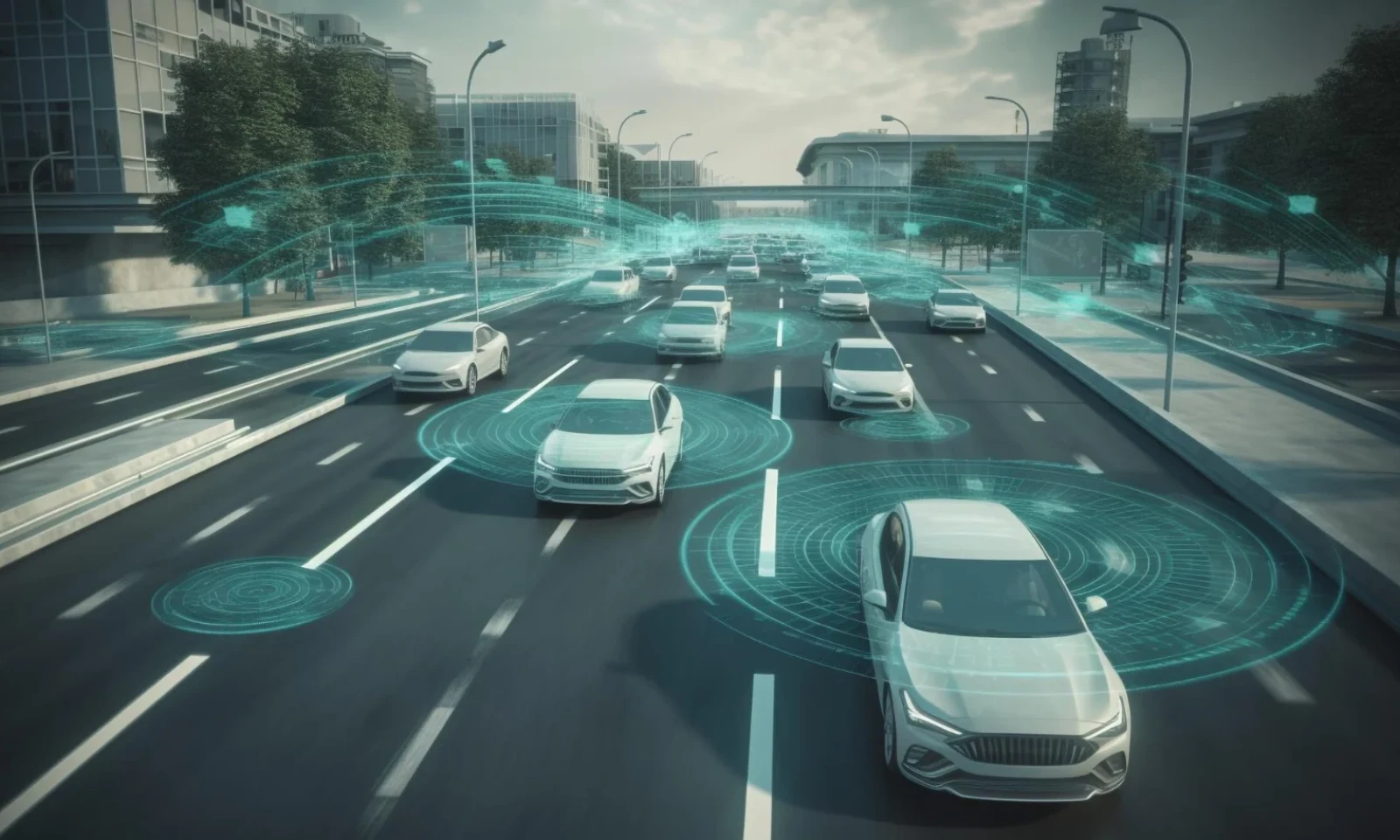



Automotive IoT refers to the integration of sensors, embedded computing, cloud services into vehicles and the infrastructure around them. Sensors capture what the vehicle is doing, a telematics unit sends that data out over a mobile network, and cloud applications turn it into diagnostics, maintenance decisions, driver-facing services, and evidence for the next vehicle program.
This guide covers how those systems get built: the architecture layer by layer, the use cases, the standards such solutions have to meet, and what breaks between a prototype and a fleet of 200,000 cars.
What is automotive IoT?
IoT in the automotive industry is the application of the internet of things to vehicles. Connected sensors collect data on how a vehicle and its parts behave, a network moves that data off the vehicle, and software acts on it. Services powered by IoT, including remote diagnostics, live navigation, usage-based insurance, are now part of the product specification rather than an option list.
The key difference is between a vehicle that only monitors its own systems and one that can exchange data with the outside world. Cars have carried sensors since the 1980s. However, the connectivity has changed: readings now leave the car while it is moving, and instructions come back immediately.
A connected car becomes a serviced asset. A fault code that used to wait for a workshop visit now arrives before the driver notices anything. A defect that meant a recall becomes an update. IoT enables a car to be diagnosed and improved long after it leaves the factory, and the impact of IoT in the automobile industry comes down mostly to that.
According to IoT Analytics, there were 21.1 billion connected IoT devices worldwide by the end of 2025, and it is growing 14% year over year. The automotive IoT market was valued at $37.20 billion for 2026 and is forecasted to reach $91.69 billion by 2034 (Fortune Business Insights, August 2026).

What hardware goes into a connected car?
IoT devices in vehicles fall into three groups:
- Factory-fitted equipment: the telematics control unit, connected ECUs, and integrated IoT sensors that ship with the vehicle.
- Aftermarket hardware: mostly OBD-II dongles and cloud-connected IoT boxes, retrofits older vehicles for fleet use.
- Infrastructure devices sitting outside the vehicle: roadside units, charge points, depot gateways.
The first group shapes engineering work, because it has to survive the life of the vehicle. The second is where most fleets start: it is the cheapest way to connect vehicles they already own.
Scoping a connected vehicle solution?
Yalantis handles everything from embedded firmware and connectivity to cloud infrastructure and compliance.
Automotive IoT architecture and how it works
An automotive IoT system has four layers. Sensors and electronic control units (ECUs) generate data inside the vehicle. A telematics control unit aggregates and sends it. A network carries it, and cloud services store and analyze what arrives. Commands travel back down the same path.

Automotive IoT systems are all some arrangement of those four layers. They differ by where the processing happens and how much of it the vehicle can do alone.
Embedded sensors and the telematics control unit

Above them sits the telematics control unit, the vehicle’s gateway. It reads the vehicle buses, buffers readings when coverage drops, holds the SIM or eSIM, and enforces the security boundary with the outside world. Everything the cloud sees passes through it.
Embedded IoT hardware in a car has constraints consumer hardware does not. It runs for fifteen years through temperature swings, vibration, and electrical noise, on a power budget that must not drain the battery while parked. Our R&D lab in Warsaw covers electronics design, PCB layout, prototyping, and firmware, because these decisions are hard to revisit once tooling is cut. Our notes on automotive PCB design go through the trade-offs.
Automotive IoT connectivity and communication protocols
Connectivity works at two levels, and they are often confused. Inside the vehicle, CAN bus carries control data between ECUs, with Automotive Ethernet handling high-bandwidth traffic from cameras and sensor fusion. Outside the vehicle, cellular carries data to the cloud.
Automotive IoT communication protocols divide by job. CAN and LIN move signals between controllers. UDS handles diagnostic sessions. MQTT publishes telemetry to the cloud efficiently over links that drop. Cellular V2X (Vehicle-to-Everything) carries the short, latency-critical messages vehicles exchange with each other and with roadside infrastructure. Our guide to connectivity protocols compares them in more depth.
For the cellular link, most programs use IoT SIM cards or eSIM profiles that can be reprovisioned remotely. A vehicle sold in one market and shipped to another cannot be recalled to swap a SIM. 5G matters less for bandwidth than for latency and device density, which is what V2X needs.
Throughput is rarely what breaks these systems. Usually, the coverage is the main issue. A system that works in a European city and fails in a tunnel or a port terminal is not complete. Poor coverage is also what turns remote network management into a discipline of its own.
Edge processing versus cloud processing
Anything safety-related runs in the vehicle, because a round trip to a data center is far too slow for a braking decision. Anything that needs history or fleet-wide comparison runs in the cloud.
Bandwidth settles most of the rest. A modern vehicle can generate terabytes a day if you let it. Nobody pays to ship raw sensor streams over cellular, so edge software reduces them first: compute the features, send the summary, keep the raw signal only around an event worth investigating. Our overview of edge computing in IoT covers where that line usually falls.
The cloud and application layer
The top layer is what people actually open: fleet dashboards, dealer diagnostic tools, driver apps, insurer portals, and partner APIs. Behind them sit ingestion, storage, device management, and the identity system that decides which vehicle a message came from.
Teams routinely underestimate device management. Provisioning, certificate rotation, configuration changes, and firmware campaigns have to work in bulk: sending a technician to touch a vehicle destroys the economics of the whole deployment.
What are the IoT use cases in automotive industry?
IoT applications in automotive industry programs cluster into a small number of patterns that recur across OEMs and fleets. The table below maps the main IoT use cases in the automotive industry, what each one needs, and who pays for it.
Connected vehicle telematics and fleet management
Fleet management is the oldest use of IoT in automotive and still the one with the clearest return. Fleet operators use IoT here to cut downtime and fuel spend. The underlying technology is well established. Location, energy use, engine hours, harsh braking and idling have all been available for years. The value comes from acting on it consistently.
The scope of data processing has been changed. Fleet management systems now schedule maintenance, verify driver hours, route around congestion, and feed cost models directly. Yalantis built an AIoT fleet management platform for a US logistics company that had been reselling tracking hardware on someone else’s SaaS. Pulling tracking, driver behavior, predictive maintenance, and billing into one platform cut cost per vehicle by 30% at 99.5% availability.

Predictive maintenance for vehicles and fleets
Predictive maintenance converts a breakdown into a planned repair. Vibration, temperature, current draw, and duty-cycle data reveal wear before failure, which matters most where downtime is expensive: trucks, buses, service fleets, and specialty vehicles.
Teams also attempt this one too early. A model needs failure history, while a fleet connected three months ago has no one. Start with condition monitoring, collect properly labeled events, then add prediction once the data supports it. Our guide to IoT predictive maintenance covers the sequence.
IoT-enabled vehicle diagnostics and remote troubleshooting
Remote diagnostics move fault detection off the workshop ramp. The vehicle reports diagnostic trouble codes and supporting sensor context as they happen, so a dealer can see the state of the car before it arrives and have the right part ready.
The engineering work is mostly filtering. Raw fault codes are noisy, and forwarding all of them trains everyone to ignore alerts. Useful diagnostics correlate codes with operating conditions and suppress the ones that clear themselves.
IoT in automotive safety systems and ADAS
Safety spans two things. Inside the vehicle, sensor fusion feeds advanced driver assistance such as lane keeping, automatic emergency braking, adaptive cruise, and blind spot monitoring. All of it runs on edge computing and never waits for a network.
Outside the vehicle, V2X lets a car detect hazards and traffic conditions beyond the driver’s line of sight. It can warn about a vehicle braking two cars ahead, a traffic light about to change, or roadworks hidden around a curve. This matters for autonomous vehicles, but the larger market is conventional cars with advanced driver assistance, since fully self-driving cars still represent a small share of vehicles sold.
All of this falls under functional safety, which constrains the architecture before feature work begins.
In-vehicle infotainment and connected services
Infotainment is what most drivers mean by a connected car: navigation with live traffic, media, voice control, and increasingly an app platform on Android Automotive OS. The driving experience improvements are visible, which is why this layer gets marketing attention out of proportion to its engineering difficulty.
The service model behind it is harder to get right. Feature subscriptions and account management across a fifteen-year vehicle life both land on the platform team.
Usage-based insurance, EV charging, and anti-theft
- Usage-based insurance. Mileage and driving behavior set the premium instead of demographics. The technical bar is low; consent and data retention design is the hard part.
- EV charging and energy management. Battery state, thermal data, and charge scheduling connect the vehicle to charge point networks and, increasingly, to the grid. See our overview of EV charging standards.
- Anti-theft and recovery. An IoT-based vehicle anti-theft system combines location reporting, geofence and tow alerts, and remote immobilizer control, so a stolen vehicle can be located and disabled. Remote immobilization means controlling a car from a distance, so it carries the strictest authentication requirements in the system.
Which use case should you build first?
Our engineers will map your vehicle data, existing hardware, and your commercial case, then tell you which one returns first and what it needs.
What is the role of IoT in automotive manufacturing?
IoT in automotive industry projects usually mean the vehicle. The plant floor runs a separate system with a separate owner. Here, IoT devices and sensors on the line feed production monitoring, quality inspection, and traceability. IoT in manufacturing has a shorter payback period than anything in the vehicle, which is why it is often funded first. Mostly, it is used for:
- Line and equipment monitoring. Condition data from presses, robots, and conveyors feeds the same predictive maintenance logic used on vehicles.
- Quality inspection. Cameras and edge AI models catch defects at the station that caused them rather than at final inspection. A secondary inspection system we built for a European automotive electronics manufacturer runs a defect classifier on an edge NPU beside its existing optical inspection line, cutting false rejects by more than 35%.
- Supply chain traceability. Component-level tracking links a part to its batch, its supplier and its VIN, which turns a blanket recall into a targeted one.
- Energy metering. Per-machine measurement finds the loads nobody budgeted for. Plants usually see their fastest measurable win here.
Most automotive plants operate with equipment installed decades apart, using different protocols and data formats. Replacing these machines simply to standardize their data is rarely practical. Instead, much of the IoT work goes into translating protocols and converting machine data into a consistent format that newer systems can use. In practice, this often takes more effort than building the dashboards themselves. This is a core part of our industrial IoT practice.
How vehicle data becomes actionable
IoT automotive data analytics starts with a decision about what to keep. A connected fleet produces continuous telemetry, and storage costs little. The real challenge is making data from a 2023 vehicle consistent with data from a 2026 model.
A consistent data model solves this problem and should be defined early. Signal names, units, and formats need to be standardized before data is analyzed across the fleet. Otherwise, even a simple change, such as renaming a signal across 400,000 deployed vehicles, can become a major project later.
Once the model holds, three kinds of work become possible. Thresholds and rules catch known conditions and remain the workhorse. Statistical analysis finds the drift that precedes a failure. Machine learning handles correlated-signal anomalies and demand forecasting. Our IoT data analytics team spends most of its time on the first two, because that is where the answers are.
Privacy belongs here rather than in a compliance appendix. Vehicle telemetry becomes personal data as soon as it can be linked to a driver, so retention limits and consent capture belong in the schema itself.
OTA updates in connected vehicles
Over-the-air updates are what make a software-defined vehicle economically viable. Without them, every defect requires a workshop visit to fix and every feature is frozen at the point of sale. With them, a fleet stays maintainable, provided the update never bricks a vehicle.
OTA programs are designed cautiously. A failed phone update is inconvenient, but a failed update to a vehicle control module can leave the car unable to unlock or operate correctly.
A safe OTA update process follows a few core rules. Every update package should be digitally signed, and the vehicle should verify that signature before installing it.
A safe OTA update process follows a few core rules:
- Sign every package, and have the vehicle verify the signature before it writes anything.
- Keep an A/B partition so a failed image falls back to the last known good one.
- Check preconditions on the vehicle: parked, sufficient battery, and outside a diagnostic session.
- Stage the rollout: internal fleet, then a small percentage, then the full population.
- Monitor for regressions between stages, and be able to stop a campaign in minutes.

UNECE R156 requires automotive companies to document their software update management system as part of vehicle type approval. This means the update process must meet technical requirements and provide evidence for audits, making engineering and compliance part of the same workflow.
Why automotive IoT security needs a different approach
Traditional IT security approaches do not fully apply to connected vehicles. A car is constantly moving, carries people, and cannot simply be taken offline for a security update. In some cases, losing access to a vehicle system can be more serious than exposing its data.
Upstream Security analyzed 494 publicly reported automotive and smart mobility incidents from 2025. Ransomware accounted for 44% of attacks, more than double the 2024 volume. 92% were carried out remotely, and 67% involved telematics and cloud systems rather than the vehicle itself.
Act on the last of those figures. The back end and its APIs are the attack surface. The CAN bus is rarely where an attacker starts. A credential that unlocks one car through an API usually unlocks the whole fleet.
The controls are well understood, and they belong in the architecture from the start:
- Hardware root of trust. Keys live in a secure element or HSM, and secure boot verifies the firmware chain.
- Mutual authentication. The vehicle proves its identity to the cloud and the cloud proves its identity to the vehicle, with per-vehicle certificates and a working rotation path.
- In-vehicle segmentation. A compromised infotainment unit must not reach the powertrain bus. The gateway enforces this, and the enforcement is tested.
- API authorization per vehicle. Every request is checked against the specific vehicle it claims to address. Large breaches start here.
- Monitoring that covers vehicles. A vehicle SOC watches fleet behavior for anomalies, because R155 requires detection and response capability alongside prevention.
Our IoT security guide covers the threat model in more depth, including the aftermarket dongles that bypass most of the above.
Automotive IoT compliance standards
Projects in this field must satisfy functional safety, cybersecurity, and data protection requirements at once. ISO 26262 covers safety-critical functions and ISO/SAE 21434 covers cybersecurity engineering. UNECE R155 and R156 make security and update management conditions of type approval, while GDPR governs vehicle data that identifies a driver.
Under the EU General Safety Regulation, these requirements have applied to every new vehicle registered in the EU since 7 July 2024, with comparable timelines in other UNECE markets. These requirements are already in force. And compliance is mostly evidence: the auditor asks what you did, when, and how you know, so the artifacts have to be produced as the work happens.
This is especially important for automotive suppliers. A Tier 1 supplier may have strong software, but without the required ISO/SAE 21434 cybersecurity documentation, it can still lose the program. The standard was developed jointly by ISO and SAE to establish a common approach to automotive cybersecurity engineering across markets.
Need to build a compliant connected vehicle?
We help engineering teams address security, documentation, testing, and regulatory requirements from architecture through release.
What are the benefits of automotive IoT?
The advantages of IoT in this sector come down to six:
- Less unplanned downtime. Condition monitoring turns a roadside failure into a scheduled repair, which is the whole commercial case for connected fleets.
- Lower warranty cost. Field data shows which components fail, under which conditions, before the claims arrive.
- Faster fault resolution. Remote diagnostics mean the right part and the right technician are ready when the vehicle arrives.
- Recalls replaced by updates. An over-the-air campaign costs a fraction of a workshop recall and reaches vehicles in days.
- New revenue after the sale. Subscriptions, connected services, and data products extend revenue across the vehicle’s life.
- Safer vehicles. Driver assistance and V2X reduce collision rates, which insurers price and regulators increasingly require.
The benefits of IoT in automotive programs arrive roughly in that order: visibility, optimization, and then new revenue. Most organizations earn back the investment before the third.
Automotive IoT challenges and how to solve them
IoT for automotive projects runs on a longer horizon than most software work, and the challenges of implementing IoT in vehicles are predictable enough to design around. These are the seven our teams meet most often, with what resolves them.
Data security and privacy
Vehicle and driver data is sensitive, and the back end is the exposed surface. Encrypt in transit and at rest, authorize every API request against the specific vehicle, rotate credentials, and penetration-test the cloud side as well as the vehicle. Handle consent and retention in the data model so privacy survives the next feature.
Interoperability across vendors
A vehicle program mixes ECUs, sensors, and platforms from suppliers who do not coordinate. Standardize on documented protocols where they exist, such as MQTT, UDS, and OPC UA on the plant side, and define one canonical signal model. Vendor-specific formats get converted at the edge before they reach the platform.
Integration with existing systems
Automotive IoT integration rarely happens in isolation. The platform has to work with dealer management systems, warranty processing, parts, and ERP. Use a stable API layer instead of point-to-point connections, and prove each integration before starting the next.
Regulatory compliance
Requirements change across markets and over time. Give each standard a named owner, generate compliance artifacts inside the development workflow, and review the regulatory position at each release rather than before an audit.
Reliability and quality assurance
Test benches do not reproduce a cold morning in a parking garage with one bar of signal. Combine hardware-in-the-loop testing with a real pilot fleet, instrumented heavily enough that a rare fault is diagnosable the first time it happens.
Scaling from pilot to fleet
A pilot on 50 vehicles can ignore bulk provisioning and staged rollouts. A fleet of 200,000 cannot. Build the pilot on the production architecture, at lower volume, so scaling is a capacity exercise rather than a rewrite.
User and operator acceptance
Drivers and fleet managers abandon systems that add work. If an alert does not tell someone what to do next, it gets ignored within a month. Design the workflow around the decision someone has to make.
How connected vehicles support sustainable urban mobility
Connected vehicles also produce data that cities can use, and this is where vehicle makers increasingly meet public-sector programs.
Traffic management systems use live flow data from vehicles and roadside sensors to retime signals, which cuts idling. Air quality monitoring links emissions to specific corridors and hours, giving low-emission zones an evidence base. Smart parking removes a good share of city-center circling.
For an OEM or a fleet operator, this matters commercially rather than reputationally. Emissions reporting is becoming a procurement requirement in public tenders, and the data that satisfies it comes from the telemetry pipeline already built for maintenance. Yalantis works with Toyota Tsusho Mobility Informatics on exactly that overlap.
Sustainability here is a byproduct of instrumentation rather than its purpose. Fleets connect vehicles to cut costs, and the emissions data arrives with the fuel data.
Trends in automotive IoT: what comes next
IoT trends in automotive industry roadmaps point in four directions worth planning around rather than waiting for. The future of automotive software is shaped more by these than by autonomy.
- The software-defined vehicle. Consolidating dozens of ECUs into a few domain controllers makes cars updatable as whole systems, and makes the update pipeline safety-critical in its own right.
- AI moving into the vehicle. Compact models now run on in-vehicle compute, so anomaly detection and perception happen where the data is produced. Edge AI capacity is becoming a purchasing criterion.
- Memory-safe embedded software. Rust adoption is growing for mission-critical firmware, because a whole class of memory bugs stops being possible. We use it deliberately as you can see in our Rust for IoT guide.
- Regulation as a design input. Security and update requirements that were contractual are now statutory, and the next wave covers data access and repair rights.
IoT technologies in the automotive sector are converging with the plant side, so the same signal models and security patterns increasingly serve both. A second program therefore costs less than the first, and IoT in the automotive sector now shares tooling with industrial programs.
IoT is becoming standard in new vehicle programs, but rolling it out across an entire model range can take years. Its biggest benefits are often practical: detecting faults early, fixing issues through OTA updates instead of recalls, and extending battery life through better monitoring. The future is less about robotaxis and more about connected vehicles that can be monitored, improved, and updated long after they leave the factory.
How to start an automotive IoT development?
Teams developing IoT solutions for vehicles get the same advice from us every time. The first decisions matter more than the platform you choose, and the potential of automotive IoT is easy to overstate at the start of a program.
Pick one use case with a number attached to it. Confirm what your existing vehicles already report before specifying new hardware. Settle the signal model and the security boundary before writing application code. Build the pilot on the production architecture, and give the compliance evidence to an owner from the first sprint.
Few programs fail on one layer alone. They fail on keeping firmware, connectivity, cloud and compliance coherent while all four move at once. IoT can enable all of this, but the underlying architecture must be designed to support a vehicle for its full lifespan. Successful IoT in automotive industry programs treat that as the starting constraint.
Yalantis provides IoT development services with one delivery team across hardware, firmware, cloud, and compliance, covering a range of IoT solutions from embedded firmware to fleet platforms. 400+ specialists, 17+ years, ISO 9001, ISO 27001, ISO 27701, and IEC 62443. If you want to pressure-test an architecture or a rollout plan, our engineers are glad to have that conversation.
Have an automotive IoT challenge to solve?
Bring us the requirements, and our engineers will help you identify the next steps and map out a practical path to implementation.
FAQ
What is automotive IoT?
Automotive IoT is the internet of things applied to vehicles: connected sensors, embedded computing, and cloud services integrated into cars and the infrastructure around them. Sensors collect data on vehicle and component behavior. A telematics control unit sends it over a cellular network, and cloud applications turn it into diagnostics, maintenance decisions and connected services.
How is IoT used in the automotive industry?
IoT in the automotive industry supports fleet telematics, predictive maintenance, remote diagnostics, driver assistance and V2X safety messaging, infotainment, usage-based insurance, EV charging, and anti-theft. On the plant side: equipment monitoring, quality inspection, and component traceability.
Which standards do automotive IoT projects need to comply with?
ISO 26262 for functional safety, ISO/SAE 21434 for cybersecurity engineering, and UNECE R155 and R156 for cybersecurity and software update management, both conditions of type approval in UNECE markets since July 2024. GDPR applies to vehicle data linked to a person, and ISO 27001 is commonly required of suppliers.
What are IoT devices for cars?
Factory-fitted devices include the telematics control unit, connected ECUs, and embedded sensors for tire pressure, battery state, and vehicle dynamics. Aftermarket devices are mainly OBD-II dongles and cloud-connected boxes used to retrofit older fleet vehicles. Infrastructure devices include roadside units and charge points.
What is an IoT-based vehicle anti-theft system?
It combines continuous location reporting, geofence and unauthorized movement alerts, and remote immobilizer control, so an owner or operator can see a vehicle being moved and disable it. Because it controls a car remotely, it needs the strongest authentication in the system.
What are the advantages of automotive IoT?
Less unplanned downtime, lower warranty costs, faster fault resolution, recalls replaced by over-the-air updates, new revenue from connected services after the sale, and measurably safer vehicles through driver assistance and V2X.
What are the key components of an automotive IoT system?
Four layers: sensors and ECUs that generate data, a telematics control unit that aggregates and transmits it, network connectivity over cellular and V2X, and cloud services for storage, analytics, device management, and applications.
About the author