



|
Key takeaways:
|
Your connected device fleet is growing. So is the attack surface you can’t see.
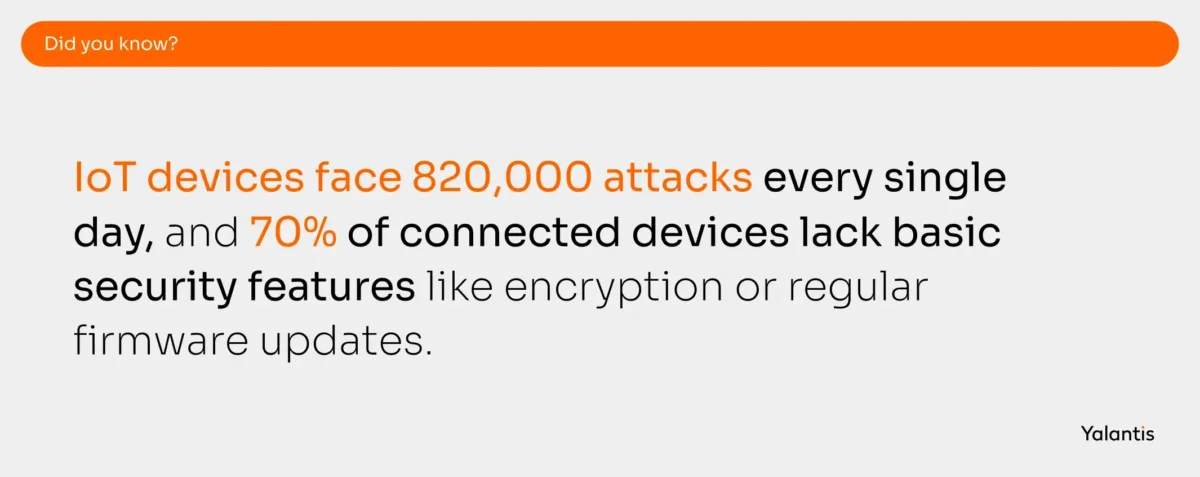
In 2025 alone, IoT devices faced roughly 820,000 attacks per day worldwide. Over 21 billion connected endpoints are now active globally, and an estimated 70% of them lack basic security features like encrypted communications or regular firmware updates. If you’re building connected products for healthcare, manufacturing, or automotive, Internet of Things security is the engineering discipline that determines whether your product ships on schedule or gets stuck in a compliance loop for months.
This guide covers securing IoT from a full-cycle engineering perspective: hardware, firmware, network, cloud, and application. We wrote it from the position of engineers who build these systems end to end, because that perspective is missing from most Internet of Things security guides on the internet today.
What is IoT security?
IoT security is the set of engineering practices that protect Internet of Things devices and the data they generate across every layer of the technology stack. It also covers the infrastructure those devices communicate with, from edge gateways to cloud platforms.
That definition matters because it separates Internet of Things security from traditional IT cybersecurity. In IT, you protect servers and workstations that run known operating systems and have the processing power to support antivirus agents, firewalls, and regular patching cycles. IoT devices rarely have that luxury.
Your typical IoT sensor runs on a microcontroller with 256 KB of RAM. It can’t run endpoint detection software. It might communicate over protocols like MQTT or CoAP that weren’t designed with encryption by default. And once deployed in the field, physically accessing the device to apply a security patch might require sending a technician to a remote location. The constraints are fundamentally different.
IoT security vs. OT security vs. IT security
These three domains overlap, and the overlap is where most security incidents happen.
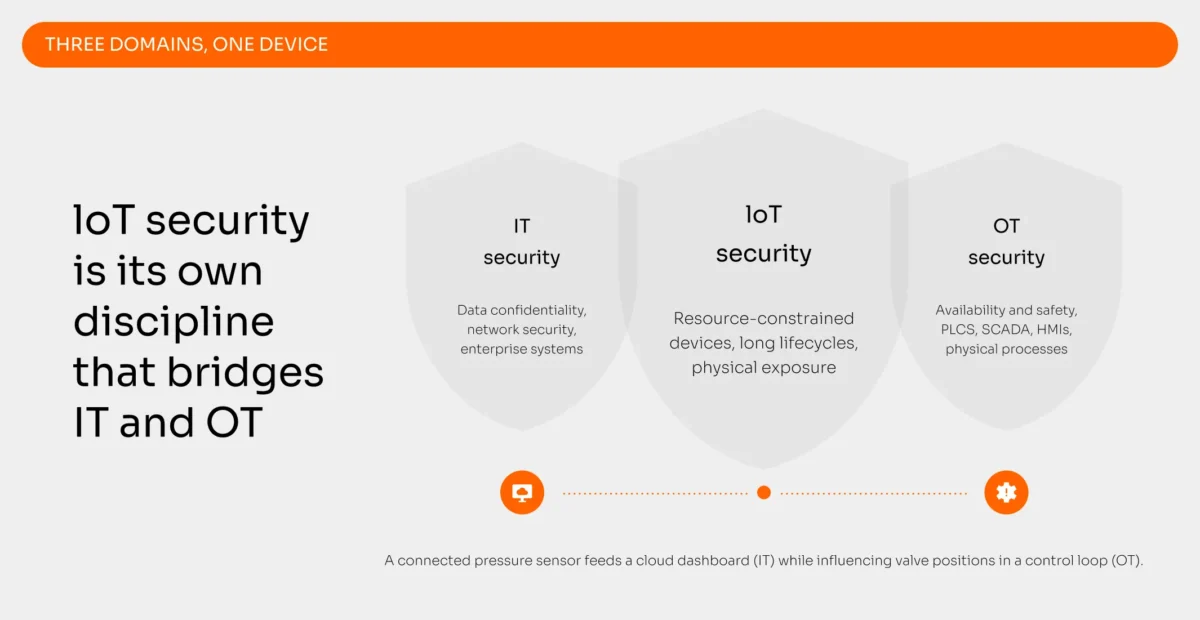
IT security focuses on data confidentiality and network security across standard enterprise systems. OT (Operational Technology) security focuses on the availability and safety of industrial control systems: PLCs, SCADA systems, and HMIs that manage physical processes. Internet of Things security sits at the intersection, because modern IoT deployments regularly bridge both worlds.
A connected pressure sensor on a factory floor is an IoT device feeding data to a cloud dashboard (IT domain), while simultaneously influencing a control loop that adjusts valve positions (OT domain). Securing that sensor requires understanding both contexts.
According to Zscaler ThreatLabz’s 2025 Mobile, IoT, and OT Threat Report, the energy sector experienced a 387% increase in IoT-based attacks year over year. That number reflects what happens when devices in an IoT environment converge with OT systems without a unified security strategy.
Why IoT security is different from traditional endpoint security
Traditional endpoint security assumes the device has resources: CPU cycles for real-time scanning, storage for signature databases, connectivity for frequent updates. IoT endpoints typically have none of that.
Three factors make security for IoT devices a distinct engineering challenge:
- Resource constraints. You’re designing security for devices with kilobytes of memory, limited processing power, and battery life measured in years. Every cryptographic operation costs energy.
- Lifecycle duration. Enterprise laptops get replaced every 3 to 5 years. Industrial IoT devices stay in the field for 10 to 15 years. Your security architecture must account for a decade of evolving cyber threats.
- Physical exposure. IoT devices are deployed in physically accessible locations: factory floors, utility poles, patient rooms. An attacker with physical access to a device can attempt side-channel attacks, JTAG probing, or firmware extraction.
The IoT attack surface: a layer-by-layer map
Protecting IoT devices requires covering five distinct layers, and a vulnerability at any single layer can compromise the entire system. Most vendor-authored security guides focus on one or two layers (usually network and cloud) and skip the rest. That creates blind spots.
Here is the full-stack view.
Hardware and device layer
The hardware layer is the foundation of IoT device security. If it’s compromised, no amount of software security will save you.
Key threats at this layer include physical tampering (removing a chip to extract firmware), side-channel attacks (measuring power consumption to derive cryptographic keys), insecure debug interfaces like JTAG and UART left enabled in production units, and supply-chain compromise where counterfeit components are substituted during manufacturing.
The engineering answer starts with the hardware root of trust. A Trusted Platform Module (TPM) or secure element stores cryptographic keys in tamper-resistant hardware, so even if an attacker gains physical access to the device, they can’t extract the keys.
Firmware layer
Firmware is where the majority of IoT vulnerabilities live. An estimated 60% of IoT devices have unpatched known vulnerabilities (CVEs) older than two years. And 90% of developers use open-source libraries in IoT firmware that may contain bugs.
The core problems start at the language level: memory-unsafe languages (C/C++) enable buffer overflows and use-after-free bugs. Absent secure boot chains allow unsigned firmware to run on devices. And many production firmware images still contain hardcoded credentials or OTA update mechanisms that don’t verify code signatures.
The engineering mitigation is multilayered. Adopt memory-safe languages like Rust for new firmware development. Implement a secure boot chain where every stage of the boot process verifies the cryptographic signature of the next stage. And design your OTA update pipeline with code signing, rollback capability, and encrypted delivery from day one.
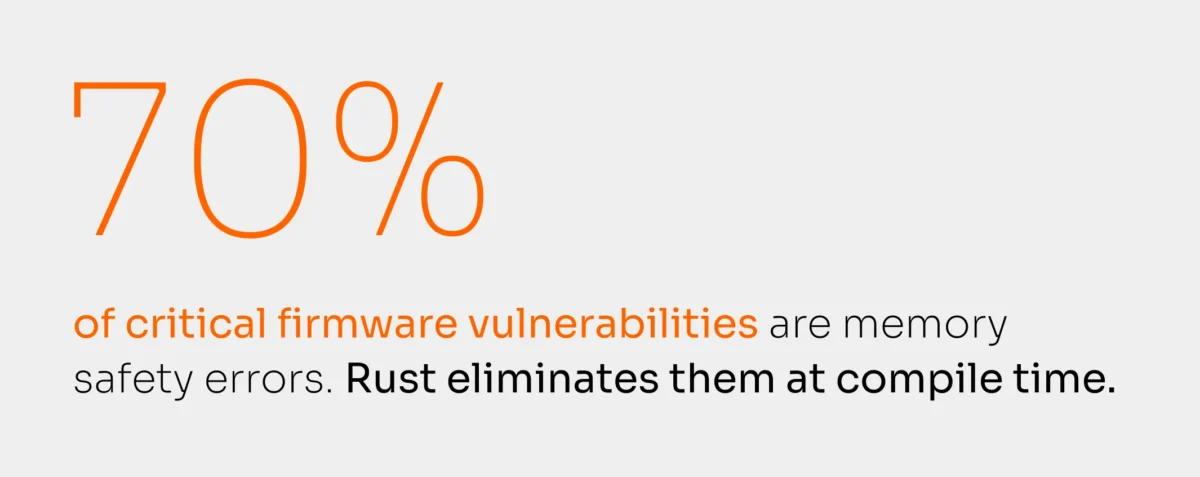
At Yalantis, we run a dedicated Rust engineering practice specifically for IoT firmware. Memory safety alone eliminates an entire class of vulnerabilities that still accounts for roughly 70% of all security bugs in systems-level code, according to Microsoft Security Response Center’s analysis of their own CVE data. The CISA/NSA joint guidance on memory safety confirmed the same figure across Google’s Chromium project and other major codebases.
Network and gateway layer
This layer covers everything between the device and the cloud: local protocols (BLE, Zigbee, LoRaWAN), gateway devices, and the transport layer.
Common vulnerabilities include MQTT brokers deployed without authentication (surprisingly common in production environments) and plaintext data transmission over protocols that support TLS but don’t enforce it. Once inside, attackers exploit lateral movement opportunities when IoT devices share a network segment with critical IT infrastructure.
A well-engineered IoT network architecture uses network segmentation (dedicated VLANs or subnets for IoT traffic) and mutual TLS for device-to-cloud communication. Edge gateways act as the security enforcement point, inspecting and encrypting traffic before it ever touches your cloud backend.
Cloud and platform layer
Your IoT cloud platform handles device provisioning, telemetry ingestion, data storage, and command dispatch. It’s the control plane for your entire fleet.
Threats here include exposed APIs without rate limiting or proper authentication, misconfigured cloud storage buckets leaking device data, broken authorization that lets one customer’s devices access another customer’s data in multi-tenant deployments, and insufficient logging that makes incident response impossible.
In early 2025, a cloud misconfiguration at Mars Hydro exposed 2.7 billion IoT device records, including Wi-Fi credentials. That’s what happens when cloud-layer security is treated as an afterthought.
Application and user layer
The mobile apps, web dashboards, and APIs that end users interact with form the final attack surface. Weak session management, API abuse, and insecure data caching on mobile devices create the biggest security and privacy risks.
This layer often gets the least security attention because it feels like a standard web/mobile development problem. It is. But the consequences are different when the API endpoint controls a medical device or an industrial actuator.
Top IoT security risks and challenges in 2026
The threat landscape is shifting fast. Understanding which risks matter most helps you allocate your security engineering budget where it counts.
The most common IoT vulnerabilities
Here are the vulnerabilities that appear most frequently across IoT penetration testing engagements and real-world breaches:
- Default and weak credentials. Many IoT devices still ship with weak security: factory-default usernames and passwords. The UK’s PSTI Act now explicitly bans universal default passwords.
- Unencrypted data transmission. Devices sending telemetry in plaintext over MQTT or HTTP.
- Missing or broken OTA updates. Most IoT devices lack an automated update mechanism, meaning discovered vulnerabilities remain exploitable indefinitely.
- Insecure APIs. Cloud-side APIs that accept unauthenticated requests or fail to validate input.
- Hardcoded credentials in firmware. API keys, cloud tokens, or Wi-Fi passwords embedded in the firmware binary.
- Insufficient physical security. Debug interfaces left active, no tamper detection, extractable flash storage.
- Outdated open-source libraries. The vast majority of IoT firmware relies on open-source components, many with known vulnerabilities that never get patched.
Real-world IoT attacks and breaches
These security breaches all happened. Every one was preventable with known engineering practices.
Mirai Botnet (2016, still active as variants). The original Mirai malware scanned the internet for IoT devices using factory-default credentials. It infected over 300,000 devices and launched a 1.2 Tbps DDoS attack against DNS provider Dyn, knocking Twitter, Netflix, and Reddit offline. Modern Mirai variants like Aisuru/TurboMirai now achieve over 20 Tbps DDoS capability. The fix: change default credentials and implement device identity certificates. Disable Telnet entirely.
Verkada (2021). Hackers gained access to a privileged admin account and viewed live feeds from over 150,000 security cameras in hospitals, prisons, schools, and Tesla factories. The root cause: overprivileged access controls and a single compromised credential with no multi-factor authentication.
BadBox 2.0 (2025). Pre-installed malware compromised more than 10 million smart TVs, projectors, and infotainment systems, creating the largest known TV botnet. The lesson: supply chain security starts with firmware integrity verification.
Why legacy IoT devices are a growing liability
Devices deployed five or ten years ago were built with the security assumptions of that era, which often means minimal encryption and no OTA update capability. Many of them lack basic security measures and simply can’t be patched remotely.
These devices are still running. They’re still connected to your network. And they represent the softest target in your infrastructure.
The practical solution is network segmentation and monitoring. Isolate legacy devices on dedicated network segments and monitor their traffic for anomalies. Then plan a phased replacement cycle. If a device can’t receive firmware updates, it should be treated as permanently vulnerable and contained accordingly.
IoT security by vertical: industry-specific requirements
Different industries face different regulatory requirements and threat profiles. The engineering approach must match.
Healthcare IoT security (IoMT)
Healthcare IoT (Internet of Medical Things) operates under the strictest regulatory burden. A vulnerability in a connected insulin pump or patient monitor risks lives. Full stop.
Key regulations include HIPAA (US, see our guide on equivalent healthcare data laws in other countries), FDA premarket cybersecurity guidance, the EU Medical Device Regulation (MDR), and IEC 62304 for medical device software lifecycle.
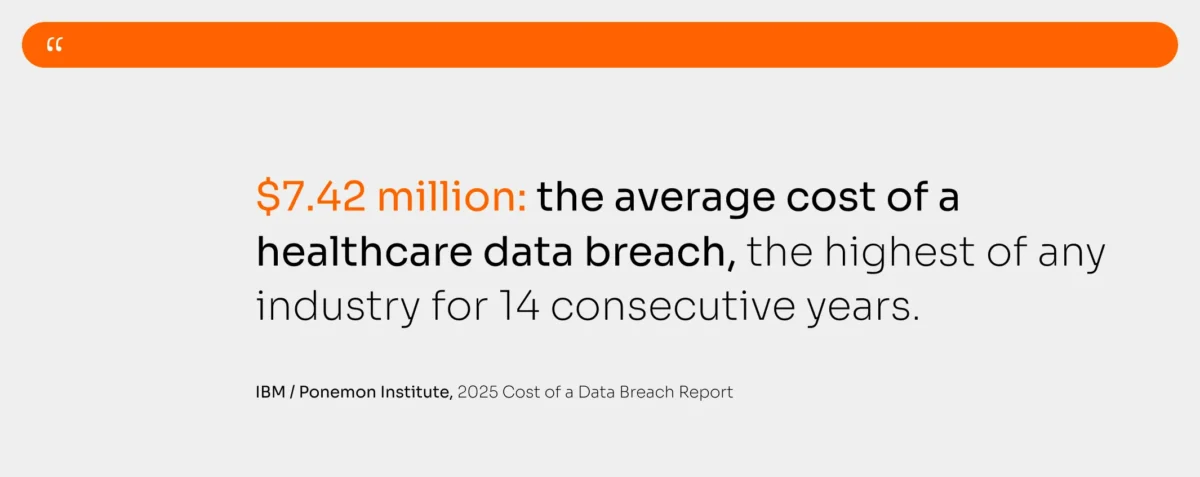
Healthcare data breaches remain the costliest across any industry for the 14th consecutive year, at $7.42 million per incident according to the IBM/Ponemon 2025 Cost of a Data Breach Report. Over 1 million IoT medical devices were found exposed online in 2025, leaking patient data because of missing encryption.
The engineering requirements are specific: patient safety risk classification from the design phase, encrypted data at rest and in transit, audit trails for every data access, and a post-market surveillance plan that covers the entire device lifecycle.
Yalantis holds ISO 13485 certification, which means our development processes are audited specifically for medical device quality management. When you’re working with an FDA or MDR submission timeline, that certification can save you months of re-qualification work.
Building a connected medical device?
Our ISO 13485-certified team handles the full stack from firmware to FDA submission, so you can focus on patient outcomes.
Industrial IoT and OT security
Industrial IoT sits at the convergence of IT and OT networks. The Purdue model (a reference architecture for industrial network segmentation) defines the zones and conduits that separate enterprise IT from the process control layer. IEC 62443 is the standard that maps security requirements to those zones.
Manufacturing and transportation sectors combined account for 40% of all IoT malware incidents, according to the ThreatLabz 2025 IoT threat report. Attackers target these industries because operational disruption creates immediate financial pressure. The industrial sector ranks third in average breach cost at $5.00 million per incident, according to the IBM/Ponemon 2025 report.
The engineering challenge in industrial IoT is retrofitting security onto legacy infrastructure. Many factories run PLCs and SCADA systems that are 15 to 20 years old, with protocols like Modbus that have zero built-in security. Edge gateways become the enforcement point: they sit between legacy OT equipment and modern IP networks, providing protocol translation, encryption, and access control without modifying the legacy systems.
Yalantis engineers hold IEC 62443 expertise and design industrial IoT architectures with zone-based segmentation from the first architecture review.
Automotive IoT and connected vehicle security
Connected vehicles generate terabytes of data per day and run dozens of ECUs (Electronic Control Units) that communicate over CAN bus, a protocol designed in the 1980s with no authentication mechanism.
ISO/SAE 21434 defines cybersecurity engineering requirements for road vehicles. UN Regulation R155 mandates a Cybersecurity Management System (CSMS) for vehicle type approval in the EU and many other markets. These aren’t optional. Without R155 compliance, your vehicle doesn’t get approved for sale.
Secure OTA updates for ECU firmware are critical in automotive. A recall to physically update vehicle software can cost hundreds of millions of dollars. A well-designed OTA pipeline with code signing, staged rollouts, and automatic rollback saves that cost entirely.
Rust is gaining traction in automotive for safety-critical software-defined vehicle (SDV) code. Its memory safety guarantees align with the reliability requirements of ISO 26262 (functional safety).
Logistics and supply-chain IoT security
Asset tracking, cold-chain monitoring, and fleet telematics create a distributed attack surface across hundreds or thousands of locations. A compromised GPS tracker can feed false location data. A tampered temperature sensor can invalidate an entire pharmaceutical shipment.
The security priorities here are device identity (certificate-based authentication for every tracker and sensor), data integrity (tamper-evident logging so you can prove the cold chain was maintained), and fleet-wide visibility (monitoring for anomalies across the entire device population).
Smart home and consumer IoT security
Smart home devices face the highest attack volume per device. According to the 2025 IoT Security Landscape Report, connected homes experienced an average of 29 daily attack attempts in 2025, a threefold increase from 2024. But consumer IoT operates under different economics: lower margins, price-sensitive buyers, and shorter product lifecycles.
The EU Cyber Resilience Act and the UK PSTI Act are changing this by mandating minimum security baselines for consumer devices. These regulations require IoT manufacturers to implement unique device credentials, a vulnerability disclosure policy, and a defined support period for security updates.
Internet of Things security standards and compliance
Compliance is where many IoT projects stall. The number of applicable standards is growing, and the penalty for getting it wrong is product delays, market access denial, or post-market recalls.
The standards that matter
Here’s a focused overview of the standards you’re most likely to encounter:
- IEC 62443: The primary standard for industrial automation and control systems security. Defines security levels, zones, and conduits. Required for industrial IoT deployments.
- ISO/IEC 27001: Information security management systems. A general-purpose standard that applies to any organization handling sensitive data.
- ISO 27701: Extension of ISO 27001 for privacy information management. Important when your IoT devices process personal data under GDPR.
- ISO 13485: Quality management for medical devices. Required for SaMD development and FDA/MDR submissions.
- NIST IR 8259 / SP 800-213: US federal Internet of Things security guidelines. Defines core device security capabilities.
- ETSI EN 303 645: European standard for consumer IoT security. Baseline requirements for residential IoT devices.
- EU Cyber Resilience Act (CRA): Vulnerability reporting obligations begin September 11, 2026. Full compliance required by December 11, 2027. Covers all products with digital elements sold in the EU.
- UK PSTI Act: Bans universal default passwords, requires vulnerability disclosure policies, mandates transparency on update support periods. Already in force.
- FDA premarket cybersecurity guidance: Required for connected medical devices seeking US market approval.
How to build a certification-ready IoT security architecture
The most expensive mistake in Internet of Things security is designing first and thinking about compliance later. Retrofitting security and compliance controls into an existing architecture typically costs 3x to 5x more than building them in from the start.
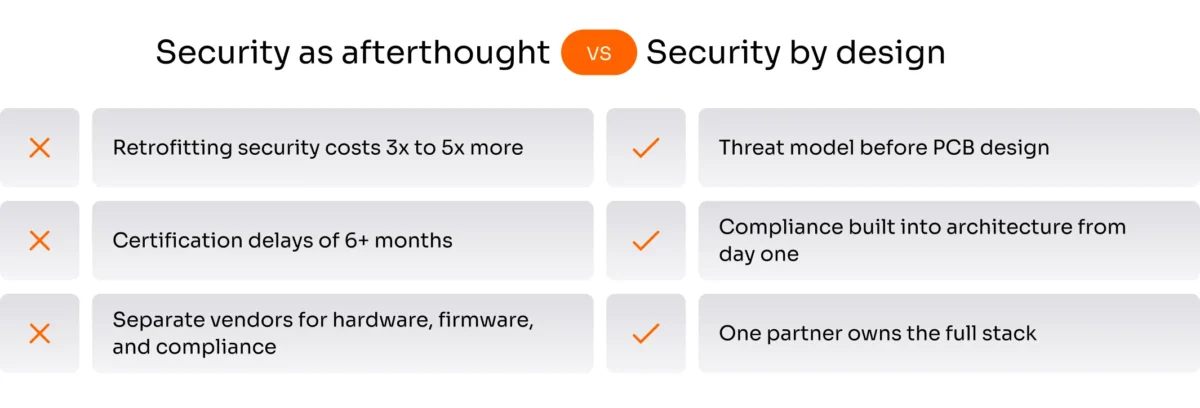
A certification-ready architecture starts with a threat model before the PCB design is finalized. It includes hardware root of trust, secure boot, encrypted communications, and audit logging as foundational architectural requirements from day one.
Yalantis operates an in-house R&D lab in Warsaw where we prototype and test IoT hardware security configurations before committing to production designs. This means we catch certification blockers at the prototype stage, when fixing them costs hours instead of months.
Concerned about IoT compliance timelines?
We catch certification blockers at the prototype stage, when fixing them costs hours instead of months.
Internet of Things security assessment and testing
Security testing for IoT requires a broader scope than traditional application testing.
A comprehensive IoT security assessment includes threat modeling (using frameworks like STRIDE and PASTA), firmware analysis (static analysis for hardcoded credentials and vulnerable libraries), penetration testing across all five layers (hardware through application), fuzz testing of device interfaces and communication protocols, and SBOM (Software Bill of Materials) generation for tracking every open-source component in your firmware.
The SBOM requirement deserves special attention. Under the EU Cyber Resilience Act, you’ll need to know exactly which components exist in your products to comply with vulnerability reporting obligations starting September 2026. If you don’t have automated SBOM generation and vulnerability tracking in your build pipeline today, you’re already behind.
IoT security best practices: a 10-step framework
Here are the ten practices that separate production-ready IoT device security from checkbox compliance. Each one addresses a specific failure mode we’ve seen in real deployments.
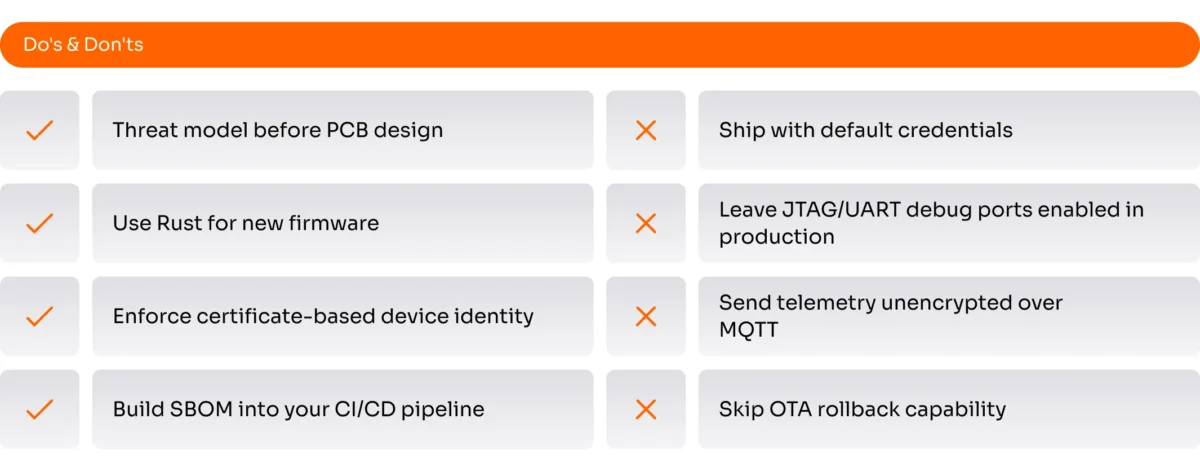
- Threat model before you design the PCB. Security decisions made at the hardware stage are nearly impossible to change later. Model your threats first.
- Implement hardware root of trust. Use a TPM or secure element to store cryptographic keys in tamper-resistant hardware.
- Adopt memory-safe languages for new firmware. Rust eliminates buffer overflows, use-after-free, and other memory safety vulnerabilities at compile time.
- Enforce secure boot and signed firmware. Every stage of the boot process should verify the cryptographic signature of the next stage.
- Encrypt data in transit and at rest. TLS 1.3 for transport, AES-256 for storage. No exceptions.
- Design a secure OTA update pipeline with rollback. Code signing, staged rollouts, automatic rollback on failure. Your devices will need patches for the next decade.
- Enforce zero-trust device identity. Certificate-based authentication for every device. No shared secrets, no default credentials.
- Segment networks and monitor the device fleet continuously. Dedicated network segments to strengthen f. Behavioral anomaly detection across your entire fleet.
- Build SBOM and patch-management workflows from day one. Track every dependency. Automate vulnerability scanning against CVE databases.
- Design for the compliance regime you will eventually need. If you’re building medical devices, design for FDA and MDR from the start. If you’re selling in the EU, start designing for CRA compliance today. December 2027 is closer than you think.
IoT security in the AI era: what’s changing
AI is changing Internet of Things security on both sides of the equation.
On the defense side, AI-powered anomaly detection can identify compromised devices in fleets of thousands by spotting behavioral patterns that rule-based systems miss. TinyML (machine learning inference running directly on microcontrollers) enables on-device threat detection without sending data to the cloud, which reduces latency and preserves bandwidth.
On the attack side, adversarial machine learning can manipulate IoT sensor data to feed false readings to AI models. And as LLMs get embedded in IoT edge devices, prompt injection at the edge becomes a new attack vector that didn’t exist two years ago.
The practical takeaway: if you’re integrating AI into your IoT product, your threat model needs to include AI-specific Internet of Things security threats. Adversarial input testing for sensor data and model integrity verification are becoming standard requirements. So is isolation of the ML inference pipeline from safety-critical device functions.
How Yalantis builds security into every IoT project
Yalantis is a full-cycle IoT development partner, delivering end-to-end security solutions across the entire stack from PCB design and firmware to cloud infrastructure and compliance.
Our approach to Internet of Things security is built on four pillars:
- Compliance-first architecture. We hold ISO 13485, IEC 62443, ISO 27001, and ISO 9001 certifications. We design for the compliance requirements your product will face, before writing the first line of code.
- Full-stack ownership. When one team owns hardware, firmware, cloud, and application security, nothing falls through the gaps between vendors. That’s where most vulnerabilities hide.
- Rust engineering practice. We use Rust for new IoT firmware development because memory safety eliminates an entire category of security bugs at the language level.
- Warsaw R&D lab. Our hardware prototyping lab lets us test security configurations on physical devices before production, catching issues when they’re cheap to fix.
We’ve worked with enterprise clients across healthcare, automotive (including Toyota Tsusho), industrial manufacturing (Bosch), and IoT hardware (RAKwireless). If you’re building a connected product and need a partner who treats security as an engineering discipline from day one, let’s talk.
Ready to build IoT security into your product from day one?
We cover the full stack from hardware root of trust to cloud compliance, so nothing falls through the gaps.
FAQ
What are the main IoT security challenges?
The biggest challenge is the combination of resource constraints and long device lifecycles. IoT devices lack the processing power to run traditional security software, yet they stay deployed for 10 to 15 years. This means your security architecture must account for threats that don’t exist yet at the time of deployment.
What are the most common IoT security risks and vulnerabilities?
The most common IoT security issues are default credentials, unencrypted data transmission, missing firmware update mechanisms, and insecure APIs. An estimated 60% of IoT devices carry unpatched CVEs older than two years.
What is the difference between IoT security and OT security?
OT security focuses on the availability and safety of industrial control systems (PLCs, SCADA, HMIs). IoT security covers the connected devices and cloud platforms that increasingly interface with OT systems. In practice, modern deployments require both, because IoT devices often bridge IT and OT networks.
How do I secure firmware and OTA updates on deployed IoT devices?
Implement a secure boot chain with cryptographic signature verification at every stage. For OTA updates, use code signing (so devices reject unsigned firmware), encrypted delivery channels, staged rollouts (update a small percentage of devices first), and automatic rollback on failure.
What is security by design for IoT, and when should it start?
Security by design means incorporating security requirements into the earliest stages of product development, starting with threat modeling before the PCB design is finalized. Adding security after the architecture is set typically costs 3x to 5x more and delays certification by months.
How is IoT security different in healthcare versus industrial environments?
Healthcare IoT prioritizes patient safety and data privacy (HIPAA, FDA, MDR). Industrial IoT prioritizes operational availability and physical safety (IEC 62443, Purdue model). The technical controls overlap significantly, but the regulatory frameworks and risk profiles are different.
Can AI improve IoT security?
Yes. AI-powered behavioral analysis can detect compromised devices across large fleets by identifying anomalous patterns. TinyML enables on-device threat detection without cloud connectivity. However, AI also introduces new security threats (adversarial inputs, prompt injection) that your threat model must address.
What is an IoT security framework, and how do I choose one?
An IoT security framework is a structured set of controls mapped to specific risk categories. IEC 62443 is the standard for industrial environments. NIST SP 800-213 applies to US federal IoT deployments. ETSI EN 303 645 covers consumer devices. The right framework depends on your industry, geographic market, and regulatory requirements.
About the author