


|
Key takeaways: • IoT device development is one hardware-to-cloud lifecycle, from industrial design through firmware, connectivity, cloud, and compliance. |
IoT (Internet of Things) device development is the end-to-end process of designing and building a connected product, from industrial design and PCB layout through firmware, embedded software, connectivity, and the cloud and application layers that turn sensor data into something useful.
This guide to IoT development follows that full hardware-to-cloud lifecycle in the order an engineering team actually works through it. You will get the eight build stages, the four architecture layers, the firmware and protocol decisions that make or break a device in the field, and the compliance work that regulated industries cannot skip. We have run this lifecycle across 40+ end-to-end IoT deployments out of our in-house R&D lab, so the trade-offs here come from shipping real devices, and from the mistakes we made along the way.
What is IoT device development (and how it differs from IoT software development)?
IoT device development is the engineering of a physical product that collects data and transmits it over a network. It spans hardware, firmware, connectivity, and the cloud and application software that make the device useful to an operator or an end user.
Three terms get used interchangeably, and they shouldn’t be. IoT device development centers on the physical product and its embedded software. IoT product development is the broader commercial effort around that device, including user experience and go-to-market. IoT software development refers specifically to the cloud backend and application layers that ingest and act on IoT data. A single IoT solution usually needs all three, which is why integration is where most projects struggle.
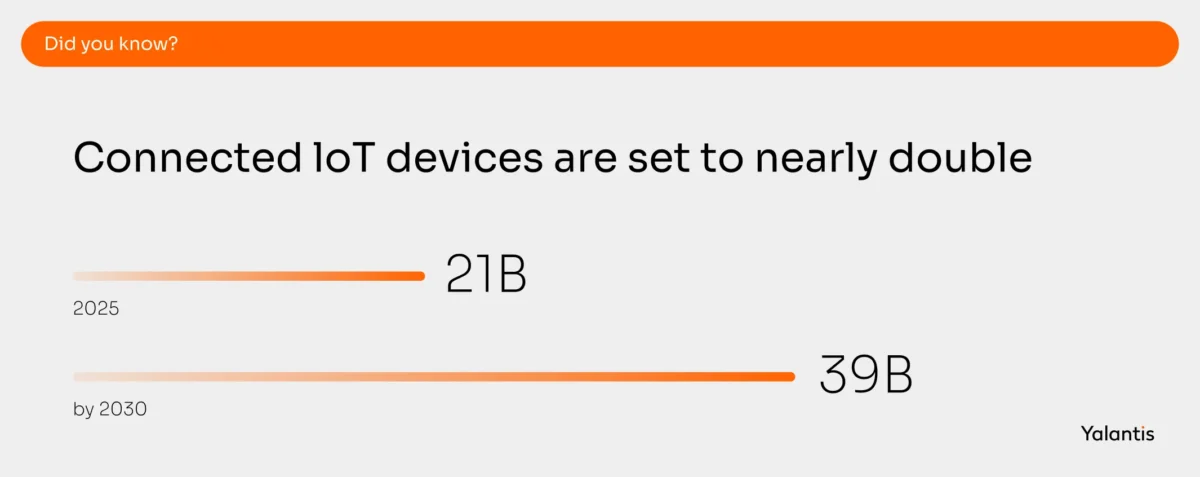
The reason this matters in 2026 is scale. The IoT market keeps expanding: IoT Analytics counted 18.5 billion connected IoT devices at the end of 2024 and put the figure past 21 billion in 2025, growing about 14% a year toward 39 billion by 2030. Behind every one of those numbers sits a chain of engineering decisions that has to survive years in the field.
The four layers of an IoT system, and why owning all of them matters
Every IoT system is built on four layers: the device layer, the connectivity layer, the edge and cloud layer, and the application layer. Your device fails in production when any one of these is treated as an afterthought.
The four layers work in sequence:
- Device layer. The physical IoT hardware: sensors, actuators, the microcontroller or microprocessor, power management, and the enclosure. This is where the firmware lives.
- Connectivity layer. The radio and network that move data off the device: BLE, Wi-Fi, LoRaWAN, or cellular, plus the messaging protocol on top, usually MQTT.
- Edge and cloud layer. Where data is processed. Edge computing handles latency-sensitive logic on or near the device; the cloud handles long-term storage and the fleet-wide analytics a device cannot run on its own.
- Application layer. What the human interacts with: dashboards, mobile companion apps, APIs, and alerts.
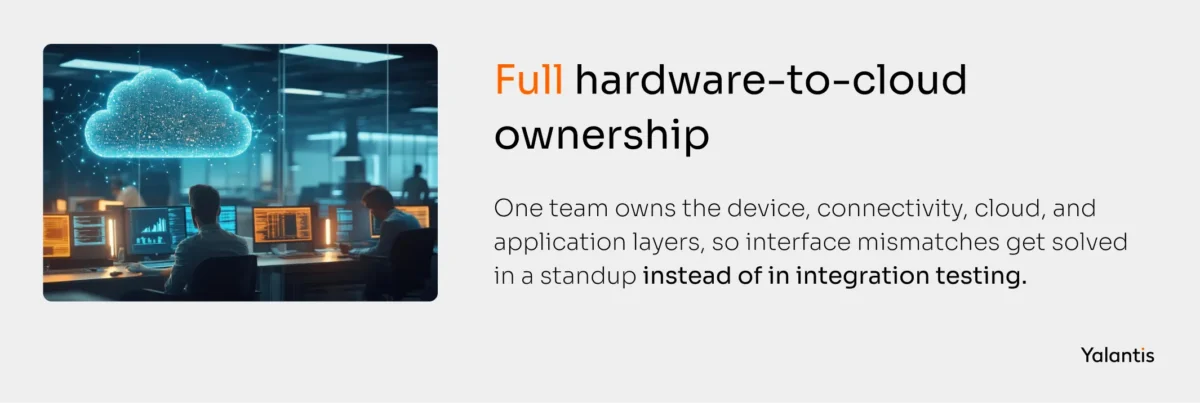
The real point here is ownership. When one team owns all four layers, the firmware engineer and the cloud architect resolve interface mismatches in a standup. When the layers are split across vendors, those same mismatches surface during integration testing, when they are most expensive to fix. We have watched that gap swallow entire schedules.
8 stages of the IoT device development process
The IoT device development process runs through eight stages: discovery and feasibility, industrial design, electronics and PCB design, prototyping and validation, firmware and embedded software, connectivity and cloud integration, testing and production handoff, and certification.
Each stage produces an artifact the next one depends on. Skipping or compressing a stage rarely saves development time; it just moves the delay to a later, costlier point in the project. Compliance work starts here too, at the beginning, because certification requirements shape design decisions from day one.
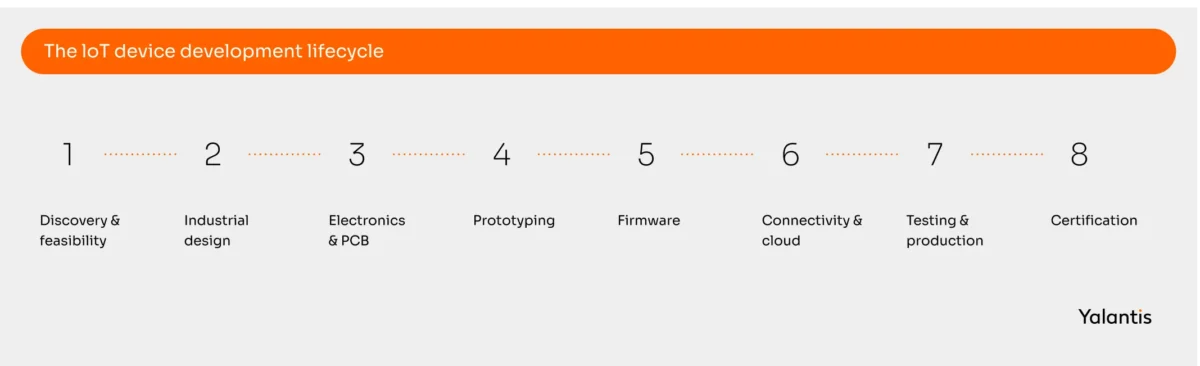
Stage 1. Discovery, requirements, and feasibility
This stage answers one question: can the device do what the business needs within its power, cost, size, and regulatory constraints? The output is a requirements specification and a feasibility assessment that surfaces the hard constraints before you spend a dollar on hardware.
For regulated devices, this is where the compliance path is chosen. A medical device commits to an ISO 13485 quality management system and an IEC 62304 software lifecycle now, because both shape the documentation trail for every later stage. Get this wrong and you are reconstructing records under deadline pressure, which is the single most common cause of certification delays we see.
Stage 2. Industrial design and enclosure
Industrial design defines how the device looks and how it survives its environment. The enclosure has to fit the electronics, dissipate heat, meet ingress protection ratings for dust and water, and pass the drop and vibration profile of its real-world use.
A cold-chain logistics sensor and a bedside patient monitor have opposite enclosure priorities, and the design has to reflect that from the start. We run mechanical and electronic design together rather than handing the work between teams.
Stage 3. Electronics and PCB design
PCB design turns the requirements into a working circuit: component selection, schematic capture, layout, and signal integrity work. Component choice here drives unit cost and power draw, and it locks in supply-chain risk for the life of the product.
Two decisions dominate. The first is the microcontroller or system-on-chip, which fixes your compute and memory headroom along with your radio options. The second is component sourcing, because a part with a long lead time or a single supplier can stall production months after the design is frozen.
|
Pro tip Lock in a second source for every critical component before you freeze the design. A single-supplier part with a 40-week lead time can halt a production run long after the engineering is finished, and we have watched it happen more than once. |
Stage 4. Prototyping and hardware validation
Prototyping produces functional hardware you can test against the real environment, on real silicon rather than in simulation. The goal is to validate your riskiest assumptions early, while changes are still cheap.
Validation usually moves through a few prototype generations:
- Proof of concept, which proves the core function works at all.
- Engineering validation test (EVT), which checks each subsystem against spec.
- Design validation test (DVT), which confirms the device meets requirements as an integrated whole and is close to production form.
Each generation narrows uncertainty. By DVT, the hardware should be stable enough that firmware and certification work can proceed without the ground shifting underneath them.
Stage 5. Firmware and embedded software development
Firmware is the embedded code that runs on the device and controls the hardware directly: sensor drivers, power management, the communication stack, and the over-the-air update mechanism. It is the layer that decides whether a device is reliable and secure in the field.
Getting that right comes down to two architectural choices. A real-time operating system such as Zephyr or FreeRTOS suits constrained, deterministic devices, while embedded Linux suits gateways and devices that need rich connectivity or a filesystem. The second choice, the language, gets its own section below, because it has quietly become a security decision.
Stage 6. Connectivity and cloud integration
This stage connects the device to its network and its backend. It covers the radio link, the messaging protocol, secure provisioning of device identity, and the cloud services that receive and route the data.
The part teams underestimate here is device identity and provisioning. Every device needs a unique, attestable identity from the moment it leaves the factory, because that identity is what lets the cloud trust its data and authorize its updates. Bolt this on later and you have created one of the most common security gaps in shipped products.
Stage 7. Testing and production handoff
This stage proves the device works, then hands a stable design to manufacturing. A thorough IoT testing process spans functional, environmental, radio, electromagnetic compatibility, and security checks, ideally automated against real hardware in a test rig.
Production handoff then transfers the validated design and its production documentation, including the bill of materials and test procedures, to the contract manufacturer.
Stage 8. Certification
Certification is what makes the device legal to sell, and it gates the launch. A radio device needs regional approvals such as FCC in the United States and CE under the Radio Equipment Directive in the EU. The work runs in parallel with the late build stages, so the teams that open it early avoid a last-minute scramble.
Want one team to run this entire build for you, hardware to cloud?
We take connected products from first sketch to production handoff.
IoT software and application development: turning device data into a product
IoT software development is the cloud backend and application work that turns raw device data into a usable product. It is a distinct discipline from firmware, with its own architecture and talent pool.
At scale, the backend has to ingest high-volume telemetry and store it efficiently as time-series data, then route events to the consumers that need them. As the installed base climbs past 21 billion devices, a scalable IoT ingestion architecture becomes a first-class design problem that you cannot defer.
On top of the backend sit the IoT applications people actually use. A fleet operator needs a web dashboard with maps and alerts; a maintenance engineer needs an API into the existing CMMS. The platform decision underneath all of this, whether you build on a hyperscaler IoT platform or stay cloud-agnostic, should be driven by where the data needs to live and which regulations apply.
Need the backend and apps built to handle device data at scale?
We build the backend and dashboards your device data flows into.
Firmware and embedded development: why Rust vs. C++ is now a security decision
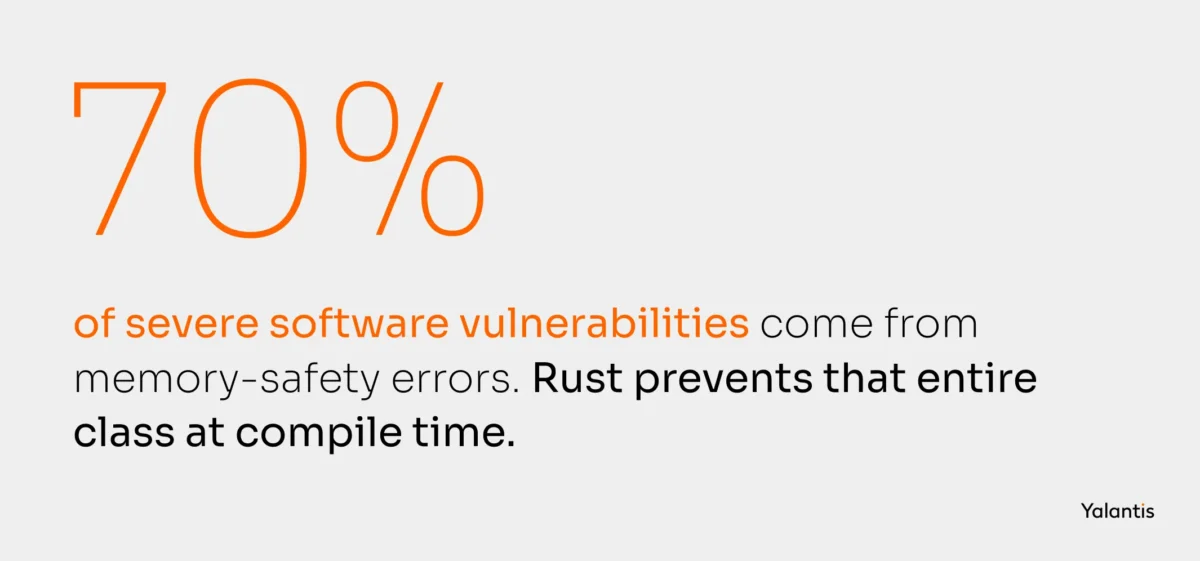
For new IoT firmware in 2026, the language choice is increasingly a security choice. C++ remains the incumbent with the deepest tooling and the largest talent pool, while Rust eliminates entire classes of memory-safety bugs at compile time, which is why regulated-device teams are adopting it.
The evidence behind the shift is hard to ignore. Independent analysis published in ACM Queue finds that roughly 70% of severe software vulnerabilities stem from memory-safety errors, the exact class Rust’s ownership model prevents before the code ever runs. Adoption is following the data: the 2024 State of Rust survey reports that about 45% of organizations now make non-trivial use of Rust in production, up roughly seven points in a single year.
Rust is not a free upgrade, and we will be honest about that. The learning curve is real, and the embedded ecosystem is younger than C’s. Most production systems run mixed Rust and C codebases rather than full rewrites, and the pragmatic pattern we use is to write new memory-critical components in Rust while keeping proven C drivers in place.
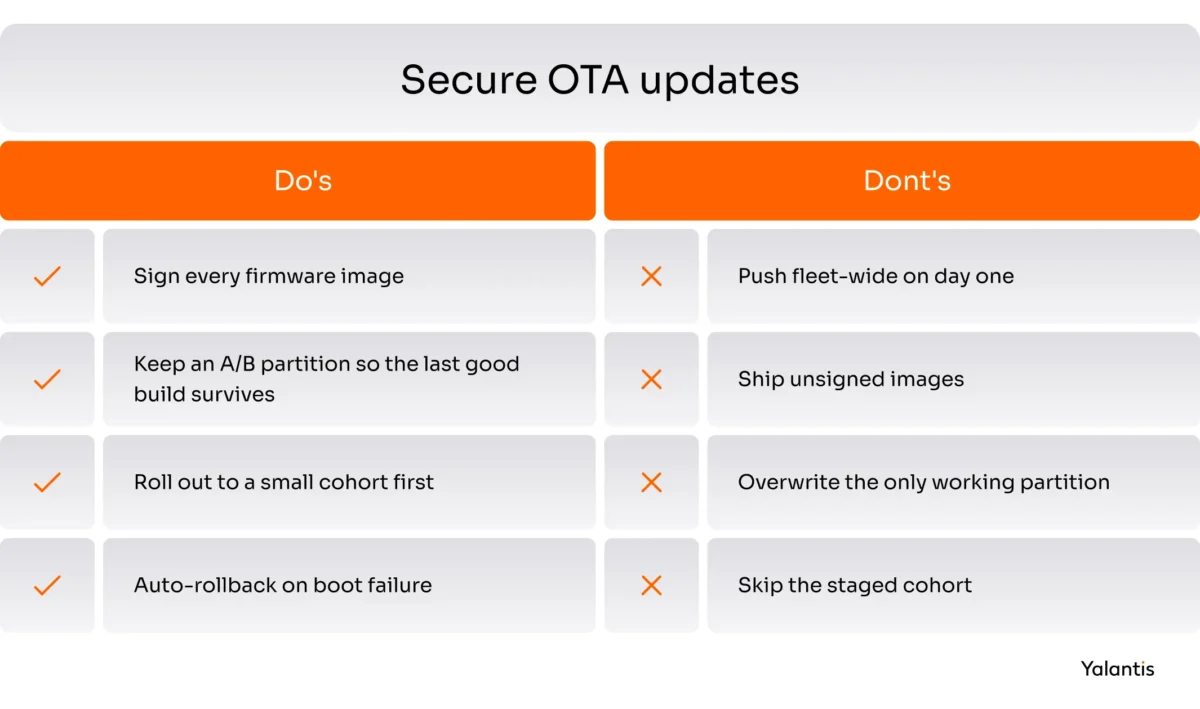
Whatever the language, the pipeline for secure over-the-air (OTA) firmware updates is the part teams fear most, because a bad update can brick a remote device. A safe pipeline uses cryptographically signed images, an A/B partition scheme so the old firmware stays intact, automatic rollback on boot failure, and staged rollouts to a small device cohort before fleet-wide release.
|
Pro tip Before your first OTA to real users, push the update to a cohort of 50 to 100 devices and watch them for a full day. Staged rollout plus automatic rollback is the difference between a bad update and a field recall. |
Building firmware that has to stay secure and updatable in the field?
Our IoT firmware development team writes embedded code in Rust and C, with safe OTA built in.
Connectivity protocols for IoT devices: why no single option fits
There is no single best IoT connectivity protocol; the right choice depends on range, power budget, data rate, and whether the device moves. Keep two decisions separate: the radio or network technology that carries the bits, and the messaging protocol that structures the data on top of it.
For the messaging layer, MQTT is the default for IoT telemetry because it is a lightweight publish-subscribe protocol built for unreliable, low-bandwidth links. CoAP is the common alternative for very constrained devices. The wireless IoT radio layer is where the real trade-offs live:
| Technology |
Range |
Power |
Data Rate |
Best Fit |
|
BLE |
Short (10 to 100 m) |
Very low |
Low to moderate |
Wearables, proximity, phone-tethered devices |
|
Wi-Fi |
Indoor / local |
High |
High |
Smart home and building, mains-powered devices |
|
LoRaWAN |
Long (kilometers) |
Very low |
Very low |
Sparse sensors over wide areas, agriculture, utilities |
|
NB-IoT / LTE-M |
Wide area (cellular) |
Low |
Low to moderate |
Remote and mobile assets, metering, logistics |
|
Cellular 4G / 5G |
Wide area |
High |
High |
Gateways, vehicles, video, high-throughput devices |
Different IoT use cases point to different radios. For a battery-powered field sensor that sends small packets infrequently, LoRaWAN or NB-IoT will almost always beat Wi-Fi on battery life by years.
|
Pro tip Prototype your connectivity with real hardware in the real environment before you commit. A protocol that tests perfectly on the bench can fall apart behind a metal door or three floors underground, and the recurring cellular data cost over a device’s life often outweighs the upfront module price. |
Security and compliance by design: what the EU Cyber Resilience Act now demands
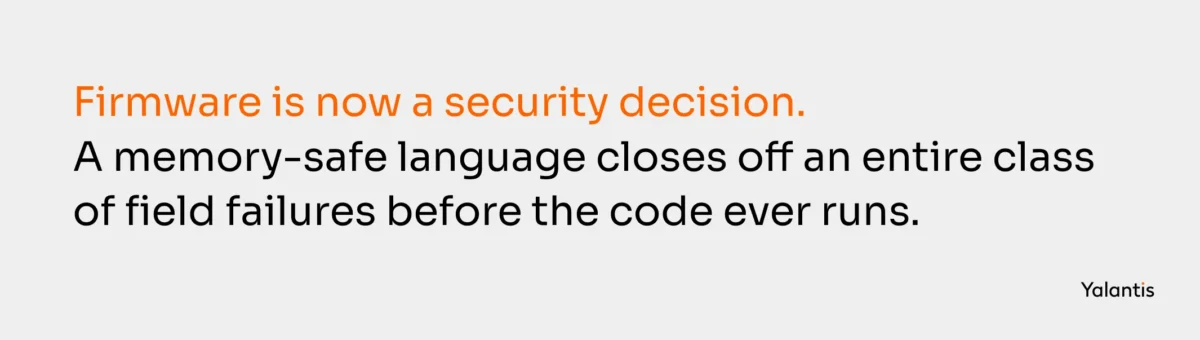
Security and compliance have to be engineered into every lifecycle stage. In 2026 this is a legal requirement, and it is the single biggest differentiator between a device that ships and one that stalls in review.
That regulatory pressure is concrete, and it comes with hard dates. According to the European Commission, the EU Cyber Resilience Act entered into force in December 2024 and applies to nearly every product with digital elements sold in the EU. Mandatory vulnerability and incident reporting begins September 11, 2026, with a 24-hour early warning and a 72-hour full notification, and full compliance is required by December 11, 2027. The CRA mandates a machine-readable software bill of materials and secure-by-design engineering. It also requires security updates across the product’s expected lifetime, with penalties reaching €15 million or 2.5% of global turnover.
Meeting that bar starts with security by design, which means specific engineering practices that belong in the design from the start: a hardware root of trust and secure boot, a unique per-device identity provisioned at manufacture, encrypted data in transit and at rest, and the signed, rollback-protected OTA pipeline described earlier.
Certification requirements differ by industry, and mapping them to lifecycle stages early is what keeps a project on schedule:
| Standard |
Domain |
Where It Lands in the Lifecycle |
|
ISO 13485 |
Medical device quality management |
Discovery onward, shapes the entire documentation trail |
|
IEC 62443 |
Industrial automation and control system security |
Architecture, firmware, connectivity |
|
ISO / IEC 27001 and 27701 |
Information security and privacy management |
Cloud, data, and organizational processes |
|
ISO 26262 |
Automotive functional safety |
Design, firmware, and verification |
|
FDA 524B / EU MDR |
Medical device market access |
Submission, requires an SBOM and a vulnerability management plan |
In our own work, we hold ISO 9001, ISO 27001, and ISO 27701 certifications and run compliance as a parallel track from day one.
|
Pro tip Open your compliance documentation at the very start of the project. For an ISO 13485 device, the design history file is built from the first requirement onward, and reconstructing it at submission time is the fastest way we know to lose a quarter. |
Shipping a device that has to clear security and compliance review?
We engineer secure IoT devices from day one and run compliance as a parallel track.
IoT device development by industry: how the constraints change
The lifecycle is the same across industries, but the constraints that dominate it change completely. The differences show up in certification and operating environment, and they should drive your engineering approach from the first stage.
Healthcare and medical devices
Healthcare IoT development, also called medical IoT or IoMT, carries the heaviest compliance load. A connected device that influences clinical decisions may qualify as Software as a Medical Device (SaMD), which pulls in ISO 13485 and IEC 62304, plus FDA submission requirements that now demand an SBOM and a vulnerability-management plan under Section 524B. The fear that keeps medical device OEMs awake is an OTA update bricking a life-critical device, which is exactly why the signed, rollback-protected update pipeline is non-negotiable here.
Building a connected medical device?
We deliver connected medical devices under ISO 13485 and FDA cybersecurity rules.
Industrial and manufacturing
Industrial IoT development, often shortened to IIoT, deals with legacy operational technology and harsh environments, governed by the IEC 62443 security standard. The common driver is predictive maintenance: vibration and temperature sensors that flag a failing motor before it stops a line. The hard part is the protocol zoo and the cybersecurity gap in older OT networks that were never designed to be connected.
Connecting a factory floor or industrial asset?
We bridge legacy OT systems and IEC 62443 security on the factory floor.
Logistics and supply chain
Logistics IoT is about assets that move and environments that must stay within limits. Cold-chain monitoring proves a vaccine shipment never broke its temperature range; fleet telematics tracks location and driver behavior across thousands of vehicles. Connectivity here usually means cellular or LoRaWAN, because the asset is rarely near Wi-Fi. We have worked in this space with enterprises including Toyota Tsusho, whose mobility arm we have partnered with since 2020.
Tracking assets across the supply chain?
We build cold-chain and fleet telematics on cellular and LoRaWAN.
Automotive
Automotive IoT is converging on the software-defined vehicle, where features ship and update as software over the air long after the car is sold. The governing standard is ISO 26262 for functional safety, and the OTA pipeline carries even higher stakes than in consumer devices. Memory-safe firmware is gaining ground fast in this sector for exactly that reason.
IoT development tools, platforms, and boards: what to standardize on
IoT development relies on a stack of IoT technologies: hardware boards and embedded operating systems, connected to a cloud platform, and the right combination depends on whether you are prototyping or shipping at volume. Standardizing on proven tools early reduces both risk and time-to-market.
For prototyping and embedded work, the common building blocks are:
- Development boards such as ESP32, the Nordic nRF series, and STM32 for embedded targets, with Raspberry Pi for gateway-class prototypes.
- Embedded operating systems including Zephyr and FreeRTOS for constrained devices and embedded Linux for gateways.
- Cloud platforms such as AWS IoT Core and Azure IoT Hub, or open and self-hosted options like ThingsBoard where a cloud-agnostic stance matters.
- On-device ML tooling such as TensorFlow Lite Micro and Edge Impulse for TinyML workloads.
A word on platform lock-in: a device designed around one provider’s proprietary services is hard to move later. For long-lived products in regulated industries, a cloud-agnostic architecture is usually worth the modest extra engineering, because it preserves your freedom to change providers as cost and compliance needs shift.
How much does IoT device development cost? The drivers that actually move it
IoT development cost varies widely because it is driven by hardware complexity, certification burden, connectivity choice, and production volume. Software effort is rarely the main factor. A consumer prototype and a certified medical device differ by an order of magnitude or more.
The main cost drivers are worth naming directly:
- Hardware and component selection, which sets both engineering and per-unit cost.
- Certification and compliance, often the largest single cost for regulated devices.
- Connectivity, including recurring cellular data fees over the device’s life.
- Production volume, where tooling and per-unit economics shift sharply at scale.
As a rough frame, consumer IoT products can move from proof of concept to a first production run in the tens to low hundreds of thousands of dollars, while a certified medical or industrial device routinely reaches six or seven figures across the full lifecycle. This is where build-versus-buy decisions matter: reusable accelerators and pre-validated modules can cut months off time-to-market and reduce the certification effort, which is often what decides a launch window.
How to choose an IoT development partner: full-cycle or multi-vendor?
The core decision is whether to engage one full-cycle development company that owns hardware through cloud, or to stitch together specialist vendors and own the integration risk yourself. The full hardware-to-cloud model removes the seams where most IoT projects fail.
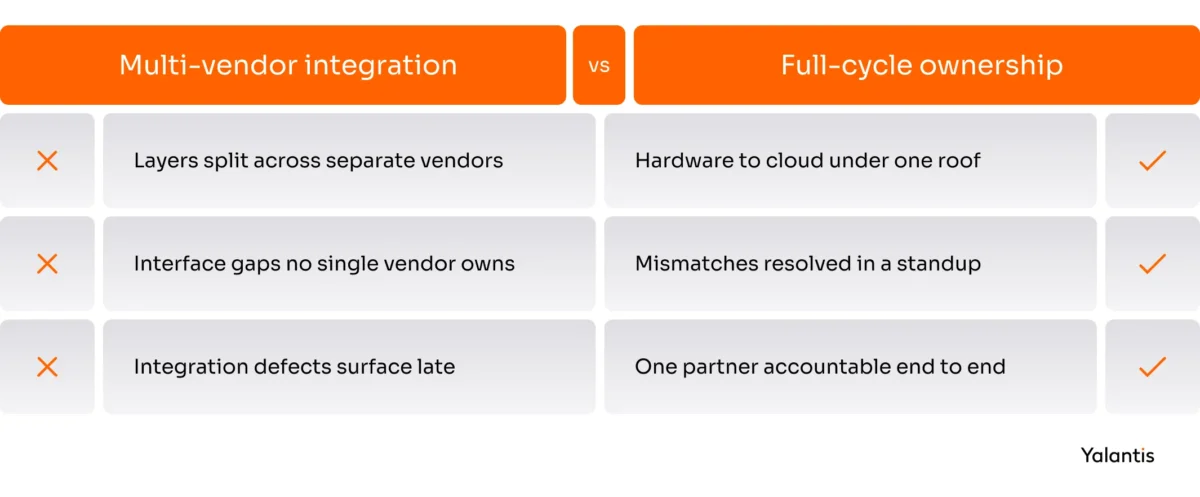
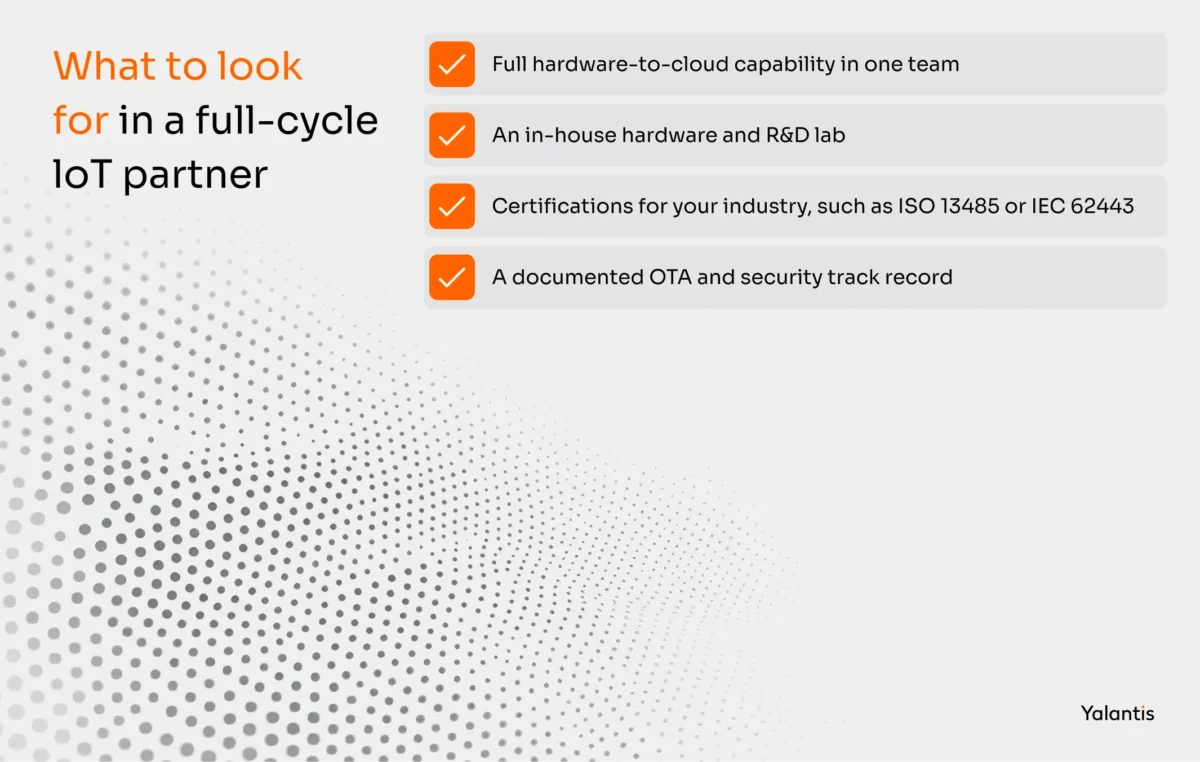
When the layers are split, the gaps between those layers become integration defects that no single vendor is accountable for, and they surface late. A single partner that owns all four layers turns those gaps into internal handoffs. With that in mind, evaluate prospective partners against criteria that map to where projects actually break:
- Full-cycle capability, meaning the full hardware-to-cloud stack under one roof.
- An in-house hardware and R&D lab, so prototyping and validation are controlled, rather than subcontracted.
- Relevant certifications, such as ISO 13485 for medical or IEC 62443 for industrial work.
- Domain proof in your specific regulated industry, rather than generic IoT experience.
- Embedded and Rust talent, the niche skills the broader market is short on.
- A documented OTA and security track record, because that is what fails in the field.
By those measures, we map to this model with 40+ end-to-end IoT deployments, an in-house R&D lab, ISO 9001, 27001, and 27701 certifications, and enterprise work for organizations including Toyota Tsusho, Bosch, and KPMG.
The future of IoT development: on-device AI and mandatory security (2026)
The next phase of IoT development is being reshaped by smarter on-device intelligence and stricter security rules. These trends are already reshaping the engineering decisions teams make this year.
Three shifts stand out:
- Edge AI and TinyML. Running machine-learning inference directly on microcontrollers, for anomaly detection or predictive maintenance, cuts latency and bandwidth while reducing the privacy exposure of sending raw data to the cloud.
- Regulation as a forcing function. The EU Cyber Resilience Act makes secure-by-design and SBOMs a legal baseline by the end of 2027, which rewards teams that engineer security in from the start.
- Software-defined devices. Products increasingly deliver and update their value through software over the air, extending revenue and capability well past the point of sale.
Memory-safe firmware ties these together. As devices get smarter and stay in the field longer under stricter rules, the reliability and security guarantees of languages like Rust move from a nice-to-have to a procurement requirement.
Why choose Yalantis for IoT device development
The hardest part of developing IoT products is rarely any single layer. It is the seams between them, where hardware meets firmware meets cloud. We close those seams by running hardware and software development in one place, out of an in-house R&D lab that has delivered more than 40 end-to-end IoT deployments.
That single-team model comes with the credentials regulated industries ask for. We hold ISO 9001, ISO 27001, and ISO 27701 certifications and run compliance as a parallel track from day one. We also bring the embedded and Rust talent the broader market is short on, and enterprises including Toyota Tsusho, Bosch, and KPMG have trusted us with that work.
If you are scoping a device now, the fastest way to de-risk it is to talk through your hardware and compliance constraints with a team that has shipped under them before.
FAQ
What are the stages of the IoT development process?
IoT development runs through eight stages: discovery and feasibility, industrial design and enclosure, electronics and PCB design, prototyping and validation, firmware and embedded software, connectivity and cloud integration, testing and production handoff, and certification.
What are the four layers (pillars) of IoT?
The four layers of an IoT system are the device layer (sensors and hardware), the connectivity layer (the radio and messaging protocol), the edge and cloud layer (processing and storage), and the application layer (dashboards and apps). Each must be engineered together.
How do you develop an IoT device?
You develop an IoT device by moving through the full hardware-to-cloud lifecycle: defining requirements, designing the enclosure and PCB, prototyping and validating the hardware, writing firmware, integrating connectivity and cloud services, then testing the device and handing it to manufacturing, with certification gating the launch.
What is the difference between IoT software development and IoT device development?
IoT device development covers the physical product and its embedded firmware. IoT software development covers the cloud backend and application layers that ingest and act on device data. Most connected products need both, integrated tightly.
What programming languages are used for IoT firmware?
C and C++ remain the most widely used languages for IoT firmware, with Rust gaining fast adoption because it prevents memory-safety bugs at compile time. Many production systems now run mixed Rust and C codebases.
What certifications matter for IoT device development?
The certifications that matter depend on the industry: ISO 13485 and FDA 524B for medical devices, IEC 62443 for industrial systems, ISO 26262 for automotive, ISO/IEC 27001 and 27701 for information security and privacy, plus regional radio approvals such as FCC and CE.
About the author