
Every supply chain executive faces the same nightmare. You need to know where your shipments are right now. You need to confirm the cold chain stayed intact. You need to explain to your CEO why a critical delivery went wrong. But you have data scattered across fifteen different carrier portals, each with its own login, each showing different information, none of them talking to each other.
The promise of visibility has been sold for years, yet most supply chain leaders still spend their mornings manually checking multiple systems, copying data into spreadsheets, and hoping they caught everything important. This fragmented approach costs time, creates blind spots, and makes it nearly impossible to respond quickly when problems emerge.
Building a unified view of your supply chain data, what the industry calls a Single Source of Truth, has become the central challenge of modern logistics management.
Based on work with dozens of enterprises managing complex multi-carrier networks, we can confirm that consolidating data from your own fleet and third-party logistics providers into one coherent system is possible.
But the path there requires understanding both the technical architecture and the political realities that make this harder than it should be.
Is It Possible to Gather Data From Different Carriers Into a Single Source of Truth in Supply Chain?
Yes, but only if you accept that you are building a whole data integration campaign inside your supply chain organization.
The technical capability exists. Companies across pharmaceuticals, food distribution, and industrial manufacturing have successfully created unified visibility platforms that pull data from dozens of carriers, their own trucks, and IoT sensors into a single dashboard. The technology works.
What makes this achievable today compared to five years ago comes down to three factors.
First, more carriers now offer API access to their tracking systems, even if they charge for it.
Second, cloud infrastructure has made it economically feasible to process and store massive volumes of shipment data.
Third, the data integration tools have matured to the point where you can build custom connectors without writing everything from scratch.
However, calling this “possible” glosses over the real challenge. You are not buying a finished product. You are building a custom integration layer that must accommodate every quirky data format, every unreliable API, and every carrier that refuses to provide real-time access. The technical architecture exists, but you need to invest in building and maintaining it.
The distinction matters because executives often approach this as a software purchase when they should be thinking about it as an engineering project. You need dedicated data engineers who understand logistics, not just a vendor relationship. The successful implementations I have seen all have one thing in common: they committed to building internal technical capability rather than expecting a vendor to solve everything.
The technology platform that makes this unified data vision possible has a name: the Supply Chain Control Tower.
This is the backbone for aggregating, standardizing, and analyzing data from every corner of your logistics network. While the term gets used loosely in the industry, a true control tower does the hard work of data integration and harmonization that most executives never see but absolutely depends on for accurate visibility.
How Does the Supply Chain Control Tower Work?
A Supply Chain Control Tower functions as a centralized data aggregation and analytics platform that collects information from multiple sources, standardizes it, and presents it through a unified interface.
The architecture has three layers, each serving a distinct purpose.
The ingestion layer sits at the bottom. This component connects to every data source in your network and pulls information continuously. For carriers with modern systems, you connect via API calls that retrieve tracking updates every few minutes. For older carriers still using Electronic Data Interchange, you build EDI parsers that translate their rigid format into something useful. For your own fleet, you integrate directly with telematics systems and any IoT sensors you have deployed. For the least sophisticated partners, you set up automated file transfers where they drop a CSV file on a server each day and your system picks it up.
The middle layer handles data harmonization. This component takes all the incoming data, which arrives in dozens of different formats, and converts it into a standardized schema. When FedEx says a package is “in transit” and DHL says it is “on vehicle for delivery” and your own driver app says “en route,” the harmonization engine maps all three to a single status code your organization understands. This layer also handles data quality checks, flagging records that look suspicious or incomplete.
The top layer provides analytics and visualization. Once data lives in a clean, standardized format, you can build dashboards, create alerts, and run analyses. This is where most vendors focus their marketing because pretty dashboards are easy to demonstrate. But the real value comes from the two layers underneath that nobody sees.
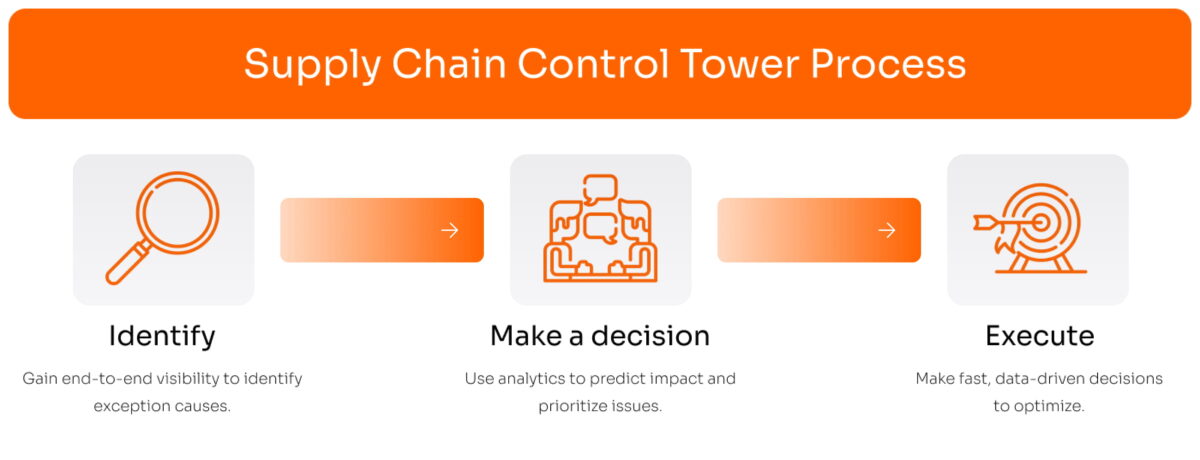
The control tower concept comes from air traffic control, where operators monitor many aircraft simultaneously from a central location. In the supply chain, you gain the same centralized visibility over all your shipments, regardless of which carrier moves them or which system tracks them. When something goes wrong, a temperature excursion, a significant delay, a missed pickup, the control tower alerts the right person immediately rather than waiting for someone to check each carrier portal manually.
How to Set Up a Proper Supply Chain Control Tower?
Setting up a control tower requires more political skill than technical skill. The technology works. Getting people to use it and feed it good data presents the real obstacle.
Start by defining your specific use case. Control towers fail when they try to do everything for everyone. Pick one high-value problem: reducing temperature excursions in pharmaceutical shipments, improving on-time delivery for critical components, or gaining visibility into international shipments. Build the control tower to solve that problem first. Once you prove value, expanding scope becomes much easier.
Secure executive sponsorship early. You will need someone with budget authority and organizational clout to push this through because you will encounter resistance. Some 3PLs will not want to share data. Some internal teams will not want another system to learn. Some business units will question why they should standardize their processes. Without executive backing, these objections kill the project.
Build a cross-functional team that includes logistics operations, IT, and data engineering. The logistics people know what data matters and how decisions get made. The IT people understand your enterprise architecture and security requirements. The data engineers build the actual integrations. All three perspectives are necessary.
Start with your own data first. Before demanding data from carriers, get your internal house in order. Connect your warehouse management system, your transportation management system, and any other internal data sources. Clean up your master data. Standardize your location codes and product identifiers. Prove that you can integrate and harmonize data from your own systems before asking partners to participate.
Then approach your top carriers with a business case. Explain what data you need, why you need it, and what value sharing it creates for them. Some carriers will resist. Prioritize relationships with carriers who move the most volume or handle your most critical shipments. You can bring along the reluctant partners later once the system proves valuable.
Invest heavily in data quality monitoring. Build automated checks that flag suspicious data: shipments that teleport between locations, temperature readings that jump impossibly, status updates that arrive out of sequence. Poor data quality destroys trust in the system faster than anything else.
Plan for continuous integration work. You will never finish building integrations because carriers update their systems, merge with other companies, or change data formats. Budget for ongoing engineering resources, not just the initial buildout.
How Much Does It Take to Develop a Supply Chain Control Tower?
The timeline depends almost entirely on how many data sources you need to integrate and how messy their data is.
For a minimal viable implementation connecting three to five carriers plus your internal systems, expect six to nine months. This assumes you have technical resources already and reasonable cooperation from carriers. The first three months go to requirements gathering, architecture design, and building the core platform. The next three to six months go to building individual integrations, testing them, and working through data quality issues.
For a full-scale implementation across a complex, multi-carrier network with dozens of partners, plan for eighteen to twenty-four months to reach mature capability. You can launch initial visibility within the first year, but getting all carriers integrated, achieving consistent data quality, and building advanced analytics takes longer.
The limiting factor is rarely the platform itself. Modern data integration platforms can be configured relatively quickly. The delays come from carrier onboarding. Some carriers take weeks to provide API documentation. Others require legal negotiations around data sharing. Some discover their internal data is messier than they thought when you start asking detailed questions. Each integration ends up being a mini-project with its own timeline.
You also need time to build organizational adoption. Even with perfect data, the system provides no value if people continue checking carrier portals individually out of habit. Plan for training, change management, and a gradual rollout that proves value to skeptical users.
Internal resource requirements typically include two to three data engineers working full-time during the build phase, plus part-time involvement from logistics operations, IT infrastructure, and data architecture teams. After launch, expect to need at least one dedicated engineer for ongoing integration maintenance and expansion.
How Much Does It Cost to Develop a Supply Chain Control Tower?
Budget $500,000 to $2 million for an essential implementation of a working supply chain control tower, depending on scale and whether you build or buy the core platform.
Now, to break down the costs helps clarify where money goes. Platform licensing or development represents the largest single line item. If you buy a commercial control tower platform from companies like project44, FourKites, or Descartes, expect $100,000 to $500,000 in annual licensing fees based on shipment volume. If you build on a general-purpose data integration platform like MuleSoft or Informatica, licensing runs $50,000 to $200,000 annually but you invest more in custom development.
Integration development costs vary wildly by carrier. A clean API integration might take forty to eighty hours of engineering time. An EDI integration for a legacy carrier could take two hundred hours when you account for testing and troubleshooting. Flat-file integrations are simpler but require ongoing monitoring. At $150 to $250 per hour for qualified data engineers, integration costs add up quickly when you have many carriers.
Infrastructure costs for cloud hosting, data storage, and compute resources typically run $2,000 to $10,000 monthly depending on data volume and retention requirements. Storing detailed tracking events for millions of shipments generates significant data.
Carrier data access fees present an often-overlooked cost. Some carriers provide basic tracking data free but charge for enhanced visibility, real-time updates, or API access. These fees range from a few cents per shipment to monthly minimums of several thousand dollars. Budget $50,000 to $200,000 annually for carrier data access across a multi-carrier network.
Internal labor represents another major cost. Even with external consultants or vendors doing the heavy lifting, your team needs to be deeply involved in requirements, testing, and rollout. Expect to consume 25% to 50% of several people’s time during implementation.
Ongoing maintenance costs run 15% to 25% of initial development costs annually. You need engineering resources to maintain integrations when carriers make changes, add new carriers as your network grows, and enhance the platform based on user feedback.
For a mid-sized enterprise connecting ten to fifteen carriers and processing a few hundred thousand shipments annually, a realistic total cost of ownership over three years runs $1.5 to $3 million including platform, integrations, infrastructure, and internal labor.
How to Unify Data From Different 3PLs and Your Own Fleet Into a Supply Chain Control Tower Step-by-Step
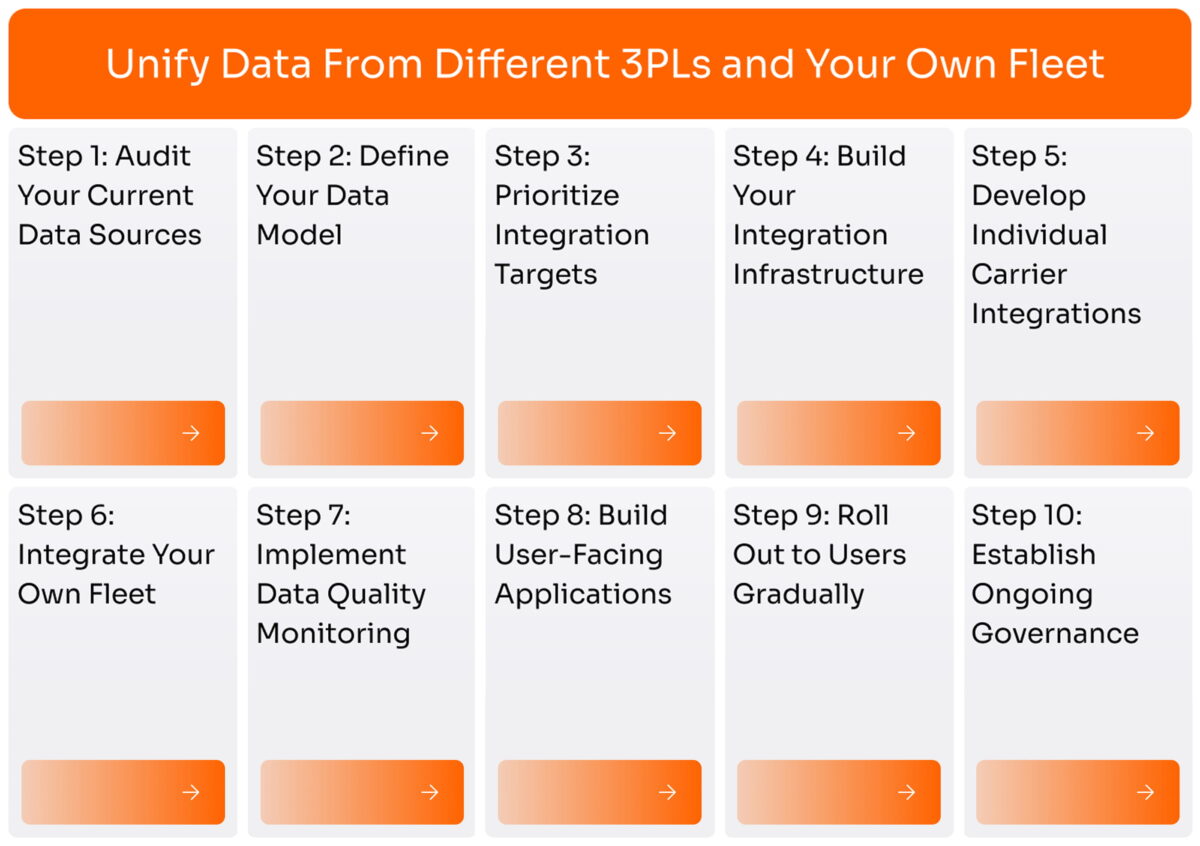
The actual implementation follows a methodical process, though rarely as cleanly as the steps suggest.
Step 1: Audit Your Current Data Sources
Document every system that contains shipment or transportation data. Include your transportation management system, warehouse management system, carrier portals you check manually, IoT sensor platforms, telematics systems for your own fleet, and any spreadsheets people maintain. For each source, identify what data elements it contains, how current the data is, and how you access it today. This audit usually reveals more data sources than you expected.
Step 2: Define Your Data Model
Decide what a shipment looks like in your unified system. Define the standard fields: shipment ID, origin, destination, carrier, current status, current location, temperature range, estimated delivery time, actual delivery time. Determine how you will handle status codes since every carrier uses different terminology. Create a master location database since carriers will use different names and codes for the same facility. This data model becomes your single source of truth that all incoming data gets mapped to.
Step 3: Prioritize Integration Targets
Rank your carriers and internal systems by strategic value. Consider shipment volume, revenue impact, data quality concerns, and integration complexity. Start with sources that are both important and relatively easy to integrate. Save the most difficult integrations for later when you have more experience.
Step 4: Build Your Integration Infrastructure
Set up your core platform, whether commercial control tower software, a data integration platform, or custom-built infrastructure. Configure your data storage, set up your ingestion pipelines, and build your harmonization rules. This foundation needs to be solid because you will build many individual integrations on top of it.
Step 5: Develop Individual Carrier Integrations
For each carrier, work through their specific requirements. If they offer an API, obtain access credentials, review documentation, and build the API client that calls their endpoints regularly. If they use EDI, set up the EDI translator, configure message types, and test the parsing logic. If they provide flat files, set up the file transfer mechanism and build the parser. Each integration requires its own testing to confirm data flows correctly and maps properly to your standard data model.
Step 6: Integrate Your Own Fleet
Connect your internal telematics and any sensors you deploy. This often requires working with the hardware vendors to obtain API access or data exports. Your own data should be cleaner since you control the systems, but expect to discover inconsistencies in how different systems identify drivers, vehicles, or shipments.
Step 7: Implement Data Quality Monitoring
Build automated checks that run continuously. Flag shipments with impossible location jumps. Identify temperature readings outside sensor specifications. Catch status updates that arrive out of logical sequence. Create dashboards showing data quality metrics by source so you can identify which carriers or systems need attention.
Step 8: Build User-Facing Applications
Once data flows reliably into your unified system, build the dashboards and alerts that users actually need. Resist the temptation to build everything at once. Start with the most critical views: current shipment status, exception alerts, and basic reporting. Add sophistication gradually based on user feedback.
Step 9: Roll Out to Users Gradually
Begin with a small group of power users who understand the system’s limitations and can provide good feedback. Fix issues they discover before expanding to broader audiences. Provide training that focuses on how this changes their daily workflow, not just how the software works.
Step 10: Establish Ongoing Governance
Create processes for handling integration failures, data quality issues, and enhancement requests. Assign clear ownership for maintaining each integration. Schedule regular reviews of data quality metrics. Plan for the continuous work of adding new carriers and enhancing existing integrations.
The entire process requires persistence and patience. You will encounter carriers who take months to respond, integrations that break unexpectedly, and data quality issues that require extensive investigation. The organizations that succeed treat this as a multi-year program rather than a one-time project, continuously improving their data unification capabilities over time.
Conclusion
The journey to a unified view of the supply chain culminates in the successful deployment of a true Supply Chain Control Tower. This platform moves logistics beyond the daily nightmare of fragmented carrier portals and siloed data, establishing the essential Single Source of Truth.
However, the technology is not a finished product; it is an engineering project. Success hinges on organizational commitment to this technical investment, not merely a software purchase.
The Control Tower’s three layers (ingestion, harmonization, and analytics) are the hard-won foundation that translates raw, messy data from APIs, EDI, and telematics into standardized, actionable insight. It is this systematic process of data unification that provides centralized visibility over all shipments, allowing the team to move from reactive crisis management to proactive intervention.
The ultimate value of the Supply Chain Control Tower is not just a pretty dashboard, but the elimination of blind spots, ensuring every critical delivery is monitored and every exception is routed to the right person, immediately.