




|
Key takeaways
|
A modern wearable is a distributed system. It combines a sensor package, firmware, a companion app, and a cloud backend that has to stay accurate and secure every second it runs. Delivering that full stack is what wearable app development really means, and the truth is it is harder than shipping a standard phone app.
This time we prepared a guide to wearable application development covers where we explain how to build a connected wearable solution end to end: the types of wearables and the software that powers them, the platforms and SDKs you choose between, the development process step by step, the tech stack, the real cost drivers, industry use cases (including our own), and the compliance work that decides whether your product ever reaches users. Healthcare gets the deepest treatment here, because that is where the engineering and regulatory bar sits highest. The same principles apply whether you build for the wrist or the factory floor.
If you lead engineering or product at a company shipping a connected device, this is the reference to keep.
What wearable app development really involves
Wearable application development is the process of designing and building the software that runs on a body worn device and the companion systems it talks to. In practice that means firmware on the device, a paired mobile or web application, and a cloud backend that stores and analyzes the data the device collects.
A wearable is more than an app, and that distinction shapes every project. A finished product usually has three layers. The device layer is the hardware and firmware: sensors, a microcontroller, a power source, and the low level code that reads the sensors and manages the radio. The companion app is the phone or tablet software most users interact with, handling pairing, settings, visualization, and alerts. The cloud layer ingests and analyzes data, then connects to other systems such as an electronic health record or an enterprise platform.
Because these layers ship together, the hardest problems in wearable device app development live in the seams between them. Firmware that drains the battery or a Bluetooth link that drops mid sync will sink a product that looked fine in a demo. Teams that own hardware, firmware, app, and cloud under one roof avoid the specification gaps that appear when each layer is outsourced separately.
|
Pro tip We recommend deciding early whether you are building a full device or an app for an existing one. An app that connects to an off the shelf smartwatch is a very different project from a custom device that needs its own PCB, firmware, and certification. The cost, timeline, and team all change completely. |
How big the wearable technology market is in 2026
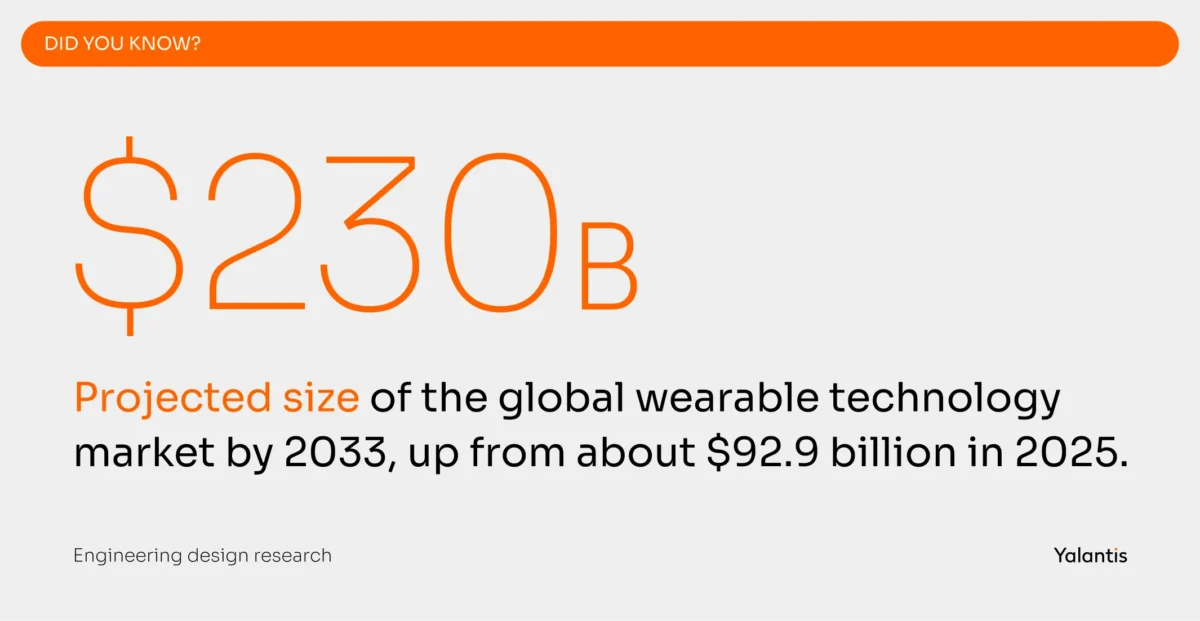
The wearable technology market is large and growing at double digit rates. Estimates vary by analyst, but Grand View Research valued the global wearable market at about $92.9 billion in 2025, projected to reach roughly $230 billion by 2033. MarketsandMarkets puts the trajectory even higher, near $239 billion by 2032, at a compound annual growth rate around 15 percent.
The growth is not evenly spread, and the fastest moving segments are the ones that carry real engineering weight.
| Segment | 2025 size | Forecast | Source |
| Wearable technology (overall) | ~$92.9B | ~$230B by 2033 | Grand View Research |
| Wearable medical devices | ~$48.3B | ~$99.6B by 2030 | Mordor Intelligence |
| Remote patient monitoring | ~$31.8B | ~$66.2B by 2031 | MarketsandMarkets |
| Connected worker (industrial) | ~$8.6B | ~$20.2B by 2030 | MarketsandMarkets |
According to Grand View Research, North America holds the largest share of the overall market at roughly 33 percent, while Asia Pacific is the fastest growing region. Wrist worn devices remain the dominant product category, accounting for more than half of revenue.
A few trends in wearable technology matter most for anyone planning wearable application development this year:
- On device AI and TinyML. Machine learning is moving onto the microcontroller itself. Running inference on the device for anomaly detection or activity recognition cuts latency and bandwidth and reduces how much raw data ever leaves the device, which helps with privacy.
- The consumer to clinical crossover. Sensors that were once confined to clinics now sit on the wrist. That blurring line is opening real markets in remote patient monitoring and at home diagnostics.
- Enterprise and safety wearables. Growth is shifting beyond consumer gadgets into industrial safety, logistics, and field operations, where the buyer is a company rather than an individual.
- Better connectivity. Bluetooth Low Energy remains the default radio for battery powered wearables, now joined by cellular options for devices that need to work without a phone nearby.
The main types of wearables and the software each needs
Wearables come in several form factors, and the different types of wearable devices each imply a different software job. The type of wearable device you choose sets the sensors you work with, the data you handle, and the app experience you build. So app development for wearable devices means matching the software to the device, from a simple fitness band to a regulated medical patch.
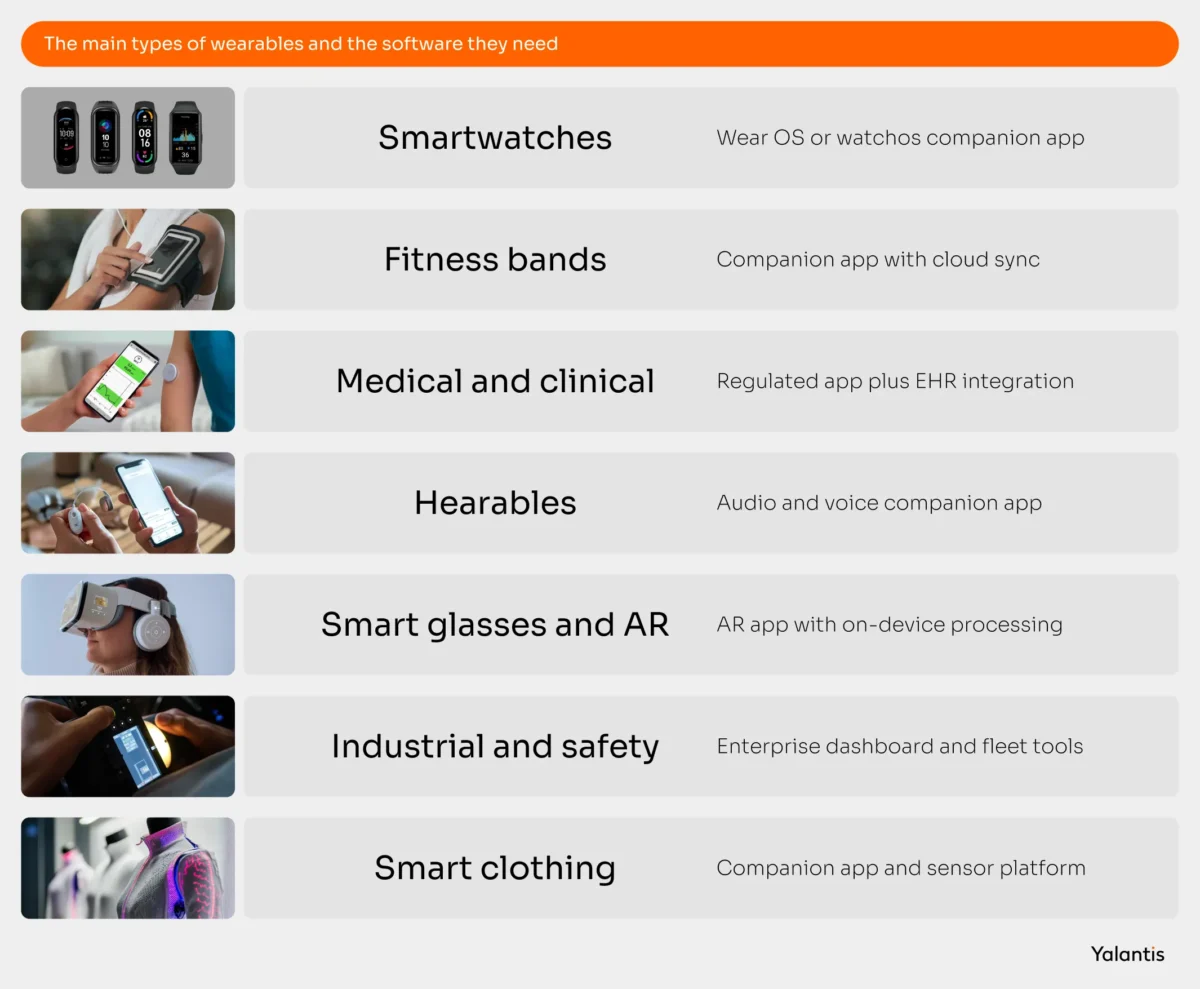
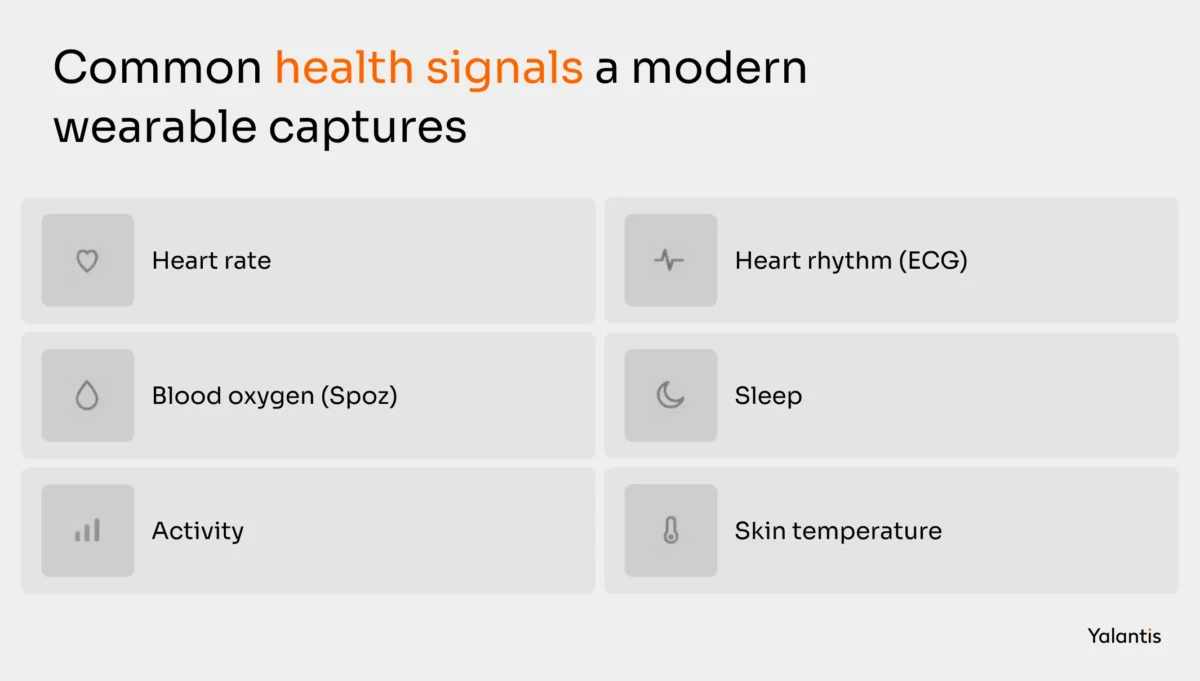
Smartwatches. The most common category. A smartwatch app usually extends a phone experience to the wrist: notifications and quick actions, plus health tracking. On the health side, consumer smartwatches now capture a wide range of signals, from heart rate and heart rhythm to blood oxygen and sleep. Smartwatch app development typically targets Wear OS or watchOS and syncs to a companion phone app.
Fitness bands. Simpler and cheaper than smartwatches, bands focus on activity, heart rate, and sleep. The app work centers on clear visualization and habit forming feedback rather than a full app platform.
Medical and clinical wearables. These are regulated devices such as continuous glucose monitors, ECG patches, and pulse oximeters. Accuracy and compliance dominate the software effort, and the data often flows to clinicians rather than only to the user. This is the heart of medical wearable software development.
Hearables. Earbuds and hearing devices that increasingly add health sensing, such as heart rate and temperature, on top of audio. The app manages audio profiles and, where present, health data.
Smart glasses and AR wearables. Head worn devices that overlay information on the world. In enterprise settings they give hands free access to instructions and remote assistance. The software challenge is rendering useful context without overwhelming the wearer.
Industrial and safety wearables. Smart helmets, sensor equipped vests, wristbands, and exoskeletons built for the job site. Their apps and dashboards focus on worker safety, location, and environmental hazards rather than personal wellness.
Smart clothing. Garments with sensors woven in, sometimes called e-textiles, that track movement, posture, or vital signs invisibly. The software has to make sense of noisy body data captured during real activity.
How to choose between wearable platforms and ecosystems
Your platform choice determines your SDKs, your distribution, and how much of the stack you control. Wearable mobile app development splits into two broad paths: building on an established consumer platform with its own wearable ecosystem, or building custom firmware for your own device.
Here is how the key wearable platforms compare.
| Platform | Best for | Language and SDK notes |
| Wear OS (Google) | Android centric smartwatch apps | Kotlin or Java, Jetpack Compose for Wear, Health Services API |
| watchOS (Apple Watch) | iOS centric smartwatch apps | Swift and SwiftUI, WatchKit, HealthKit |
| Fitbit | Fitness focused consumer devices | Web technologies for older SDKs, plus Google Health Connect on Android |
| Garmin | Sports and outdoor devices | Connect IQ SDK (Monkey C) |
| Custom firmware (RTOS or bare metal) | Purpose built medical and industrial devices | C, C++, and increasingly Rust for safety critical firmware |
On the data side, three SDKs do most of the heavy lifting in health and fitness. HealthKit is Apple’s framework for storing and sharing health data on iOS. Google Fit and Health Connect play the equivalent role on Android, with Health Connect now the preferred hub for on device health data. Choosing the right one early keeps your data model consistent and your integrations clean.
Cross platform is the recurring question. If you build a companion app, you will likely support both iOS and Android, which pushes many teams toward a shared codebase built with cross-platform development frameworks. If you build a custom device, the firmware is platform independent by nature, but the companion app still needs to reach users on both major phone platforms. Plan for that split from day one rather than bolting on the second platform later.
A wearable is only as strong as the seams between its hardware, firmware, app, and cloud. Yalantis engineers all of them under one roof.
The wearable app development process, step by step
Wearable app development follows a repeatable path from concept to launch. The wearable application development process has eight stages, and for a custom device the early hardware decisions constrain everything that follows.
Step 1: Discovery and concept. Define the problem you are solving and the data the product needs. Decide whether you are building a full device or an app for existing hardware. For regulated products, choose your compliance path now, because it shapes the documentation trail for every later stage.
Step 2: Hardware and sensor selection. Pick the sensors that produce the signals your product depends on, then the microcontroller and power source that can run them within your battery target. For custom devices, this is where PCB design and prototyping begin.
Step 3: Firmware development. Write the low level code that reads the sensors and drives the radio while managing power. Firmware quality decides battery life and reliability more than any other single factor.
Step 4: Connectivity. Build the link between the device and the outside world, usually Bluetooth Low Energy for battery powered wearables, with Wi-Fi or cellular where the use case demands it. Reliable pairing and stable data sync are make or break.
Step 5: Companion app and UX. Design the phone or web application users actually touch. Wearable interfaces are small, so the design work is about surfacing the right information at the right moment on a limited screen.
Step 6: Cloud and data. Stand up the backend that ingests and analyzes device data, and integrates with the systems that consume it, such as an EHR or an enterprise platform.
Step 7: Testing and certification. Validate the full system against your accuracy, security, and regulatory requirements. For medical devices this includes formal verification and validation tied to your quality management system.
Step 8: Launch and support. Ship, then keep the product healthy with monitoring and over the air firmware updates, then add new features as needs evolve. A wearable is a long lived product, and post launch support belongs in the plan from the start.
The full cycle matters here. When one vendor owns hardware, firmware, app, and cloud, the seams between stages stay tight and specifications do not get lost in handoffs. Yalantis runs this model from an in-house R&D lab in Warsaw, where PCB design, prototyping, and environmental testing happen under the same roof as firmware and software, which removes the coordination overhead of splitting physical prototyping across separate suppliers.
The tech stack and architecture a wearable needs
A wearable solution is a layered architecture, and each layer has its own technology choices. Data moves from sensors on the body, through firmware and a radio, into a companion app and a cloud backend, with security applied at every hop.
At the device layer you have the sensors and the microcontroller. Common sensors include the accelerometer and gyroscope for motion, the PPG sensor for heart rate, ECG for heart rhythm, and SpO2 for blood oxygen. Getting clean signals out of small, low power sensors is a discipline in itself, which is why designing sensors for medical devices is a specialty rather than a checkbox.
Firmware sits on top of the hardware. It is written in C or C++ on most devices, with Rust increasingly chosen for safety critical work because its memory safety guarantees prevent whole classes of bugs. The connectivity stack is usually built around Bluetooth Low Energy, with Wi-Fi, cellular, or long range options such as LoRaWAN for devices that operate away from a phone.
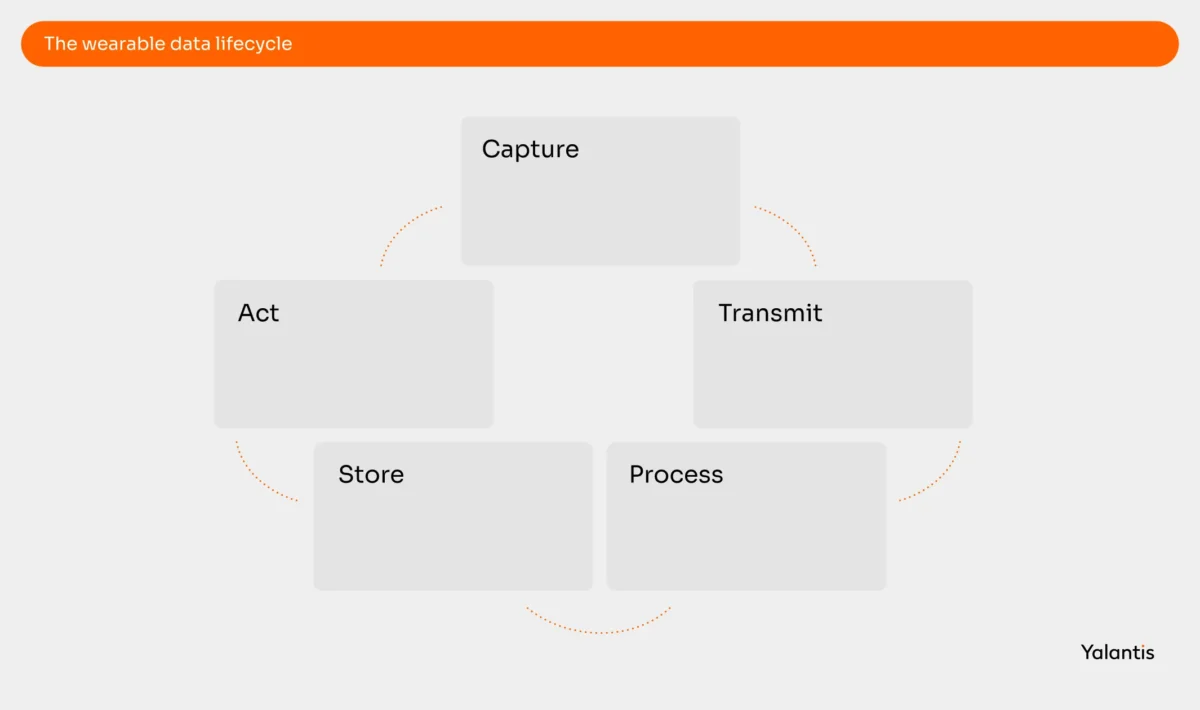
The wearable data lifecycle, from capture through action and back again.
Above the device, two architectural choices define performance:
- Edge computing and TinyML. Processing data on the device or a nearby gateway reduces latency and bandwidth while limiting how much raw data travels to the cloud. Running small machine learning models directly on the microcontroller is now practical for tasks such as anomaly detection.
- Cloud and data pipeline. The cloud handles heavy computation, long term storage, device management, and over the air updates. A well designed pipeline keeps costs predictable as the number of devices grows into the thousands.
Security has to run through the whole stack from the first design decision: encrypted data in transit and at rest, strong authentication, secure APIs between the device and its services, and a signed, rollback protected update pipeline so a bad firmware push cannot brick a device in the field.
How much wearable app development costs
The cost of wearable app development depends most on one decision: whether you build a full device or an app for existing hardware. An app that connects to an off the shelf smartwatch is far cheaper than a custom device that needs its own electronics, firmware, and certification.
The main cost drivers are:
- Hardware versus app only. Custom PCB design, prototyping, and manufacturing add significant cost that an app for an existing device avoids entirely.
- Sensors and complexity. Medical grade sensors and the signal processing they require cost more than consumer motion tracking.
- Compliance. Regulatory work for a medical or industrial device adds documentation and certification effort that consumer products do not carry.
- Platforms. Supporting iOS, Android, and a custom device at once multiplies the surface area you build and test.
As a rough guide, development costs range widely. A companion app for an existing wearable often starts in the tens of thousands of dollars, a full consumer device program runs into the low to mid six figures, and a regulated medical device from concept to certification is typically a multi year, higher budget effort. For context, Yalantis notes that a new medical device or Software as a Medical Device usually takes 12 to 24 months from concept to certification, while a focused integration or compliance engagement can run in weeks.
Engagement models shape the cost too. A fixed scope suits a well defined app, while a dedicated team or a full product engagement fits a device program where requirements evolve as prototypes reveal what works.
Unsure what your device will cost or how long it will take? Scoping the hardware and software together gives you a realistic answer up front.
Wearable app development across industries
Wearables create value in very different settings, and the software changes with the context. Healthcare remains the deepest and most demanding domain, so it gets the most detail below, followed by the other sectors where connected wearables are gaining ground. Wearables app development in a hospital looks very different from the same work on a factory floor.
Healthcare and medical wearables
Healthcare wearable app development is the most regulated and highest stakes category, and also the one with the clearest return. Connected medical wearables let clinicians monitor patients continuously outside the clinic, which supports earlier intervention and fewer avoidable hospitalizations.
The demand is structural. The World Health Organization estimates that by 2030 one in six people worldwide will be 60 or older, and according to IQVIA, more than 142 million people in the United States, nearly 40 percent of the population, are expected to use remote patient monitoring technology by 2030. That is why remote patient monitoring sits at the center of most healthcare wearable programs.
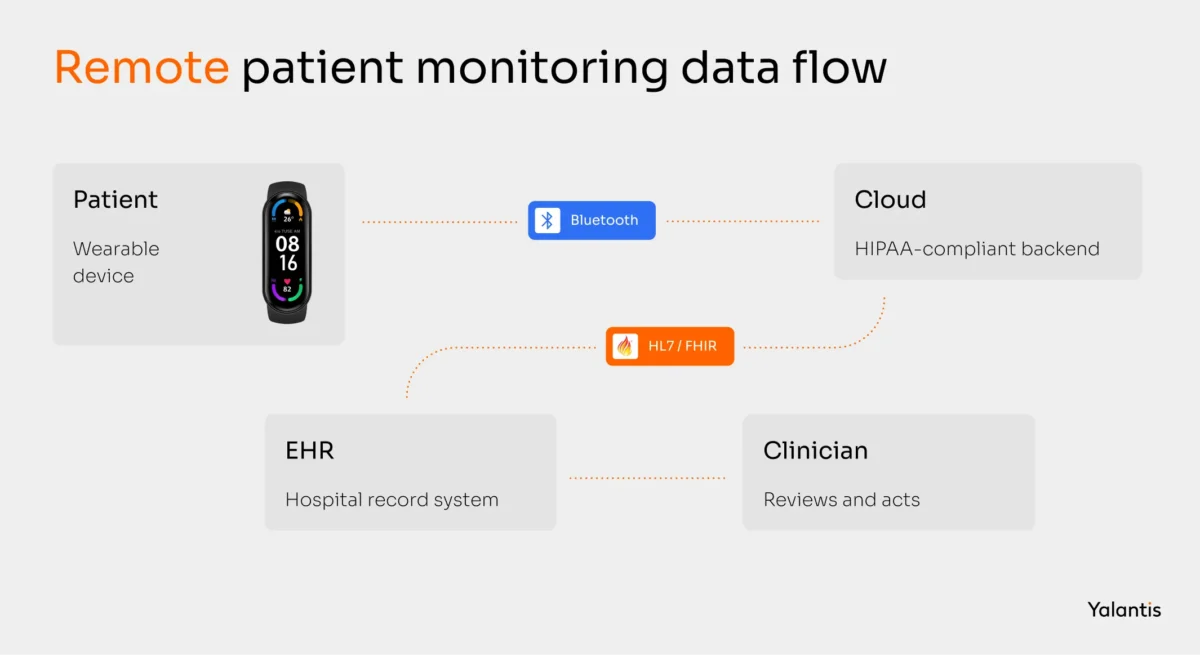
A typical remote patient monitoring solution moves data from a patient’s device, over a local wireless link, into a cloud backend that clinicians can review and act on.
Wearables now serve many clinical specialties:
- Chronic disease management. Real time tracking helps providers watch patients with chronic conditions and catch flares early, so they can adjust treatment sooner.
- Cardiology. Continuous tracking of heart rate and rhythm supports early detection of arrhythmias and remote monitoring for people with chronic heart conditions.
- Endocrinology. Continuous glucose monitors give people with diabetes real time readings so they can manage insulin against live data.
- Oncology. Devices can watch vital signs and flag early signs of complications in patients undergoing chemotherapy.
- Pediatrics. Wearables track vital signs and activity in children, supporting remote monitoring for young patients with chronic conditions.
- Addiction management. Wearables can detect physiological signals linked to cravings or relapse, giving clinicians and patients an early warning during recovery.
- Elderly care. Vital sign tracking and fall detection trigger real time alerts for caregivers and emergency services, supporting independence with a safety net.
Beyond individual care, wearable technology in healthcare can widen access. For underserved and rural populations, connected devices offer a lower cost way to track vital signs and manage chronic conditions without frequent trips to a facility, which helps close the gaps that distance and provider shortages create and moves more care toward a connected healthcare model.
The engineering bar is high because the data is clinical and the integration is complex. Connected medical wearables have to speak the language of hospital systems, and that HL7 and FHIR interoperability with electronic health records is the foundation of medical IoT solutions.
In one Yalantis engagement, our team helped replace a non-compliant application with a HIPAA and FDA compliant platform that connected ECG and pulse oximeter wearables to hospital EHR systems through certified Bluetooth pairing and an AWS data pipeline. As a result, we managed to achieve:
✓ more than 60 hospitals onboarded,
✓ 30 percent revenue growth,
✓ a new B2B sales channel opened through EHR connectivity.
Give clinicians a secure, real-time view of patient data outside the clinic. Yalantis connects wearables to EHR systems with the compliance already handled.
Fitness and wellness
Fitness and wellness is the largest consumer category. Here the software job for a fitness tracking app is engagement: clear visualization, goal tracking, and feedback that keeps people coming back. Accuracy still matters, but the product succeeds or fails on daily habit rather than clinical precision.
Industrial, manufacturing, and worker safety
Industrial wearables protect workers and keep operations visible. The connected worker market is set to grow from about $8.6 billion in 2025 to more than $20 billion by 2030, according to MarketsandMarkets, driven by safety focused wearables and industrial IoT.
The need is concrete. The U.S. Government Accountability Office reported that in 2022 the warehousing, manufacturing, and construction industries saw over 700,000 nonfatal injuries and more than 2,000 fatal accidents. Smart helmets, sensor equipped vests, and wristbands can flag hazards such as falls and heat stress and alert supervisors before an incident. Exoskeletons reduce strain on the body: exosuit maker HeroWear reports that its Apex 2 exosuits protected workers across more than 280,000 warehouse work hours with zero back injuries recorded. Industrial software carries its own security standard, IEC 62443, and has to integrate with operational technology on the plant floor.
Logistics and field operations
In logistics and field work, wearables give visibility into a distributed workforce. Wrist devices and smart glasses help warehouse and field teams work hands free and track shipments, staying coordinated across sites. Low power operation and reliable data transmission matter most, because these devices work far from a charger and often outside strong network coverage.
Consumer and smart lifestyle
Beyond fitness, everyday wearables such as smart rings and connected accessories track wellness signals and tie into smart home and payment ecosystems. The software job is a smooth, low friction experience that fits into daily life without demanding attention.
Key challenges in wearable app development and how to solve them
Wearable application development runs into a consistent set of technical and organizational challenges. The good news is that each one has a known path to a solution.
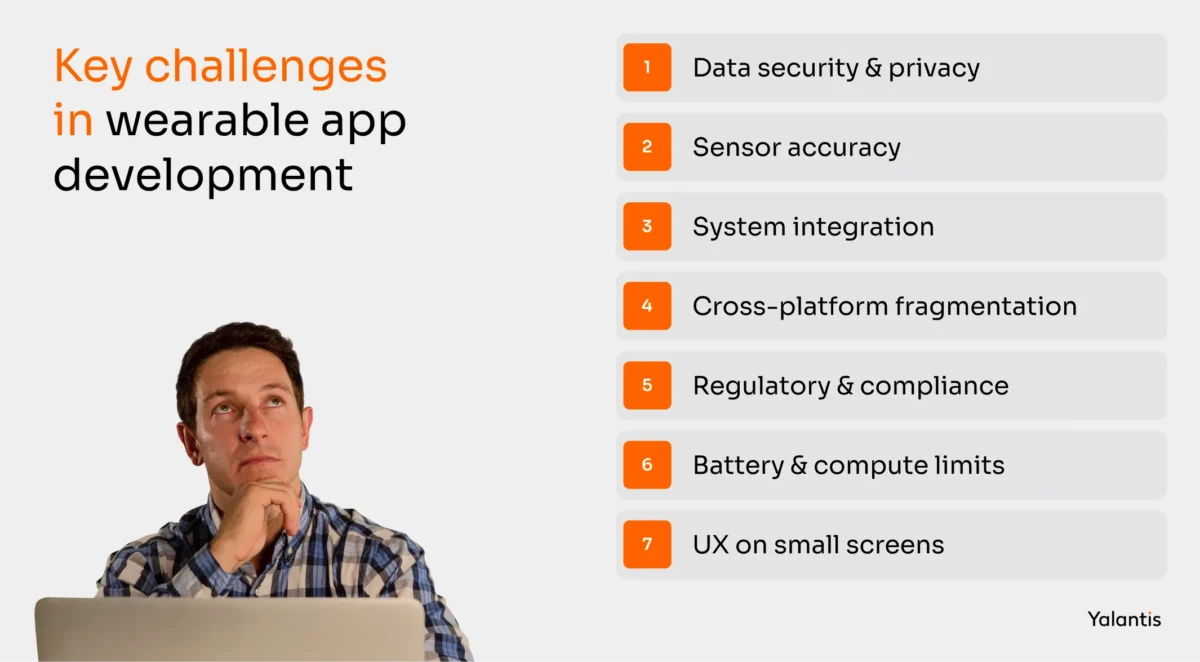
Data security and privacy. Wearables collect sensitive personal data, often stored in the cloud, and users worry about who can see it. Solve it with encryption in transit and at rest, strong authentication, secure APIs, and clear, plain language policies that tell users how their data is stored and used.
Regulatory and compliance complexity. Medical and industrial devices face strict rules that vary by market. Build compliance in from day one and keep a compliance specialist on the team, so regulatory requirements sit in the initial specification rather than becoming a final gate.
Sensor accuracy. Consumer sensors are often less clinically validated than dedicated medical equipment. Choose sensors carefully and invest in signal processing. Be transparent with users about what the device measures and how.
Battery and compute limits. You cannot fit unlimited processing into a small device. Write lightweight, efficient firmware and push heavy work to a gateway or the cloud through edge computing. Optimize aggressively for power.
Integration with enterprise and clinical systems. Legacy hospital and enterprise systems use many data formats and protocols. Use standards such as HL7 and FHIR in healthcare, invest in robust APIs, and add middleware to bridge gaps between the device and existing systems.
UX on small screens. Tiny displays make dense interfaces unusable, and some users face a real learning curve. Follow platform accessibility guidance and favor clear icons and simple navigation. Add voice controls where they help.
Cross platform fragmentation. Behavior differs across phone makers and OS versions, especially for Bluetooth. Test across a broad device matrix and plan for both major mobile platforms from the start.
Why regulatory compliance decides whether a wearable ships
Compliance decides whether a wearable can legally reach users, and the requirements depend on what the device does and where it ships. For anything that touches patient care, the bar is high and the documentation load is heavy.
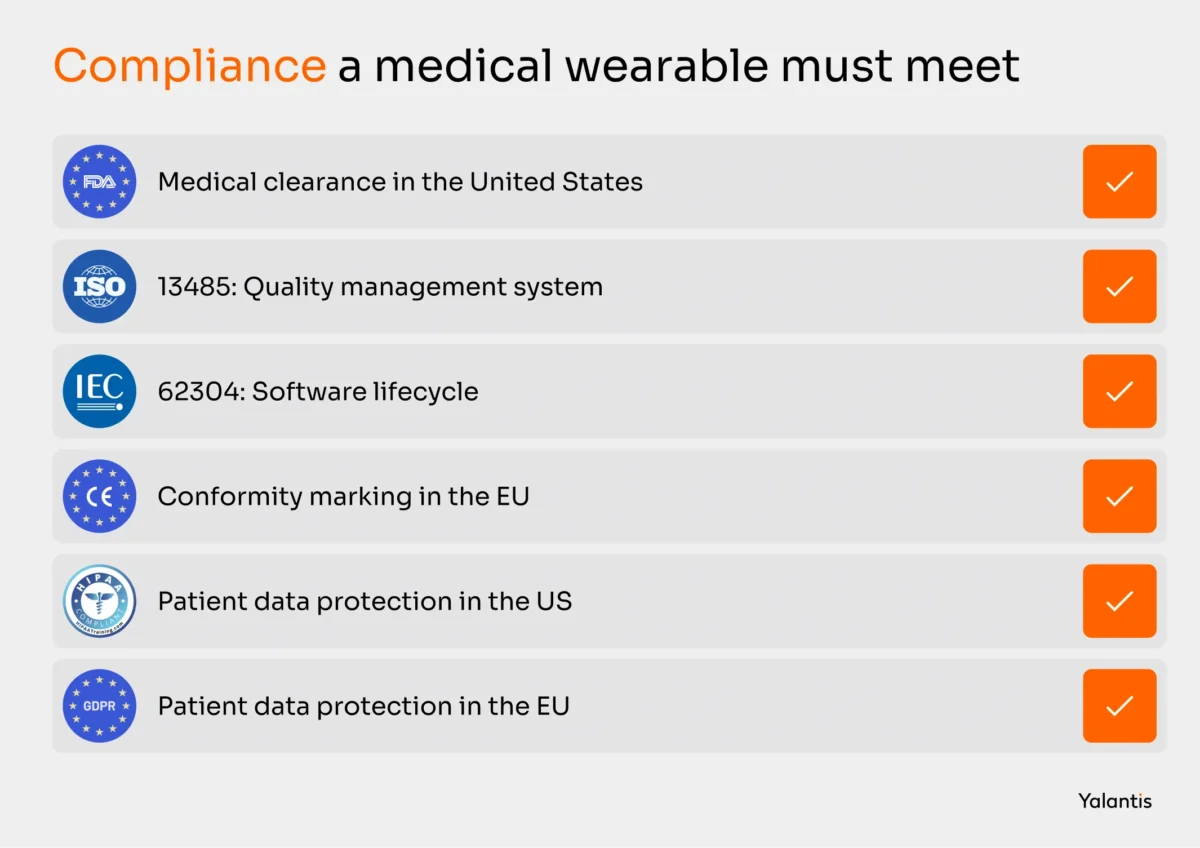
For medical wearables, the core frameworks are:
- FDA (United States). Devices for medical use need FDA clearance. Software that meets the definition of Software as a Medical Device carries extra obligations, and recent cybersecurity rules under Section 524B require a software bill of materials and a vulnerability management plan.
- ISO 13485 and IEC 62304. ISO 13485 governs the quality management system for medical devices, and IEC 62304 governs the software lifecycle, the two standards behind building compliant embedded medical software. As of February 2, 2026, the FDA’s Quality Management System Regulation incorporates ISO 13485 by reference, which effectively makes the standard mandatory for United States manufacturers.
- CE marking and EU MDR. In Europe, medical devices must meet the Medical Device Regulation and carry CE marking.
- HIPAA and GDPR. Any device handling patient data must protect it, HIPAA in the United States and GDPR in Europe.
For industrial and enterprise wearables, security standards such as IEC 62443 take center stage, alongside GDPR and general data protection duties. Across every category, the pattern is the same: security and compliance belong in the architecture from the first sprint, because retrofitting them is the single most common cause of certification delay and cost overrun.
Yalantis holds ISO 13485 certification and builds FDA and IEC 62304 requirements into a medical device from the first sprint, before compliance becomes a bottleneck.
How to choose a wearable app development partner
Choosing a wearable app development partner comes down to one question: can they cover the whole stack that a wearable requires? A wearable is a device, so a software only vendor leaves you managing separate suppliers for hardware, firmware, and cloud, which is where specifications get lost in translation.
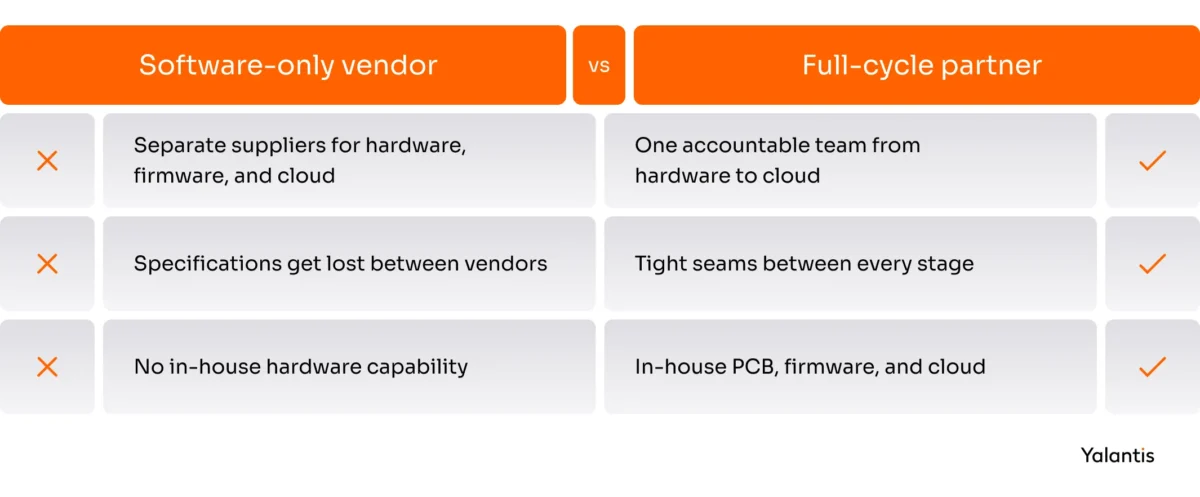
A single full-cycle partner removes the gaps that open up between separate vendors.
Look for these capabilities:
- Full cycle, hardware to cloud. One partner that handles PCB design, electronics, firmware, connectivity, the companion app, and the cloud backend. In-house hardware capability is the clearest signal of a true device partner.
- Relevant certifications with audit evidence. ISO 27001 for information security, ISO 9001 for delivery maturity, and industry specific certifications such as ISO 13485 for medical or IEC 62443 for industrial work.
- Domain proof in your industry. Verifiable enterprise references and real production work in your regulated space rather than generic IoT experience or prototypes.
- Niche embedded talent. Experienced wearable app developers, especially firmware and Rust engineers, are scarce, and they are exactly the skills a wearable device needs.
- A real track record on updates and security. Over the air update and security experience, because that is what fails in the field.
Questions worth asking a prospective partner: Do you design and prototype hardware in house? Can you show ISO 13485 or IEC 62443 evidence? Have you shipped a device in my industry to production? How do you handle over the air updates and security? What does post launch support look like?
Why choose Yalantis for wearable development
As we noted, wearable app development is a full-stack discipline. Wearable succeeds only when hardware, firmware, a companion app, and cloud work together reliably and securely, inside the rules of your industry. Whatever the sector, from regulated healthcare to industrial operations, the path is the same: define the device as a system from day one, choose the right platform and stack, build compliance in early, and ship something people trust. The single biggest factor in getting there is the partner you choose.
That is what Yalantis is built for. As a full-cycle IoT engineering company, we take wearable programs across hardware, firmware, embedded software, and cloud under one accountable team, which removes the gaps that open up between separate vendors.
- An in-house R&D lab in Warsaw for PCB design, prototyping, and environmental testing, so hardware and firmware are developed and integrated under one roof.
- A rare combination of certifications: ISO 9001, ISO 27001, ISO/IEC 27701, ISO 13485, and IEC 62443, with HIPAA compliant processes, so products pass FDA, CE, or FCC audits without last minute rework.
- Safety critical firmware in Rust, alongside deep C and C++ experience and more than 40 end to end IoT deployments for organizations such as Bosch, Toyota Tsusho, and KPMG.
- Measurable outcomes, such as a connected medical platform that onboarded more than 60 hospitals and drove 30 percent revenue growth, backed by average client retention above four years and an NPS of 91
So, whether you are building a consumer product or a regulated medical device, Yalantis can scope the hardware and software together and take it from concept to production. The best next step is to get in touch and tell us about your device.
FAQ
How much does it cost to develop a wearable app?
The cost of developing a wearable depends most on whether you build a full device or an app for existing hardware. A companion smartphone app for an off the shelf wearable often starts in the tens of thousands of dollars, a full consumer device program runs into the low to mid six figures, and a regulated medical device from concept to certification is a larger, multi year investment. Sensors, compliance, and the number of platforms you support are the main cost drivers.
How long does it take to build a wearable app?
A companion app for an existing device can take a few months. A custom consumer device usually takes several months to a year once hardware, firmware, app, and cloud are all in scope. A new medical device or Software as a Medical Device typically takes 12 to 24 months from concept to certification, because verification, validation, and regulatory documentation add significant time.
What platforms can wearable apps be built for?
The main consumer platforms are Wear OS for Android centric smartwatches and watchOS for Apple Watch, plus device specific ecosystems such as Fitbit and Garmin. Purpose built medical and industrial devices run custom firmware on a real time operating system or bare metal. Companion apps are usually built for both iOS and Android.
What is the difference between a wearable app and a companion app?
A wearable app runs on the device itself, such as an app on a smartwatch. A companion app runs on a paired phone or tablet and handles pairing, settings, visualization, and syncing data to the cloud. Many products have both, and for custom devices the companion app is often where most user interaction happens.
What programming languages and SDKs are used for wearable development?
Firmware is usually written in C or C++, with Rust increasingly used for safety critical work. Smartwatch apps use Kotlin or Java on Wear OS and Swift on watchOS. For health data, the key SDKs are HealthKit on iOS and Google Fit or Health Connect on Android. Connectivity is most often built on Bluetooth Low Energy.
How do you integrate a wearable device with a mobile app or enterprise system?
The device connects to a companion app, typically over Bluetooth Low Energy, and the app or a cloud backend forwards data to other systems through APIs. In healthcare, integration with electronic health records uses HL7 and FHIR standards. Enterprise integrations connect to platforms such as ERP or MES. Robust APIs and, where needed, middleware bridge differences in data formats.
What are the main challenges in wearable app development?
The recurring challenges are data security and privacy, regulatory compliance, sensor accuracy, battery and compute limits, integration with legacy systems, usability on small screens, and cross platform fragmentation, especially around Bluetooth. Each has a known solution, from edge computing for compute limits to HL7 and FHIR for healthcare integration.
What are the compliance requirements for building a healthcare wearable?
A healthcare wearable in the United States generally needs FDA clearance, and software that qualifies as a medical device carries added cybersecurity obligations under Section 524B. ISO 13485 governs quality management and IEC 62304 governs the software lifecycle. In Europe, devices need CE marking under the Medical Device Regulation. HIPAA and GDPR protect patient data. Building these in from the start prevents costly rework.
Are wearable devices secure?
They can be, and security depends on the choices made by developers, manufacturers, and users. Strong wearable security relies on encryption of data in transit and at rest, robust authentication, secure APIs, regular firmware updates delivered through a signed and rollback protected pipeline, and user education on safe settings. Security has to be designed into the architecture rather than added at the end.
About the author