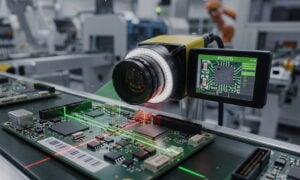

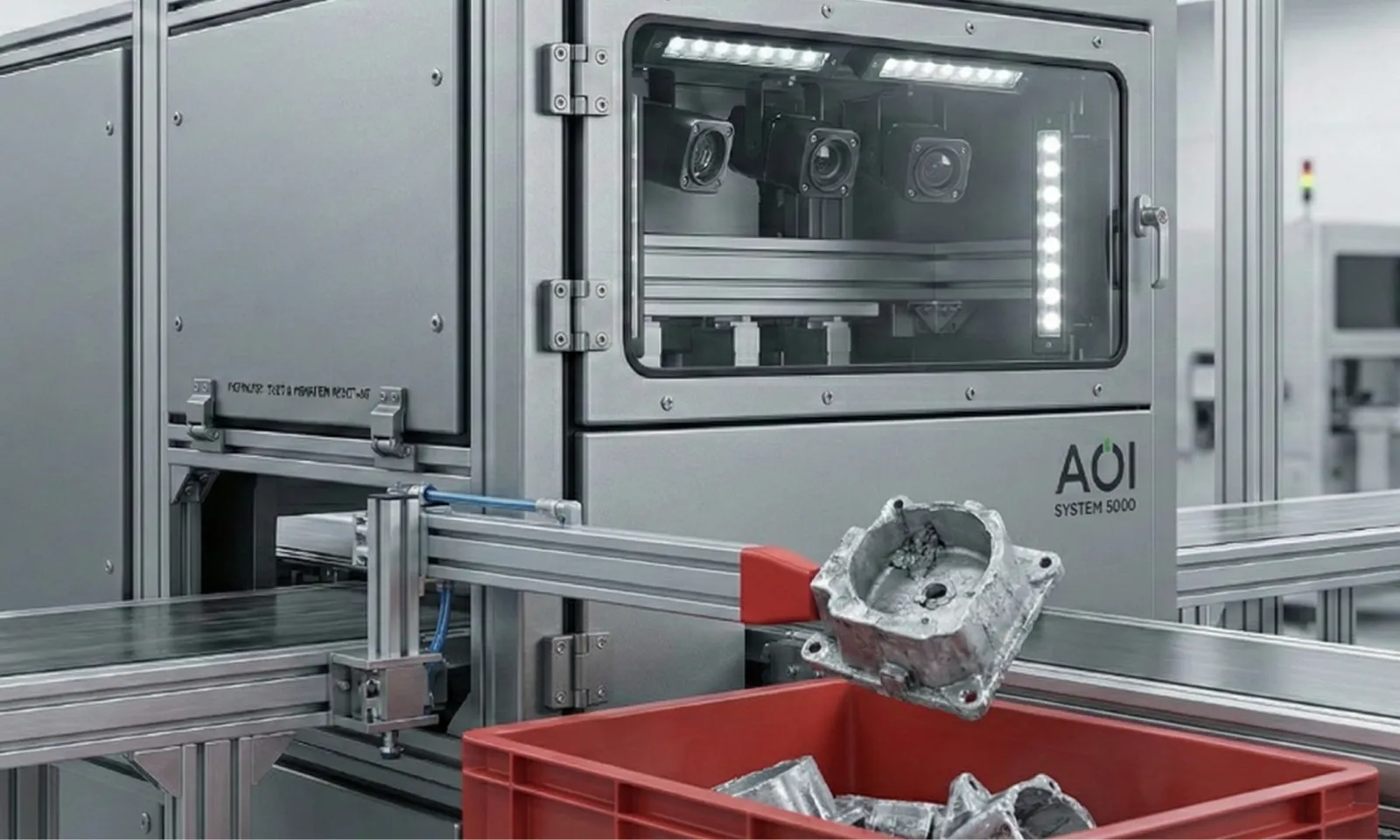


Manual quality inspection has long been a bottleneck in manufacturing. Human inspectors get fatigued, miss subtle defects, and can’t keep up with high-speed production lines. According to the American Society for Quality, most manufacturers spend between 15% and 20% of their total sales revenue on quality-related costs. This figure can climb as high as 40% of total operations when hidden costs are factored in. Automated visual inspection (AVI) solves this problem directly, using cameras, lighting systems, and AI-powered image analysis to detect defects faster and more reliably than any human team can.
This guide covers everything manufacturers need to know about implementing automated visual inspection: the quality problems it solves, the technologies behind it, how Yalantis approaches implementation, and how to calculate whether it makes financial sense for your operation.
Key takeaways:
- Automated visual inspection (AVI) replaces manual quality checks with continuous, real-time defect detection at full production speed.
- Inspection performance depends more on imaging stability and data quality than on the AI model itself.
- Poor lighting or inconsistent part positioning will break detection accuracy.
- There is no universal model. Each inspection use case requires its own dataset, tuning, and validation against real production conditions.
- High-speed inspection generates large volumes of data. Without a proper storage and retention strategy, that data becomes a cost instead of an asset.
- Custom-engineered systems outperform off-the-shelf tools in real production environments, especially for complex surfaces, subtle defects, and high-speed lines.
- Successful AVI implementation requires a system-level approach that combines optics, hardware, AI, and integration into a single production-ready solution.
Need more than defect detection?
Explore how our Industrial IoT solutions unite plant data with production workflows into a connected factory system
Automated visual inspection solves numerous manufacturing quality problems
Before investing in any inspection technology, it helps to understand which specific quality failures it actually addresses. AVI is not a universal fix, but it solves a well-defined set of recurring problems that cost manufacturers significantly every year. Here’s what you can achieve by applying it:
Detect surface defects automatically
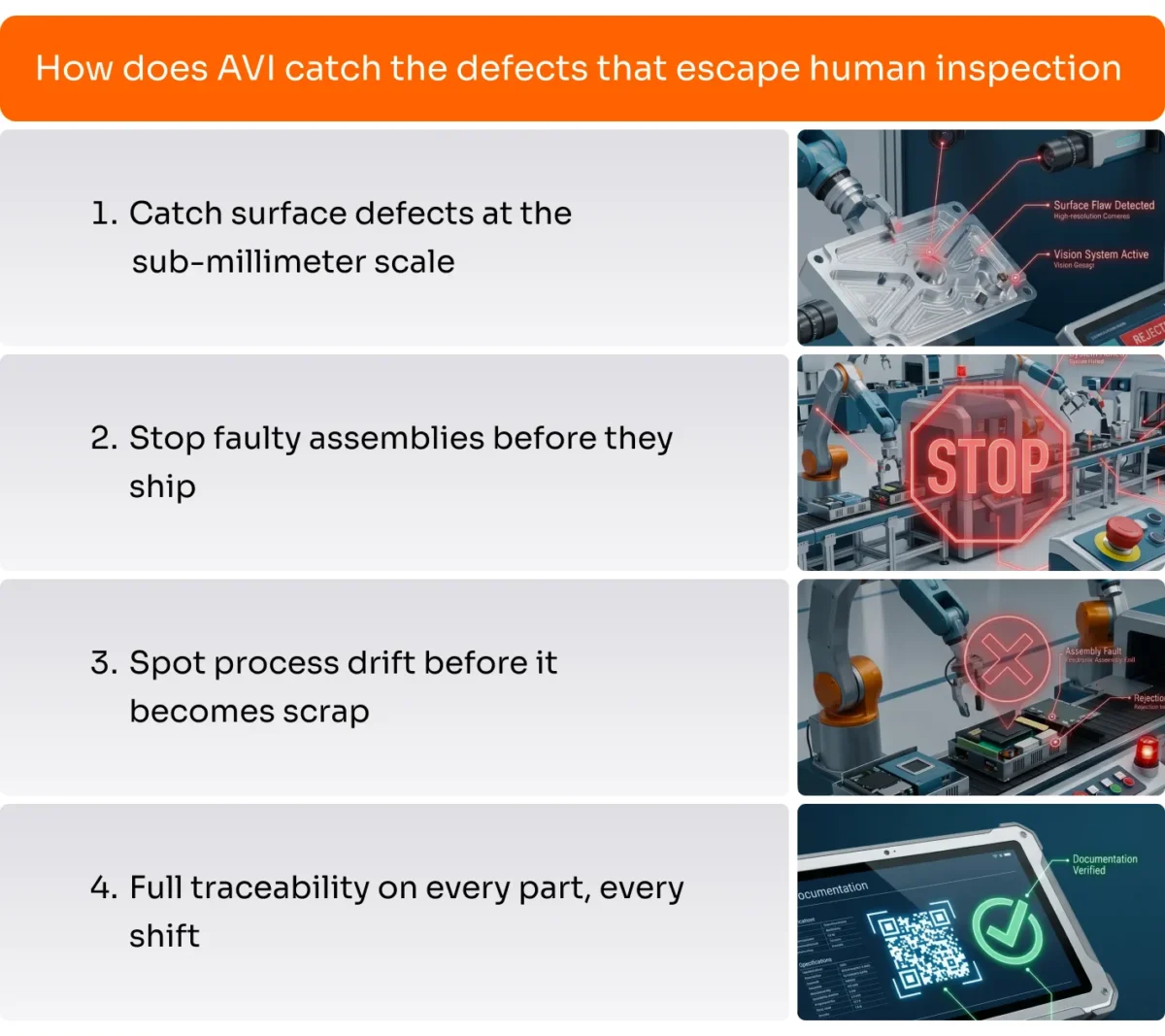
Surface defects are the most common quality failure in manufacturing. A scratch on a machined aluminum part, a pinhole in a pharmaceutical tablet coating, or a hairline crack in an injection-molded housing are all examples of the problems that AVI was built to catch.
Human inspectors struggle with surface defects for predictable reasons. Fatigue degrades performance after hours of repetitive visual scanning. Lighting conditions also vary across shifts. Defect thresholds are applied inconsistently between inspectors, and some defects are simply invisible to the naked eye because they may be too small, too subtle in contrast, or hidden in recessed geometry. Workforce instability complicates the problem further: a McKinsey analysis found that manufacturing sector turnover averaged 36.6% in 2023, making it virtually impossible to sustain consistent inspection quality through people alone.
Automated visual inspection addresses each of these weaknesses. High-resolution industrial cameras capture images at consistent intervals with calibrated, controlled lighting. AI models trained on thousands of defect examples detect anomalies at sub-millimeter scales and flag them with the same sensitivity at the beginning of a shift as at the end. The result is consistent detection performance that does not degrade with time, volume, or workforce changes.
Prevent defective assemblies from reaching customers
Assembly defects are harder to catch than surface defects, and that’s part of what makes them expensive. A missing connector, for example, may pass end-of-line functional tests. The product will work, at least initially. The failure will show up later in a warranty claim or a field return, by which point the cost is way higher than it would have been to catch on the line.
AI visual inspection in manufacturing can verify assembly completeness and correctness at each stage of production, not just at the end of the line. A camera positioned at an assembly station can confirm that all required components are present and properly seated before the product moves to the next step. This approach catches assembly failures early, when rework is cheap. In such a way, preventing even a small number of defective assemblies from reaching customers can justify an entire inspection system.
Detect production process deviations early
Not every quality problem starts with the product. Many start upstream: a tool slowly wearing down, a temperature setpoint drifting, a raw material batch behaving slightly differently. Process deviations show up in the product before any alarm goes off on the process side.
When AVI is connected to a data management system, it functions as an early warning mechanism. A defect rate that starts climbing on a specific product feature tells engineers that something upstream has changed. This signal often arrives before the relevant process parameter has crossed its control limit and triggered a formal alert. Catching the problem at this stage means less scrap. It also means faster diagnosis, because engineers are investigating a fresh deviation rather than a batch failure that has already been running for hours.
Build reliable quality traceability
In most regulated industries, traceability is a requirement. Medical device manufacturers, automotive suppliers, and food producers must prove that specific products were inspected, by what method, and with what result. Manual inspection logs rarely meet that standard. They are inconsistent across shifts, often incomplete, and slow to audit.
Automated visual inspection generates a complete digital record for every part or batch: the image captured, the result, and the production conditions at the time of inspection. That record is what allows a manufacturer to conduct a targeted recall affecting only confirmed defective units rather than an entire production run. It is also what satisfies auditors who require documented evidence of systematic quality control.
Advantages of automated visual inspection in production
Stable and repeatable inspection quality
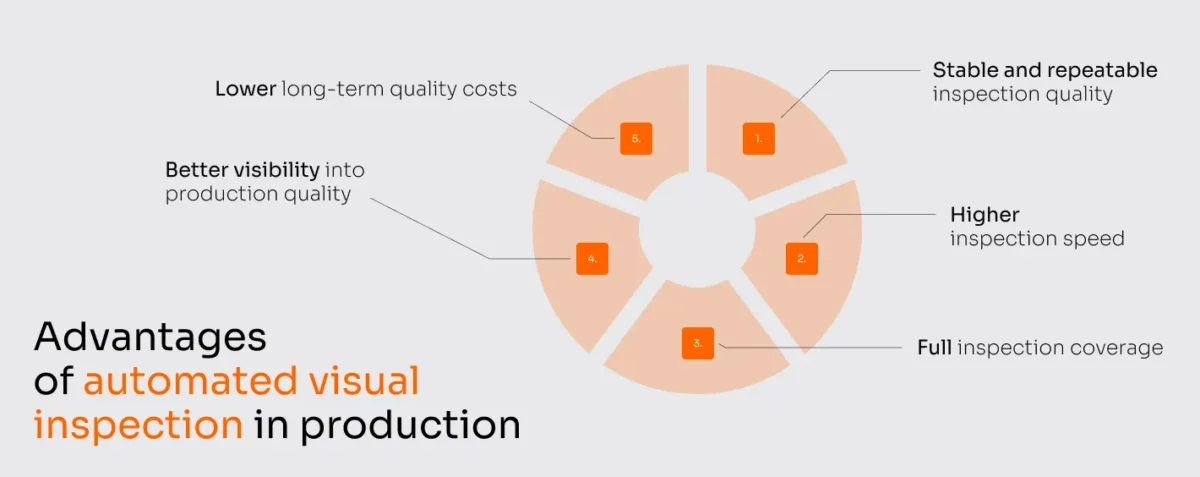
Automated visual inspection produces consistent results because the detection criteria never change. The same thresholds apply on every shift, to every part, regardless of who is on the line. For instance, the latest cohort of WEF Global Lighthouse Network factories reported a 41% average decrease in defects and a 44% reduction in production cycle time.
Higher inspection speed without slowing production
An automated station evaluates parts as they move through the line, with no separate inspection step. Inspection time drops by up to 50% compared to manual processes because the system runs in parallel with production.
Full inspection coverage instead of sampling
Manual QA often relies on statistical sampling. AVI inspects every unit and, in such a way, eliminates blind spots where defects pass through unchecked. The coverage increases without adding labor or extending cycle time.
Better visibility into production quality
Because every inspection result is timestamped and tied to production context, quality data becomes analyzable in ways manual records are not. Defect rates can be traced to specific shifts, material batches, or tooling cycles, which makes diagnosing a quality problem significantly faster.
Lower long-term quality costs
Detecting defects earlier in the production sequence reduces their cost directly. A defect caught in process requires only rework. The same defect at the end-of-line costs more, and even more at a customer site.
Automated visual inspection case study
A Tier-1 European automotive supplier producing cast aluminum brake calipers was losing OEM contracts due to a 0.8% micro-fracture escape rate. Inspectors could not keep pace with a conveyor running at 1.2 m/s, and an off-the-shelf vision system had already failed since polished aluminum’s reflectivity created glare that standard sensors could not resolve.
“Generic vision systems fail on reflective surfaces — that’s a well-known problem in foundries. The client needed custom optics, custom lighting, and a model trained specifically on their defect types. Off-the-shelf wasn’t going to cut it.”

Mykhailo Maidan, CTO at Yalantis
Yalantis built a custom automated optical inspection system from scratch. The solution combined a dome illumination setup with polarized filters to eliminate specular reflections, monochrome sensors with telecentric lenses for distortion-free imaging of complex geometry, and a U-Net segmentation model trained on the client’s specific defect types. Rare defects with limited training examples were addressed through synthetic data generation.
Results delivered:
- 99.7% defect detection accuracy, exceeding the 99% OEM-mandated KPI
- 100% part coverage at full conveyor speed, replacing manual sampling
- 15% increase in line speed after the inspection bottleneck was removed
- Full ROI in 8 months through the elimination of OEM penalty fees and rework reduction
Off-the-shelf vision tools often fail in real environments
Build the one that holds up in production with Yalantis.
How does Yalantis implement automated visual inspection
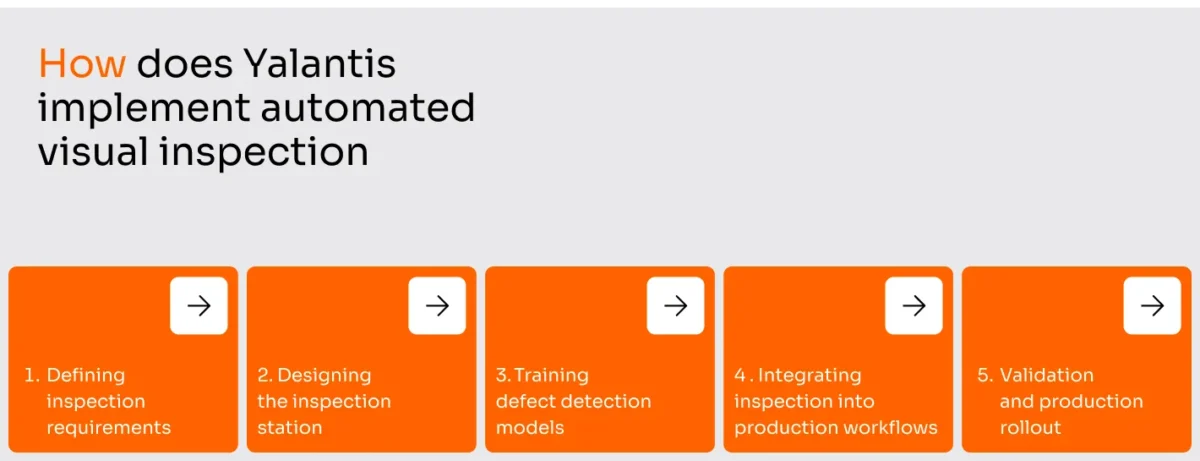
Yalantis builds industrial automated visual inspection systems end-to-end, whether you are building a system from scratch or need some help on the go. Every project follows the same five-step process, which is what keeps implementations on schedule and systems performing to spec from day one.
1. Defining inspection requirements
We work with your quality and production teams to turn business objectives into a precise technical specification before you start buying components. This is also where we agree on the acceptance criteria that your system will be validated against. As a result, you get a signed defect catalogue with severity thresholds, throughput and accuracy targets, and the acceptance criteria against which the finished system will be validated.
2. Designing the inspection station
Our optical engineers design and prototype the full setup against your actual production parts, so the imaging is right before model training begins rather than after. You receive an optical design specification and a station layout with mounting dimensions, which will allow you to see defects on real parts.
3. Training defect detection models
We collect and annotate production images covering the full range of defect types your line produces, and use synthetic data generation to cover rare failure modes that do not appear in production often enough to collect naturally. The model is benchmarked and retrained if needed until it meets the detection rate and false positive targets agreed in Step 1.
4. Integrating inspection into production workflows
We connect the inspection system to your programmable logic controllers (PLC) for triggering and reject actions, send results to your manufacturing execution system (MES) for traceability, and build clear operator interfaces that show only relevant data. Integration works with both modern and legacy systems, which keeps downtime to a minimum.
You get:
- Configured PLC interface with tested reject actuation
- MES data feed with confirmed traceability record format
- Operator dashboards and alert logic
- End-to-end integration test report
5. Validation and production rollout
Before full deployment, we validate the system in real operating conditions. Our team checks performance on the line, verifies repeatability, tunes thresholds, and confirms that outputs meet production and compliance requirements. After validation, we roll the solution into live use and support stabilization.
Technologies behind visual inspection automation
Each layer of an AVI system affects reliability, speed, and cost. Manufacturers that understand these layers can assess vendor proposals more accurately and avoid overpaying for features they do not need. High-speed inspection also produces large data volumes, which makes architecture decisions critical early on.
Imaging hardware and lighting
The imaging layer is the foundation that everything else depends on:
- Industrial cameras for visual inspection range from standard area-scan sensors for general-purpose applications to line-scan cameras for continuous web materials.
- 3D sensors handle dimensional verification.
- Hyperspectral cameras are used when material composition matters alongside surface appearance.
The right camera type depends on the resolution required, the speed at which parts move through the inspection field, and the geometry of the surface under inspection.
What’s even more important for making defects visible is consistent, well-controlled lighting:
- Diffuse lighting reveals surface texture.
- Dark-field illumination makes scratches visible by catching reflected light at oblique angles.
- Backlighting renders silhouette features sharply.
- Structured light projection maps 3D surface geometry.
A poor lighting setup can defeat an otherwise capable AI system. A well-designed one can make relatively simple algorithms perform reliably. Lighting consistently receives less engineering attention than it deserves.
Edge computing for real-time inspection
Sending raw images to a remote server or cloud for processing introduces latency. At production speeds, that latency makes real-time reject actuation impractical. Production-grade automated visual inspection systems run inference locally, on industrial computing hardware positioned at or near the inspection station.
Edge computing platforms for visual inspection typically use industrial PCs or embedded computing modules with GPUs or dedicated AI inference accelerators. These are designed for continuous operation in industrial conditions: they tolerate temperature variation, vibration, and electrical interference that would degrade standard computing hardware. Running inference at the edge also resolves the data volume problem. A high-resolution camera at production speed generates more image data than is practical to transmit centrally. Only results and flagged images need to leave the edge device.
AI models for defect detection
Modern AI-based visual inspection systems use deep learning models trained on labeled image datasets. The visual inspection software layer sits between the camera and the production control system. It receives raw image data, runs it through the trained model, produces a confidence-scored pass or fail decision, and triggers downstream actions accordingly.
Different inspection tasks require different modeling approaches:
- Image classification determines whether a part is acceptable or defective overall.
- Object detection goes further, localizing the defect within the image and identifying its type.
- Semantic segmentation maps the defect at the pixel level, which matters when the location or area of a defect determines how the part is dispositioned.
- Anomaly detection learns what a good part looks like and flags deviations from that baseline.
One point that is easy to underestimate: a model trained on one product does not transfer to another, even a superficially similar one. Every application requires its own training data and its own model. There is no universal visual inspection model.
Integration with production systems
The inspection system connects to production control and quality systems. PLCs handle triggers and reject actions. MES platforms store results for traceability. SCADA systems can provide process context when needed.
Modern systems support standard protocols, which simplifies integration. Legacy environments often require adapters or middleware. Integration is usually feasible, but scope and effort are often underestimated.
Inspection data management
The data generated by an automated visual inspection system has value well beyond the immediate inspection decision. Defect images, results, timestamps, and production context form a historical record that supports traceability requirements, regulatory audits, and ongoing process analysis.
Managing that data in practice requires deliberate planning. A high-resolution camera at production speed accumulates image data quickly: several terabytes per day on a busy line is not unusual. Tiered storage, with recent data held in fast-access storage and older data archived at lower cost, is the standard architecture. Clear retention policies and efficient indexing are what make the data accessible for analysis. Without that structure, inspection data becomes a growing storage cost rather than a useful operational asset.
Cost factors and ROI of automated visual inspection systems
AVI is a capital investment. Manufacturers reasonably want to understand what drives the cost and when the system pays back. Costs vary widely, but the factors that determine them are consistent and predictable.
What makes automated visual inspection systems expensive
Inspection difficulty is the primary cost driver. Detecting sub-millimeter cracks on a curved, reflective surface requires higher-resolution cameras, purpose-built lighting, and AI models trained on carefully labeled datasets. That combination costs significantly more than verifying whether a large component is present or absent.
Throughput requirements add cost as well. Fast inspection requires faster cameras and more powerful computing hardware. Integrating with a line that cannot stop for inspection adds mechanical engineering work. Systems covering multiple inspection points across a production line cost more than single-station implementations. Older infrastructure, including PLCs with proprietary communication protocols and closed MES platforms, requires additional integration engineering.
None of these factors is a reason not to proceed. They are inputs to an honest cost estimate.
Why cheap off-the-shelf inspection solutions often fail
A category of low-cost visual inspection tools exists. These are packaged software products with generic defect detection, configured through simple interfaces. They appeal to manufacturers who want to control initial spending. They frequently fail in practice.
The reason is that visual inspection performance depends heavily on context. Defect detectability is a function of lighting, camera geometry, surface characteristics, and the specific defect types present in a given product. A generic model trained on broad datasets handles textbook defect examples adequately. It struggles with the surface conditions, part variations, and production tolerances of any real manufacturing application.
The cost of that failure extends beyond the wasted investment in the tool itself. It includes the time spent, the erosion of confidence in the technology, and the continued cost of the quality problem that the solution did not solve. Manufacturers who go through that experience typically conclude that a proper engineering engagement was required from the start.
What reduces the cost of automated visual inspection projects
Good training data availability matters most. If a manufacturer already holds an archive of labeled defect images, model training costs drop significantly. Collecting and annotating training data from scratch is typically the most time-consuming and expensive component of an AI inspection project.
Clear and stable requirements also reduce cost. Projects where inspection criteria are well-defined before development begins execute faster than those where requirements evolve during the build. A thorough requirements phase at the start pays back in reduced development cost later.
Building on established industrial hardware and software platforms rather than fully custom architectures reduces engineering time and makes future modifications less costly. Starting with a single high-impact inspection point and expanding after demonstrated success reduces initial investment and builds operational familiarity before the system scales.
When automated visual inspection becomes profitable
Payback comes from several sources: reduced inspection labor, lower scrap and rework costs, reduced warranty claims, and lower field failure costs. In some cases, demonstrably better quality enables access to customer tiers or contract terms that were previously unavailable.
McKinsey’s analysis of industrial manufacturers investing in quality system improvements found that early-stage companies reduced their cost of nonquality (warranty claims, production waste, and rework) by approximately 30%. Accenture’s manufacturing research documents one manufacturer reducing scrap by up to 10% per ton of production within months of deploying AI-powered process monitoring. WEF Lighthouse Network data from 2024 shows AI-enabled quality analytics reducing scrap and waste by an average of 55% across the latest Lighthouse cohort.
In high-volume environments with meaningful defect escape rates, payback within 12 to 24 months is common. The Yalantis automotive case study in this article reached full ROI in 8 months, driven primarily by the elimination of OEM penalty fees and rework costs. Lower-volume or lower-defect-rate applications extend that timeline to 2 to 4 years. The most important input to any ROI calculation is an honest accounting of current quality costs across all departments. Most manufacturers underestimate this figure because the costs sit across separate budget lines that are never aggregated.
Not sure which visual inspection setup makes financial sense for your line?
Book a free consultation with Yalantis to assess your quality costs, production constraints, and choose a technology stack that fit your project.
Challenges of automated visual inspection and how to solve them
According to Deloitte’s 2025 Smart Manufacturing Survey, 98% of manufacturers have started digital transformation, yet only 29% have adopted AI at scale. When AVI is concerned, most get stuck at the same four challenges.
Achieving stable image quality
AI inspection models are only as reliable as the images they receive. Ambient light leaking into the station, parts arriving at inconsistent positions, or aging lighting components will all degrade detection performance in ways that are difficult to diagnose after the fact.
Solution by Yalantis
We treat imaging stability as a design requirement and fully enclose inspection stations to control ambient light. Our experts fix each part in place to maintain consistent geometry. Yalantis monitors lighting health continuously and either implements predictive maintenance or defines preventive maintenance schedules for all imaging hardware before the system goes live.
Obtaining representative defect data
A model can only detect what it has learned to recognize. Rare but critical defect types, which appear only a handful of times in historical production data, are consistently the hardest to cover.
Solution by Yalantis
Our ML engineers collect production samples systematically before training begins, covering the full range of defect types the line produces. For rare failure modes with too few real examples, we generate photorealistic synthetic defect images and fold them into the training set. After go-live, our team monitors model performance and re-trains on newly collected production data as it accumulates.
Reducing false positives and missed defects
Set the detection threshold too sensitive and good parts are needlessly rejected, which will disrupt the production. Set it too permissive, and defective parts slip through. Neither is acceptable in a working production environment.
Solution by Yalantis
Rather than a binary pass/fail, our engineers configure models to output a probability score. The system handles high-confidence results automatically in either direction, while our team routes borderline cases to a human reviewer. We calibrate the threshold against the client’s actual production data and set it based on what the application prioritizes. Either way, we minimize defect escapes or false rejects.
Integrating inspection into legacy production systems
Older PLCs often rely on proprietary protocols, and this factor limits interoperability. Legacy MES platforms expose restricted APIs, making data exchange difficult. Many plant networks were designed for control signals rather than high-volume data flow.
As a result, connecting inspection systems to existing infrastructure requires more engineering effort than expected. Integration is consistently one of the most underestimated aspects of a visual inspection project.
Solution by Yalantis
We assess integration complexity at the requirements stage, before design begins, so it is budgeted and planned rather than discovered mid-project. Our team has hands-on experience with OPC-UA, Profinet, EtherNet/IP, and MQTT, and has integrated inspection systems with both modern and legacy production environments. Where real-time integration is not justified, batch transfer mechanisms fulfill traceability requirements without requiring live connectivity.
Conclusion
Automated visual inspection for manufacturing replaces inconsistent manual checks with a controlled, data-driven process. It detects defects earlier, covers every unit, and produces traceable quality records that support both operations and compliance. The business impacts are lower scrap and rework, fewer field failures, and faster root cause analysis. Cost and complexity vary by use case, but the system becomes profitable when it targets high-impact failure modes and is engineered around real production constraints.
Yalantis delivers automated visual inspection solutions end-to-end, meaning we can build you an AVI system from scratch or help you at a certain point of your current project. Our team designs imaging systems that produce stable data, train models on your actual defect patterns, and integrate inspection into existing production workflows without disrupting throughput. Each project starts with clear acceptance criteria and ends with a validated system that performs on the line. That approach reduces implementation risk and shortens the path to ROI.
FAQ
What is automated visual inspection in manufacturing?
Automated visual inspection uses industrial cameras, lighting systems, and AI-powered image analysis software to inspect manufactured parts for defects without human involvement in the detection process. The system captures an image of each part as it moves through production, analyzes that image against a trained defect detection model, and makes a pass or fail decision in real time.
What types of defects can automated visual inspection detect?
The system detects surface defects such as scratches, cracks, chips, dents, discoloration, and pinholes. It also detects dimensional deviations, assembly errors, including missing or misaligned components, contamination, and coating or labeling irregularities. What a specific system can detect depends on how the imaging hardware is configured and what the AI model was trained on.
How accurate is automated visual inspection compared to manual inspection?
In well-implemented systems, automated visual inspection consistently outperforms manual inspection. Yalantis, for instance, achieved a 99.7% defect detection accuracy. In contrast, human inspectors typically achieve detection rates of 70 to 90% on subtle defects under controlled conditions. Performance declines further as fatigue accumulates. A properly trained and validated automated system applies the same detection sensitivity to every part, on every shift, without degradation over time.
What industries use automated visual inspection?
It is used across virtually all manufacturing sectors. Electronics and PCB manufacturing, automotive components, pharmaceutical and medical device manufacturing, food and beverage production, glass and display manufacturing, textile inspection, metal fabrication, and consumer goods production all rely on it. The specific implementation varies by industry, but the underlying technology is the same.
How long does it take to implement an automated visual inspection system?
Implementation timelines depend on application complexity. A pilot deployment with adequate training data may be implemented in 2 to 4 months. Complex applications involving difficult surface types, multiple defect categories, high throughput requirements, or challenging legacy integration typically require 6 to 12 months. A thorough requirements assessment at the start of the project is what makes accurate timeline estimation possible.
What data does an automated visual inspection system generate?
Every inspection event produces a timestamped record. That record includes the pass or fail result, the defect type and location if one was detected, the image captured, and production context such as line identifier, shift, batch, and part serial number. This data supports quality traceability, regulatory compliance, and process improvement analysis.
Can automated visual inspection work with existing production equipment?
Yes, in most cases. Integration complexity depends on the communication capabilities of existing PLCs, MES platforms, and production control systems. Modern inspection platforms support standard industrial communication protocols compatible with most equipment. Older systems may require additional integration work, but genuine technical incompatibility is rare.
What is remote visual inspection, and how does it differ from automated visual inspection?
Remote visual inspection is an inspection performed at a physical distance from the object being examined. It typically uses cameras, borescopes, or drones to access locations that are difficult to reach: pipeline interiors, turbine blades, elevated structures, or sealed assemblies. It is primarily used for maintenance and infrastructure inspection rather than production line quality control. AVI, by contrast, is integrated directly into a manufacturing line. It operates continuously at production speed and makes a pass or fail decision for every part produced. Both increasingly rely on AI-based visual inspection models to improve detection accuracy, but they serve fundamentally different purposes.
What is the ROI of automated visual inspection?
Payback periods of 12 to 24 months are common in production environments with meaningful defect escape rates or significant inspection labor costs. The Yalantis automotive case study in this article reached full ROI in 8 months, driven by OEM penalty elimination and rework cost reduction rather than headcount changes. Accurate ROI depends on a clear view of current quality costs across the entire operation. Many manufacturers underestimate this number because those costs sit in different budgets and are rarely consolidated.
About the author