
If you don’t schedule vehicle maintenance, your equipment will schedule it for you. The traditional approach of preventive maintenance helps you reduce risks, but it still relies on fixed intervals and guesswork. However, if you apply predictive maintenance for commercial fleets, you’ll know when an issue is likely to occur and will be able to choose the best time to schedule service. Such an approach prevents emergency repairs and makes planning more predictable, which helps keep vehicles available when they are needed.
To make decisions based on real vehicle condition, you need accurate data from the vehicle’s onboard systems. With IoT services for logistics and supply chain, this data is collected, processed, and delivered in a way that fleet managers can act on. You see which vehicles need attention first, how soon the problem may escalate, and when to fit maintenance into your schedule without interrupting operations.
So, how exactly can you benefit from predictive fleet maintenance? Which use cases bring the most value? How do they work in commercial fleets? Let’s find out.
Predictive vs preventive maintenance in fleet management
Preventive maintenance follows a fixed-mileage or time-based schedule. It maintains consistent servicing but assumes all vehicles age at the same rate. In practice, usage conditions vary widely. A highway-driven truck experiences steady loads, while a city truck with frequent braking and idling wears out components much faster. When both are serviced at the same time, one is serviced prematurely, while the other may be at risk of failure despite being “on schedule”.
|
Description |
Technology used |
Value for fleets |
|
|
Reactive |
Fix after failure |
Manual inspection |
High downtime, high cost |
|
Preventive |
Scheduled servicing |
Basic logs, OEM recommendations |
Reduces breakdowns, but over-maintains |
|
Predictive |
Repair based on real-time condition data |
Sensors, telematics, predictive analytics |
Cuts downtime, reduces costs, improves asset lifespan |
|
Prescriptive |
Automatically plan, prioritize, and schedule repairs |
Predictive + fleet management + AI optimization |
Automates decisions, optimizes fleet-wide maintenance |
Why predictive maintenance is more effective
Predictive maintenance fleet management moves away from fixed schedules. It focuses on component condition and degradation patterns, not mileage. Predictive maintenance software for fleets identifies which parts are deteriorating faster and when attention is required, helping teams intervene at the right moment rather than at every scheduled visit. The approach improves timing and accuracy, without increasing service frequency.
Where preventive maintenance still fits
Preventive maintenance remains suitable for smaller fleets, vehicles without connectivity, or operations where usage patterns are very uniform. It helps establish maintenance discipline but cannot support decisions for safety-critical assets, mixed fleet types, or cases where the impact of failure is high. In such fleets, preventive maintenance acts more as a baseline than a complete strategy.
Prescriptive maintenance is the next step
Prescriptive maintenance builds on predictive insights. Instead of only signaling risk, it recommends what to do, when, and sometimes automates the scheduling or work order. It gives planners options rather than alerts and helps prepare resources in advance. The approach works only when predictive models are mature and data flows are reliable, making it a strategic evolution rather than a starting point.
Benefits of predictive maintenance in fleet management
Predictive maintenance delivers value when it helps fleets avoid unexpected breakdowns and reduce unplanned downtime. Here are some of the outcomes fleets report after applying it:
- Reduced downtime: When component wear or system anomalies are detected early, repairs can be scheduled before failure, which helps to reduce vehicle downtime. Predictive maintenance by Volvo Trucks, for example, shows a 24% reduction in unplanned stops.
- Lower maintenance costs: Servicing only those components that show real signs of wear or actual risk of failure leads to significant cost savings with predictive fleet maintenance. IBM shows that this approach can save up to $5 for every $1 invested in preventive or predictive maintenance.
- Improved delivery reliability: Fault predictions allow maintenance teams to plan service during low-demand periods, preventing last-minute vehicle withdrawals from routes. Such proactive scheduling supports on-time delivery performance without adding spare vehicles.
- Extended vehicle lifespan: Continuous monitoring helps prevent minor wear from evolving into major mechanical damage. It protects critical components and slows equipment degradation. IBM reports that using predictive maintenance in logistics helps to achieve a 17% longer vehicle lifespan.
- Higher safety and compliance: Predictive alerts identify issues in brakes, tires, and steering before they turn into safety hazards. Real-time monitoring of safety-critical components supports IoT compliance and helps fleets align with standards such as ISO 26262 and ISO/SAE 21434.
Here is how you can benefit from our embedded software development services
Top 5 use cases of predictive maintenance in commercial fleets
Most predictive maintenance initiatives in fleets start with a few systems that cause the most disruption when they fail. Embedded systems for fleet maintenance collect data from those components and help turn it into early warnings and concrete maintenance actions. Below are five areas where predictive maintenance is applied most often in commercial fleets.
1. Engine performance optimisation
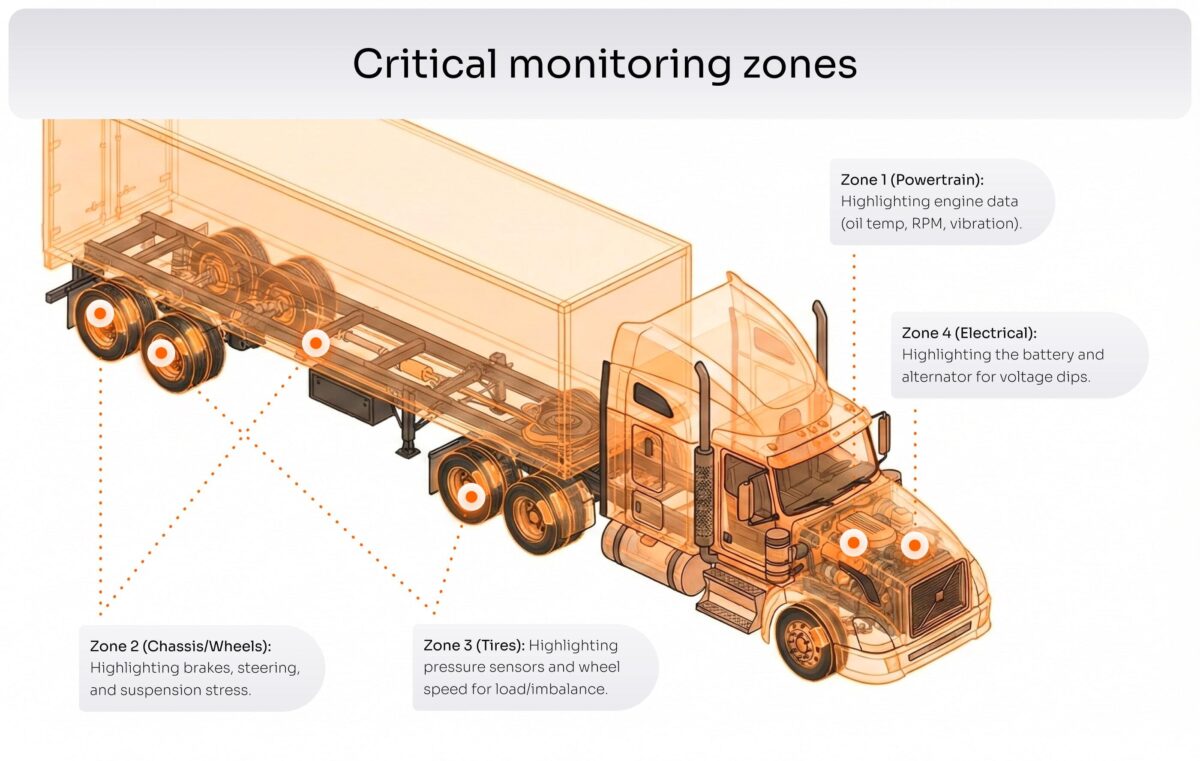
Engine breakdowns create the most expensive downtime in fleet operations. One failed engine can take a vehicle off the road for days and trigger secondary costs as a consequence. Predictive maintenance reduces that risk by detecting early signs of engine stress long before drivers notice performance issues or warning lights.
Sensors track how the engine behaves under real operating conditions and compare that behavior to its normal performance pattern. When the system detects drift that usually precedes issues such as lubrication problems, injector faults, or overheating, the maintenance team receives advance notice. Instead of reacting to power loss or roadside failure, they schedule inspections or targeted part replacement before damage escalates into a major repair.
2. Brake, steering, and suspension safety monitoring
Failures in braking, steering, or suspension systems carry direct safety and legal risks for fleet operators. Even minor deterioration in these systems can increase stopping distance, reduce vehicle control, and trigger compliance issues during inspections. Predictive maintenance helps fleets act before these risks turn into incidents.
Instead of relying only on mileage-based checks, the system monitors how these components behave during everyday driving. It tracks how braking heat builds up, how hydraulic pressure responds, and how vehicle load shifts across axles. When those patterns begin to change in ways that usually precede safety issues, maintenance teams receive early warnings. They focus inspections on the vehicles that actually show risk, not on every unit in the fleet. As a result, fleets reduce accident exposure and avoid pulling safe vehicles into the workshop unnecessarily.
3. Tire wear, pressure imbalance, and load-related stress
Tire-related incidents remain one of the most frequent causes of unplanned roadside stops in commercial fleets. Even a minor failure can disrupt delivery schedules and create safety risks.
Predictive maintenance systems monitors how tire condition evolves during real operation and catches early warning signs such as gradual pressure loss or abnormal heat buildup. When this data is linked to how the vehicle is loaded and where it operates, the systems reveal which units face growing failure risk. Maintenance teams intervene before damage occurs by correcting pressure, for example. If they need to replace tires, the system shows which ones are affected. If the issue comes from uneven load distribution, planners adjust loading practices based on calculated stress patterns observed during real operation.
4. Battery and electrical system reliability
Battery and electrical issues usually show up through borderline behavior rather than immediate failure. Vehicles usually show early warning signs such as slower starts or unstable charging. Predictive maintenance follows these changes over time and detects when systems start to deviate from normal performance.
When the system detects a steady decline in battery or alternator performance, it flags the vehicle for inspection or planned replacement. Fleet teams prepare the repair in advance and avoid no-start incidents. At the same time, batteries that still perform well stay in service longer instead of being replaced too early.
5. Fleet-wide insights and predictive scheduling
The real advantage of predictive maintenance appears at the fleet level, when condition data from all vehicles comes together in one place. Fleet management predictive maintenance software ranks vehicles by risk and estimated time to failure for key components. Planners see which units can stay in service, which should be brought in during the next low-demand window, and which require attention as soon as possible.
This real-time fleet diagnostics allows workshops to align parts availability and technician schedules based on current maintenance needs. Planners then adjust vehicle routing according to the actual condition and availability of each unit. As a result, trucks are no longer pulled from service unpredictably, and maintenance work happens during shorter, planned visits.
How predictive maintenance systems work in commercial fleets
Connected vehicle predictive maintenance systems turn the raw sensor data into decisions about when and how to service the equipment. The process usually follows these five steps.
1. Data generation inside the vehicle
Sensors, ECUs, and telematics units continuously monitor how the vehicle behaves on the road and how its mechanical and electrical systems respond to real operating conditions. The vehicle streams this data to a backend or cloud platform, where the predictive vehicle maintenance system analyzes it to detect early signs of wear.
2. Data processing and normalization
The platform filters noisy data, aligns readings from different sources, and builds a baseline of normal behaviour for each vehicle or component. Once that reference point is established, the system can spot gradual shifts or behavioral anomalies that may turn into a failure if ignored.
3. Failure prediction and remaining useful life
Analytics models interpret these behavioral shifts to estimate how likely a component is to fail and how soon. Instead of issuing a generic fault code that says something has gone wrong, the system tells fleet teams which part is drifting away from normal performance and how much useful life it has left. That information gives planners enough lead time to react before the issue turns into a breakdown.
4. Alerts and maintenance recommendations
The system converts risk insights into instructions for the people who plan and perform maintenance. Alerts show where the issue is occurring on the vehicle and present it with a clear priority level and recommended action. Each alert specifies which component is at risk and when it should be serviced.
5. Planning and maintenance execution
Dispatchers and maintenance planners use these alerts to decide when to pull a vehicle off the road and how to align that downtime with existing route planning. They schedule repairs before problems escalate, while vehicles that remain in good condition continue operating without disruption. Such an approach helps fleets to avoid both premature servicing and unplanned breakdowns.
Advanced technologies behind fleet predictive maintenance solutions
Each step of the predictive maintenance workflow relies on specific technology layers. These layers support condition monitoring, real-time data transmission, risk modeling, and maintenance planning. Together, they form the technical foundation of fleet-wide predictive maintenance.
Hardware and sensor layer
Modern fleets generate data directly from the vehicle’s embedded systems and onboard electronics. ECUs, CAN bus, OBD-II interfaces, and GPS modules capture parameters related to vehicle health and operating behavior.
Extended sensing devices capture additional context that influences component wear and safety:
- LiDAR and radar (road and object detection);
- Tire pressure and load sensors (stress and imbalance);
- Cameras and video modules (driver actions, road conditions).
Together, these hardware sources provide the real-world operating data that predictive maintenance and driver monitoring models rely on.
Connectivity and telematics infrastructure
Telematics control units (TCUs) and IoT gateways collect sensor data from across the vehicle and send it to the cloud. They maintain reliable links through 4G/5G, satellite, or eSIM-based channels, depending on where the fleet operates. These devices also manage security functions such as authentication and encrypted communication to ensure that data remains intact.
Support for protocols like MQTT, REST, or WebSocket allows the system to deliver high-frequency data without losing packets or creating delays. Consistent telemetry is essential since predictive models need uninterrupted signals to recognize gradual deterioration and avoid blind spots in component health tracking.
Cloud and backend architecture
The cloud layer runs the predictive maintenance engine and stores the historical data used for modeling. It hosts services responsible for data ingestion, processing, storage, and visualization. Many modern platforms rely on a modular or microservice-based design to scale across thousands of vehicles without degrading performance.
This backend environment often includes a digital shadow for each vehicle. Digital shadow is used to reflect the current condition of each vehicle and make sensor data accessible to modeling and visualization tools.
Analytics and predictive modeling
Once processed, the data moves to analytics engines that evaluate component behavior. ML models detect patterns that point to early wear, inefficient operation, or abnormal behavior. They estimate how quickly deterioration is progressing and calculate remaining useful life for key components.
Digital twin models add another layer of precision. They simulate how a component may deteriorate under the influence of different environmental factors and workloads, making remaining useful life estimates more accurate.
Visualization and decision support
Insights become actionable only when they are presented in a way that teams can use. Dashboards combine outputs from each system to show clear maintenance priorities. They display condition scores and estimated failure timelines to help managers evaluate risk instantly.
Technicians and planners receive role-specific views: component-level diagnostics for workshop teams, risk-ranked vehicle lists for dispatchers, and long-term performance trends for operations managers. This alignment ensures that predictive insights translate into concrete maintenance decisions.
Our experience with fleet predictive maintenance solutions
Our client was a US-based B2B logistics company that sold GPS tracking devices but depended on a third-party telematics platform to monitor vehicles. They had no control over the software, and therefore, could not expand features such as predictive maintenance or real-time analytics. Such situation led to growing per-vehicle costs every time the fleet scaled. To replace the third-party product with its own solution, the company partnered with Yalantis.
Our team developed a custom AIoT fleet management platform on AWS using a scalable microservice architecture. We integrated it with the client’s existing telematics hardware, allowing it to collect, process, and visualize real-time vehicle data. The solution enabled features such as predictive maintenance alerts, delivery forecasting, and driver performance monitoring. The client’s personnel now can view the data through role-based dashboards.
The custom fleet management platform helped the client:
- reduce cost per connected vehicle by approximately 30%;
- cut mapping and video streaming expenses nearly tenfold;
- eliminate dependency on third-party telematics software and related license fees;
- scale to thousands of vehicles without additional per-unit costs;
- gain full control over platform features, including predictive maintenance, driver analytics, and maintenance scheduling.
These improvements granted the client full ownership of both hardware and software and laid the foundation for predictive maintenance capabilities across the fleet.
Conclusion
Predictive maintenance shifts fleet upkeep from fixed schedules to condition-based decisions. Vehicles send real-time data on component health, and analytics tools monitor it to spot early signs of wear. When the system flags a real risk, maintenance teams act exactly when it’s needed—not too soon, not too late. As a result, fleets avoid unnecessary workshop visits and keep vehicles available when operations depend on them most.
To achieve real efficiency and keep predictive maintenance systems working in practice, companies need a partner with a full set of capabilities:
- IoT, embedded engineering;
- Cloud architecture;
- Analytics;
- Compliance;
- System integration.
Yalantis brings over 15 years of experience, a team of more than 500 engineers, and deep expertise in connected fleet solutions, including data pipelines, telematics integration, and predictive maintenance platforms. We build systems that transform vehicle performance data into clear maintenance decisions that improve uptime and reduce cost per mile.
Are you ready to increase fleet uptime?
FAQ
How does a predictive vehicle maintenance system work in practice?
It collects live data from vehicle sensors, ECUs, and telematics units, such as temperature, pressure, vibration, voltage, and load. Predictive analytics models monitor changes in these indicators and identify when a component begins to deviate from normal behavior. When failure risk increases, the system sends alerts with recommended service timing, helping fleet managers schedule maintenance before breakdowns occur.
What types of problems can predictive maintenance prevent?
It helps prevent failures in engines, brakes, tires, steering, batteries, air suspension, fuel injectors, cooling systems, and electrical components. It also detects early signs of stress, underperformance, fluid degradation, and abnormal wear caused by load, driving style, or road conditions. That means fewer roadside breakdowns, safer vehicles, and optimized replacement of parts.
How is predictive maintenance software for fleets different from traditional maintenance?
Traditional maintenance relies on fixed schedules, mileage, or workshop inspections. Predictive maintenance uses real-time vehicle data and failure modelling to decide when service is actually needed. It doesn’t replace parts too early or too late. As a result, fleets reduce unnecessary servicing, avoid unexpected failures, and plan maintenance with more accuracy.
How long does it take to implement predictive fleet maintenance software?
The timeline depends on fleet size, vehicle connectivity, and integration needs. A small pilot project can be launched in 2-3 months, including data collection setup, modeling, and basic dashboards. Full deployment across a fleet with custom analytics, integrations, and automated workflows typically takes 4-8 months.
What data is collected for fleet monitoring and predictive analytics?
Predictive systems gather data related to component health and vehicle behavior, including oil pressure, engine temperature, fuel usage, vibration levels, battery voltage, tire pressure, brake wear, shock loads, GPS location, and driving patterns. Some solutions also use fault codes, emissions, sensor logs, and historical inspection data to improve prediction accuracy.