

Here’s what our teams often hear during early conversations with clients:
“Our patient app has amazing engagement numbers.”
Great. Now ask the CFO if those numbers translate to revenue. Or, try to ask the Chief Medical Officer if they’d stake their license on it.
The silence that follows? That’s actually the sound of a wellness app hitting a ceiling it didn’t know existed.
By 2026, in most major markets, the moment your product clearly influences care decisions, you’re very likely in regulated medical device territory. The truth is we’ve seen problems with that repeatedly. A team builds something useful and gets real traction with users. Then they approach their first health system buyer. The questions come fast: Can you show clinical validation? What’s your regulatory status? Does this connect to our EHR?
And most teams weren’t planning for any of that. They built an app, not a medical device. And rewiring everything after the fact takes months.
When you build for SaMD from the start, procurement already has what they need. Payers can reimburse you through CPT codes (in the U.S.) or public programs like DiGA in Germany and PECAN in France. Your users generate revenue.
In this article we’ll show you how to get there, based on what we’ve learned working with teams who’ve already made the jump. Time to break it down.
So what counts as “mHealth” in 2026?
That depends on who’s asking. But if it’s a regulator, a hospital, or a payer, then the line is clear. What matters isn’t how the software looks or what it promises. It’s more about how it functions and whether it affects clinical outcomes.
Here’s how they draw the line:
|
Type |
What It Does |
Regulated? |
|
Patient engagement app |
Reminds, nudges, messages |
No |
|
mHealth app |
Captures health data |
Sometimes |
|
SaMD |
Supports diagnosis, adjusts care |
Yes |
If your app influences care decisions, even indirectly, you’re in SaMD territory. That means more scrutiny, but it also opens doors to serious business upside: reimbursement, clinical trials, and strategic value as a medical-grade digital product.
Why ‘just an app’ is no longer enough
If your software helps monitor patients, detect deterioration, or guide care decisions, it’s no longer in “wellness” territory. It’s now regulated software (and yes, it’s subject to validation, documentation, and audit trails, even if you’re still calling it an MVP).
In other words, this isn’t just an app anymore. It’s a medical device, and that changes everything.
|
💡 Good to know |
What it takes to meet the 2026 standard
By 2026, it’ll be very hard for any health system or payer to adopt software that can’t prove measurable outcomes.
In other words, if your product doesn’t meet clinical-grade standards, it won’t survive procurement. Not with regulators, not with insurers, and not with health systems looking to close care gaps and reduce risk!
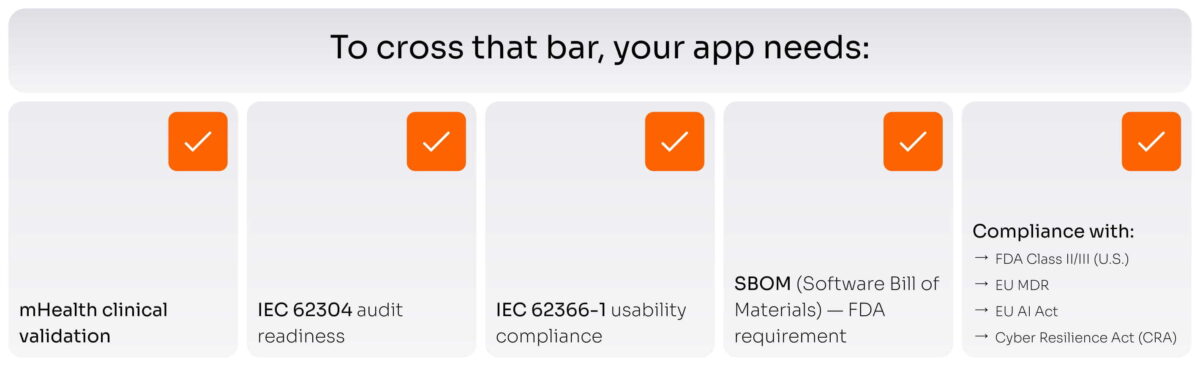
Which of these apply depends on your intended use, risk class, and target markets, but this is the direction regulators are clearly heading.
What’s changed technically?
Legacy patient engagement apps → sent data to the cloud and hoped for the best.
Modern mHealth solutions → embed intelligence directly on the device.
By 2026, this shift is the new normal:
- Edge AI enables faster, safer, HIPAA-compliant decisions by processing data directly on the device.
*It also keeps data private, as it never leaves the device). - Digital Twins go beyond monitoring as they model the patient’s condition to forecast deterioration or treatment response.
- Synthetic data accelerates validation without waiting months for real-world data access
- Modular architecture isolates the medical logic from the UI, so you can redesign the interface without re-certifying your codebase.
- Explainable AI (XAI) ensures your algorithms are transparent.
*In 2026, regulators will require that clinical predictions can be explained, because black boxes won’t pass.
Where mHealth proves its clinical worth
Now, let’s talk about where mHealth actually delivers clinical and business value, and what makes those use cases work.
We’ll start with something familiar.

If your app collects vitals and flags when something’s off, it’s already involved in clinical decisions. That’s not just a wellness tracker anymore.
What we’ve seen is that monitoring becomes valuable when it helps providers catch problems early. That leads to fewer hospitalizations and better-managed chronic conditions. It also gives the product a reason to be taken seriously by care teams, and to be integrated into their workflows as well.
But that shift also means higher expectations. Providers will want to know how your alert logic works. They’ll expect quick response times, especially if something needs attention right away. And you’ll need to show how the product protects patient data.
Showing numbers isn’t enough. If your app helps someone take action, it has to work like part of the care team (not just look like one).
That same idea applies when you’re guiding care decisions, even if no one’s calling it that yet.
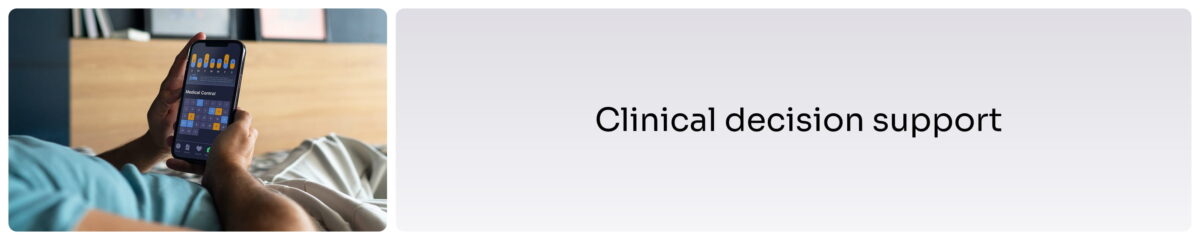
Some might say: “It just helps clinicians focus.” But even that has an impact. If your product highlights what to review, flags risks, or shapes what happens next, then it’s playing a clinical role.
These tools help when they make decisions clearer, not harder. But they only work if users trust what they’re seeing. That means your logic can’t be hidden. Instead, it needs to make sense to someone using it under pressure.
It also needs to be proven in the kind of environment where it’ll actually be used.
If providers can’t understand or explain how it works, they won’t use it. If they can, it becomes part of the way they work.
And that’s a different kind of trust, one that matters even more when your product becomes part of the treatment itself.
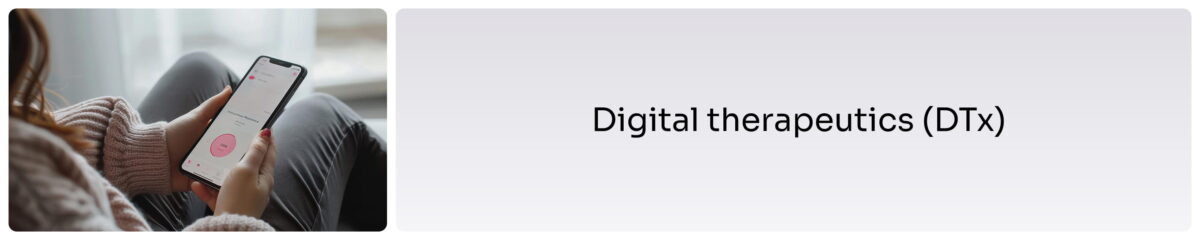
Some apps go further than support. They help people sleep better, manage anxiety, stick with rehab. In those cases, you’re delivering care.
If the product is improving health, it needs to be treated that way. That means showing that it works, clearly stating what it’s trying to achieve, and making it possible for providers to track those results.
When that’s in place, DTx apps become eligible for reimbursement, which changes the whole conversation around scaling.
If an app is expected to deliver outcomes, it needs to prove it. That’s what moves it from support tool to treatment option.
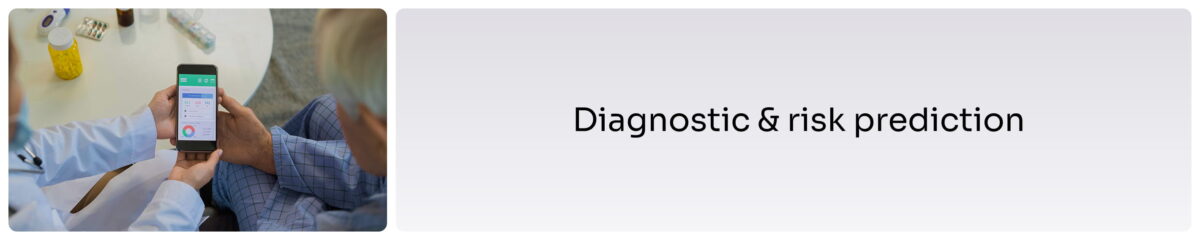
There’s a lot of excitement around AI in healthcare, but here’s the part that gets missed: if your tool predicts risk, flags potential conditions, or helps narrow down a diagnosis (even partially), it’s already part of the diagnostic process.
And once you’re there, the standards change.
Prediction is only helpful if people can trust it. That means your tool needs to be tested the same way any diagnostic system would be, with performance data that reflects real-world use.
It also has to be understandable. If the person using it can’t explain why the system flagged something, they probably won’t use it, or worse, they’ll ignore it when it matters.
If your product offers medical insight, it has to be held to the same standard as medical judgment. Anything less puts your users, and your product, at risk.
And even after a diagnosis is made, digital tools still have a role to play. Especially when patients leave the hospital and care moves to the home.
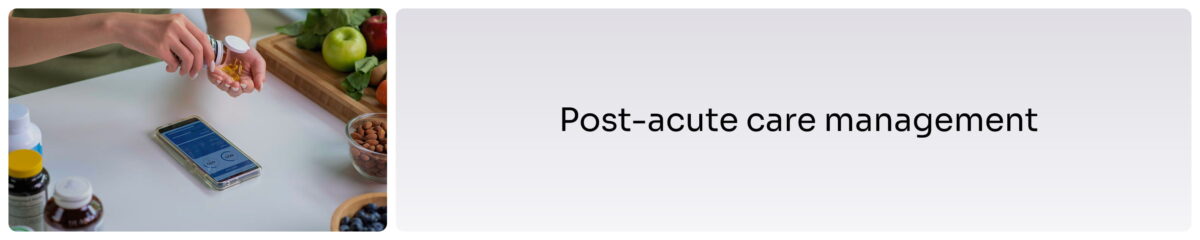
This is where many health systems lose visibility. Once a patient is discharged, it’s hard to know if they’re following care plans, taking meds, or heading toward a setback.
mHealth apps can help by supporting recovery in a way that’s proactive and timely. But to do that well, the product can’t just check off to-dos or send reminders. It needs to understand patient behavior and flag concerns before they turn into readmissions.
If your app is guiding post-op rehab, managing recovery milestones, or escalating based on real signals, then it’s already supporting care, not just engagement.
And if insurers or providers are going to rely on it, they’ll want proof that it works, and fits within the systems they already use.
Care doesn’t stop at discharge. If your product can keep patients on track and give providers real signals when something’s going wrong, it becomes part of the care model.
Looking to go to market 2x faster?
Why patient engagement apps fail without a solid mHealth strategy
If you’re still weighing the value of SaMD, here’s another reason to take it seriously. The majority of patient engagement apps don’t fail because of poor design, instead they usually fail because they lack a strategic foundation.
When there’s no plan to meet clinical, regulatory, and adoption standards, even promising tools lose momentum.
Here’s what we see time and again:
❌ Lack of clinical validation keeps the product out of regulated care settings
❌ Weak medical positioning leads to low patient adherence and limited trust
❌ Absence of measurable outcomes makes it difficult to prove value or secure funding
❌ Security oversights create friction with HIPAA and GDPR compliance
❌ The product remains stuck in the “wellness” category and never becomes a true medical solution
However, there is a solution! With the right mHealth strategy, each of these barriers can be addressed early. And more importantly, they can be turned into advantages. Below, we listed the most important ones.
Time to shift from app to SaMD?
The business and clinical benefits of building SaMD instead of “just an app”
Here’s what building SaMD unlocks for your business, your buyers, and your product’s long-term future:
Access to reimbursement & provider procurement
Let’s start with the most practical one: getting paid.
Payers won’t reimburse features. But they will reimburse products that show clinical outcomes. When your app is built and positioned as SaMD, it fits into billing frameworks. That makes it easier for insurers to cover and easier for hospitals to procure. You’re not asking for a budget exception. You’re offering a treatment pathway.
Stronger market differentiation & regulatory moat
Now let’s talk about positioning. In a crowded market, lookalike apps are everywhere. But few can back their claims with clinical validation.
When your product meets SaMD standards, you’re no longer competing on UI or features. You’re competing on substance. And that makes it harder to copy because the differentiation isn’t visual, but structural.
Higher trust from clinicians, partners & regulators
Buyers want something they can trust in the real world.
That trust comes from showing your logic, your data, and your process. SaMD does exactly that. It gives clinical teams confidence, shows partners you’re serious, and makes regulator conversations far more straightforward.
Long-term defensibility vs. feature apps
Last but not least, staying power.
Most apps fade because they’re easy to replace. But once your product supports care, fits into workflows, and meets clinical standards, it’s much harder to displace. That kind of staying power is what turns software into real infrastructure.
The 8-step roadmap to turning a patient engagement app into a clinically validated SaMD
At Yalantis, we’ve worked with enough digital health teams to see what works, and what stalls. Over time, we shaped a clear roadmap for turning engagement apps into regulated, clinically ready products. Here’s the step-by-step approach we recommend.

Before anything else, you need to be clear on what the product does clinically. Are you monitoring vitals? Guiding recovery? Supporting decision-making? Once that’s defined, we classify the risk. This helps determine how tightly regulated the product will be, and what level of evidence and documentation you’ll need later. We typically use ISO 14971-based risk analysis to keep the clinical and regulatory picture aligned.

From there, we look at your target markets. Are you aiming for FDA clearance, CE marking, or both? Based on that, we identify exactly what your product needs to demonstrate, and what types of studies or technical files must be in place before submission.

This step often gets overlooked, but it’s critical. You’ll need a plan for what data you’re collecting, how you’ll ensure its quality, and how the system will integrate with clinical records. If the product includes any algorithmic logic, we’ll also need to consider explainability, safety, and real-world accuracy from day one.

Here, we map out how you’ll prove your product actually works. It doesn’t always mean a full trial, but it does mean measurable outcomes. These results will be important not just for regulators, but for payers and clinical buyers who will want to see impact before adopting or reimbursing the solution.
|
💡 Pro tip |

Once we have a prototype, we test it with clinicians. Not as a final product, but as something in motion. This creates a feedback loop that helps you refine usability, surface edge cases, and catch issues that internal teams often miss. It’s one of the fastest ways to de-risk your build.

As feedback stabilizes and the product gets closer to launch, we move into formal validation. That includes clinical validation, usability testing (especially under IEC 62366-1), and producing the documentation required for approval. This part takes time, but it pays off in the next step.
|
💡 Good to know |

Now we move into submission to the FDA, CE, or both. If the earlier steps were done right, this stage is predictable. There may still be questions or back-and-forth, but having clean documentation and traceable logic will significantly speed things up.

Finally, once the product is live, post-market surveillance becomes essential. It’s a practical way to track performance, catch rare issues, and stay compliant over time. Plus, it also strengthens your position for future updates or expanded indications.
4 key features of clinically validated mHealth (SaMD) apps
These are the features we believe every serious SaMD product should build around.
- Remote monitoring & real-time data collection. This feature is more about how the app handles data. If it’s collecting vitals or symptoms, that data has to be steady and come in on time. Processing it directly on the device can help with speed and keep sensitive data more secure. It’s also a practical way to meet compliance requirements like IEC 62304, which are expected at this level.
- Clinical decision support components. Next, if the app highlights risk or suggests next steps, the reasoning behind that needs to be clear. It should be easy for care teams to understand why something was flagged, and for regulators to review the process if needed. Keeping those records in place is about making the product safe to use in real decisions.
- AI-based patient adherence tools. The truth is staying on track with treatment isn’t always easy. That’s why the app should gently support patients along the way. Timely reminders, check-ins when someone misses a step, or nudges based on behavior can help people stay engaged. These tools should feel helpful, not pushy. They also should be designed in a way that’s safe and easy to explain.
- Integration into clinical workflow. Lastly, everything needs to fit into how care is already delivered. That includes connecting to the EHR using FHIR, but also making sure alerts go to the right person, records update smoothly, and the app doesn’t get in the way. When the product supports the flow of care instead of disrupting it, adoption becomes much more natural.
Our experience with mHealth and SaMD solutions
One of our clients, a U.S.-based pharmacy network, needed a safer, faster way to calculate and prescribe medication dosages for patients with chronic conditions. Their manual process was slow, error-prone, and difficult to scale. It also lacked the clinical credibility needed to enter regulated markets.
The problem:
Pharmacists were relying on disconnected systems to calculate dosages. They had to log into PDMP portals manually and double-check prescriptions across multiple platforms. This fragmented approach introduced risk, drained time, and made compliance nearly impossible. The process simply couldn’t keep up with the company’s growth or regulatory goals.
What Yalantis did:
- Built a HIPAA-compliant SaMD product for automated dosage calculations
- Integrated with multiple EHR systems using Redox API for complete patient data access (that’s a scalable approach designed to support rapid rollout across diverse hospital networks)
- Connected to PDMPs for instant drug history and Narx Score calculations
- Created a focused, clinical-grade UI for pharmacists to work with confidence
- Prepared all documentation for FDA clearance and supported the client through the process
What the client achieved:
- 30% faster patient processing by reducing manual work
- 10 minutes saved per prescription through automated PDMP checks
- FDA clearance that enabled go-to-market confidence and compliance
“The way prescriptions were handled just wasn’t working well. It took too much manual effort and left too much room for error. We helped simplify the process so pharmacists could focus on their patients instead of paperwork.”
– Mykhailo Maidan, CTO at Yalantis

Why choose Yalantis for your mHealth strategy
So, what turns an app into a certified medical product? Not a feature. A strategy. SaMD success depends on how you plan, structure, and validate your solution from the beginning. Without that foundation, even solid ideas struggle. But with it, your product can meet clinical expectations and open the door to market access.
If you’re working toward that goal, Yalantis is here to support you. We help teams shape the right use case, navigate compliance, and build solutions that are ready for real-world care. Wherever you are in the process, we’ll help you move forward with clarity and confidence. Let’s make it happen.
Building something clinical? Make sure it’s covered.
Request your SaMD regulatory & technical gap analysis today.
FAQ
What’s the difference between ISO 13485 and FDA 21 CFR Part 820?
ISO 13485 is the global standard (used in the EU and many other markets), while FDA 21 CFR Part 820 is the U.S. version. Both cover how you manage quality and safety in medical device development, but if you’re going global, you’ll probably need to comply with both.
How do SBOM and VEX help pass audits in 2026?
SBOM (Software Bill of Materials) lists every software component in your app, so auditors know exactly what’s inside. VEX (Vulnerability Exploitability eXchange) adds context by showing which vulnerabilit
How much does EHR integration cost?
It depends on the complexity. A basic FHIR integration might start at $25K–50K, but if you’re working with multiple hospital systems or older EHRs, costs can climb fast—sometimes to $200K+.
What is the typical EHR integration timeline?
For a well-scoped project using SMART on FHIR, you might be looking at 8–12 weeks. But if you’re dealing with legacy systems or multiple hospital networks, it can take 4–6 months or longer.