
You can see AI everywhere. From ECG readings on your smartwatch to algorithms that help doctors detect lung nodules, artificial intelligence and machine learning are transforming modern medical devices.
But here’s the truth. The same technology that drives innovation also introduces new layers of regulation.
When you integrate AI/ML into a medical device, you also have to make sure it checks every regulatory box and earns the trust of clinicians who rely on it. And that’s often the harder part. Because the moment your algorithm influences a diagnosis or adjusts a dose, it’s treated as regulated software. For you, that shift brings new responsibilities.
You need accuracy and transparency. And you need a clear, documented process that aligns with FDA and ISO expectations.
And this is usually where teams run into trouble.
Here’s what we’ll cover:
- What AI/ML integration actually means for regulated medical devices
- Which FDA and ISO rules apply to your AI algorithms
- A step-by-step process for building audit-ready software
- Post-launch tips to stay compliant
- Plus: free PDF guide to ISO 13485 & FDA compliance
- …and more insights to help you stay ahead
What does “integrating AI/ML into a regulated medical device” mean?
AI integration means taking responsibility for how your model performs in real clinical settings. Not every AI feature in healthcare is automatically a medical device as it depends on the intended use. But once your model starts influencing diagnosis, treatment, monitoring, or prevention, it falls under medical device rules. If your algorithm influences clinical outcomes, it becomes part of a regulated system.
In practice, that system often extends beyond a single device and includes connected software, cloud services, or clinical platforms that together influence clinical decisions.
In other words, you move from building a smart tool to building regulated software.
FDA and ISO frameworks for regulated AI/ML devices
Now, let’s talk about the rules. Because no matter how advanced your algorithm is, it won’t make it to market without clearing some high bars.
If your product qualifies as an AI/ML-enabled medical device, then the FDA and ISO already have expectations for how you develop, test, document, and maintain it. These elements form the foundation of AI compliance requirements. That’s why they should guide your AI software development process from day one.
Here’s what’s on the radar.
FDA’s guidance for AI/ML in medical devices
The FDA approaches AI as a potential risk that needs to be controlled rather than a technological advantage. Over the past few years, the agency has published a focused AI/ML Action Plan for healthcare technologies. It emphasizes the need for transparency, repeatability, and a solid documentation trail. One of its core pillars is Good Machine Learning Practice (GMLP) — a framework that outlines best practices for developing and validating machine learning models in medical software.
ISO and IEC: The technical foundations
The ISO sets the stage for how regulated software should be built and maintained.
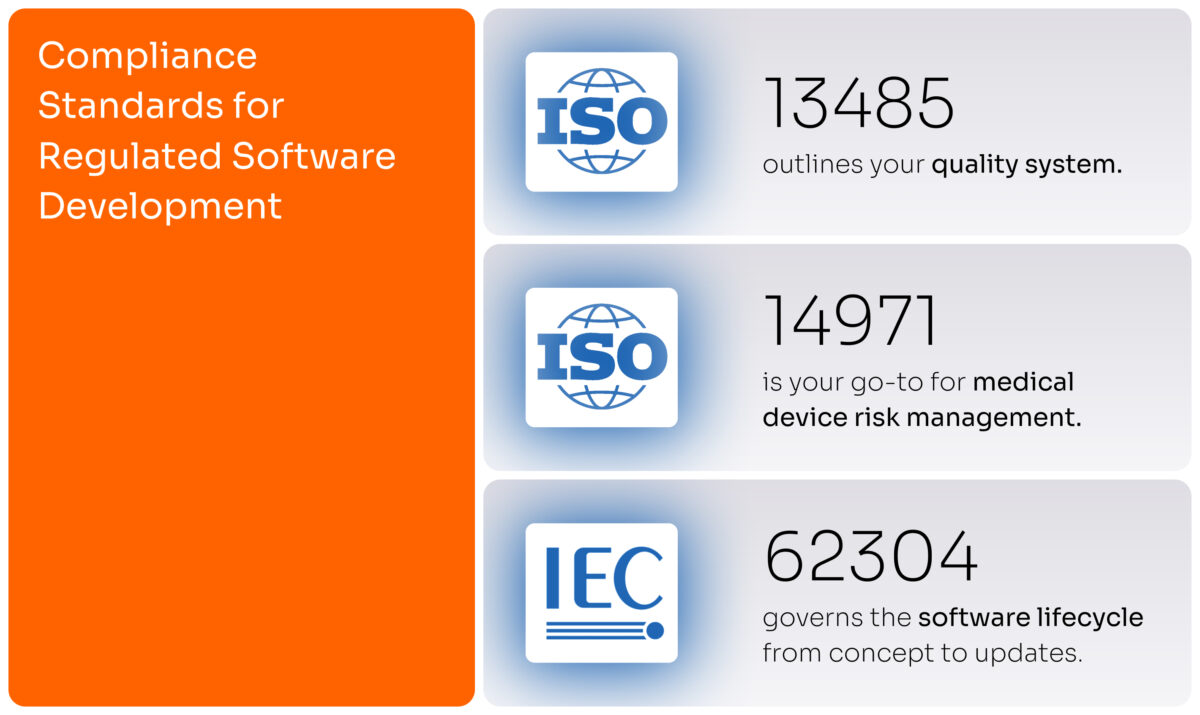
Together, these standards shape how you manage everything from cybersecurity to software traceability. And while none of them say “AI” directly, they absolutely apply to AI/ML-enabled devices, including cases where AI is delivered as part of a broader medical system rather than a standalone device.
Why? Because regulators don’t care what tech you use. Instead, they care whether it’s safe, documented, and auditable.
Why AI makes risk management harder
Risk isn’t static when you’re working with machine learning models. Performance might change, and data inputs could shift too. What’s more, clinician expectations may vary.
The more adaptive your system is, the harder it is to prove it’s still safe.
This step trips up a lot of teams. They complete risk documentation because they have to, not because it informs real design decisions. In practice, this means your ISO 14971 risk file can’t be a static PDF, It needs to evolve with every significant model update and real-world performance signal.
4 Key challenges in AI/ML integration for medical devices
Integrating AI sounds exciting, until you get into the details.
Here’s what usually slows you down, and what you’ll need to get right before thinking about submissions or scale.
| 4 Key challenges of AI/ML in medical devices | |
|
Challenge |
What to watch for |
|
Data quality |
Incomplete or biased datasets. Missing representation leads to flawed model performance. |
|
Algorithm transparency |
Lack of explainability. Clinicians and regulators need to understand how the model reaches decisions. |
|
Model updates |
No clear strategy for updates. Changes must be documented, revalidated, and traceable. |
|
Validation & compliance |
Weak clinical validation or poor documentation. Regulatory compliance depends on proof and rigor. |
Challenge #1: Data quality and representativeness
AI starts with data. If your training set doesn’t reflect the diversity of real-world patients, your model will struggle in practice. Worse, it could mislead.
Data bias is a top reason why otherwise promising AI tools fail in clinical settings. Underrepresentation of specific age groups, genders, or comorbidities can lead to inconsistent results and impact clinical validation.
Challenge #2: Algorithm transparency and explainability
Regulators don’t like black boxes, and neither do doctors.
If your model makes a recommendation, clinicians need to understand where it came from. Without model transparency, trust breaks down. And so does your approval timeline.
This doesn’t mean your algorithm has to be simple. But you do need a way to explain what it does, even if it’s a complex neural network.
Challenge #3: Continuous learning and model updates
The truth is AI models don’t always stay the same. Some evolve with new data. And when that happens, the original validation might no longer apply.
The FDA is still shaping policies around adaptive algorithms. But right now, if your model changes, you’re expected to test it again and show clear records of what was done.
This applies whether the learning is continuous or triggered manually by the developer. From a quality system view, every meaningful model update should follow the same disciplined change control process as any traditional software update. That means doing an impact analysis, reviewing risks, creating a regression plan, and clearly documenting whether to move forward or not.
Challenge #4: Validation, verification, and clinical evidence
A lot of teams think technical accuracy will get them through. But that’s rarely enough.
AI/ML validation for medical devices needs clinical relevance too. Regulators expect to see both algorithm performance (like sensitivity or AUC) and proof that it works in the clinical setting where it will be used.
That means clinical testing, usability studies, and evidence that your AI supports better outcomes (or at least does no harm).
And all of this has to be part of your broader regulatory compliance plan. If it’s not documented, it didn’t happen. If it’s not reproducible, it doesn’t count.
5 Steps to successfully integrate AI/ML into a regulated medical device
Now, let’s walk through a practical guide that combines both technical execution and regulatory requirements for AI medical devices.
It shows the actual AI/ML lifecycle you’ll need to follow to build safe, compliant, and effective AI/ML-enabled medical devices.
Step 1. Define intended use and risk level
Start with clarity. What will your model do? Diagnose, detect, prioritize, or guide treatment?
Define the intended use upfront. Then assess the risk level based on how the model impacts clinical decisions. This risk-based approach determines your regulatory pathway and evidence needs.
Step 2. Collect and curate high-quality data
You can’t build a trustworthy algorithm without reliable data.
Make sure your dataset represents your end users and clinical context. Include diverse populations, multiple devices, and data sources when needed. Pay attention to annotation quality. It’s the foundation your model learns from.
Step 3. Train and validate models according to GMLP
At this stage, your AI becomes SaMD.
Follow Good Machine Learning Practices (GMLP) when training your model. Split your data properly. Prevent data leakage. And use a validation process that includes both technical performance and clinical relevance.
Checklist:
- Train-test split documented?
- Performance metrics meaningful to clinicians?
- Model locked before clinical testing?
Step 4. Document the development lifecycle (per IEC 62304)
AI/ML is software, and like any software used in medical devices, it needs documentation.
This means you’ll need traceability from requirements to code, version control, risk analysis, and test evidence. The gold standard here is IEC 62304. Start documenting early, so you’re not scrambling to catch up later.
Step 5. Prepare regulatory submissions and evidence packages
Your algorithm might be excellent. But without a solid evidence package, it’s not getting approved.
You’ll need to demonstrate how you followed a risk-based approach across the entire AI/ML lifecycle. That includes your intended use, clinical validation, GMLP adherence, and post-market plans.
Organize your evidence around FDA or MDR requirements, depending on your market.
3 Main applications and case examples
AI/ML isn’t some far-off idea. It’s already built into regulated medical devices, from cardiac monitors to connected respiratory systems. Many manufacturers are using it to support clinical decisions or spot problems early.
Let’s look at how top manufacturers are putting it to work.
1. Imaging AI that supports diagnostics
Some AI tools are now used to flag signs of conditions like lung nodules or fractures in medical scans. They don’t replace radiologists, but they help catch things that might be missed. To stay dependable, these systems rely on a well-defined software maintenance process that keeps them accurate as new data comes in.
2. Predictive analytics for chronic disease
Many connected devices now include models that try to spot when a patient’s health might take a turn. For example, early signs of heart failure or a diabetes complication. But making a prediction isn’t enough. You need a clear problem resolution process. That includes how you handle false alerts, what actions are taken, and how all of it gets recorded for review.
3. Clinical Decision Support Systems (CDSS)
Some software now supports real decisions, like adjusting a dose or flagging a patient for follow-up. For Class II/III devices, this comes with more responsibility. You need to explain how the software makes decisions. Any changes must be tracked. And you’ll need to show that the system helps, without adding new risks.
Ensuring continuous compliance and post-market monitoring
Following the initial development and regulatory submission, your responsibilities don’t stop. The 5 steps we outlined earlier are essential to get your AI/ML-enabled medical device to market. But staying compliant requires just as much focus.
Once your device is in use, you need a clear plan for post-market surveillance. These systems don’t stay frozen in time as they can change as more data comes in. And when that happens, their behavior might shift too. That’s why monitoring model drift is a big deal. If it starts giving different results than expected, you need a way to catch that early and step in before it causes problems. That usually means a formal internal review, extra testing, and a clear decision on whether the change only needs internal approval or also triggers a new regulatory submission.
Sometimes, an AI model update is necessary. Maybe you’ve got new data, or performance isn’t what it used to be. That’s totally normal. But even small changes still need to go through continuous validation. You’ll have to check how the model is performing and make sure nothing new has slipped through the cracks.
And don’t forget to gather real-world clinical data. It gives you the kind of insights that not only guide updates, but also helps maintain FDA monitoring requirements and keep your problem resolution process sharp.
Our experience with AI-enabled medical device software
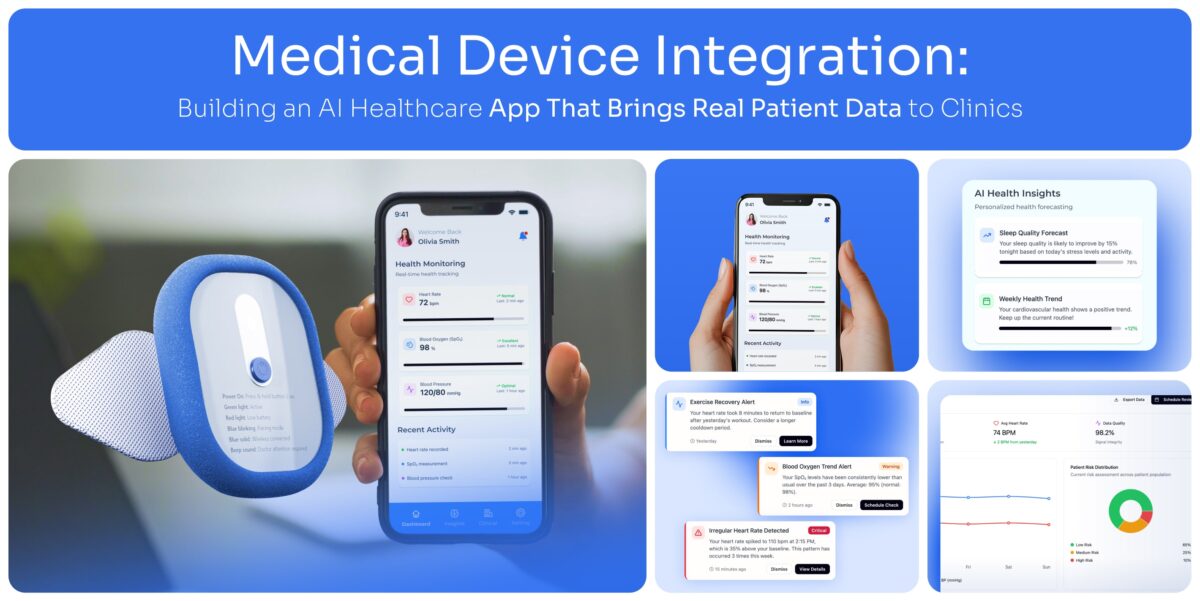
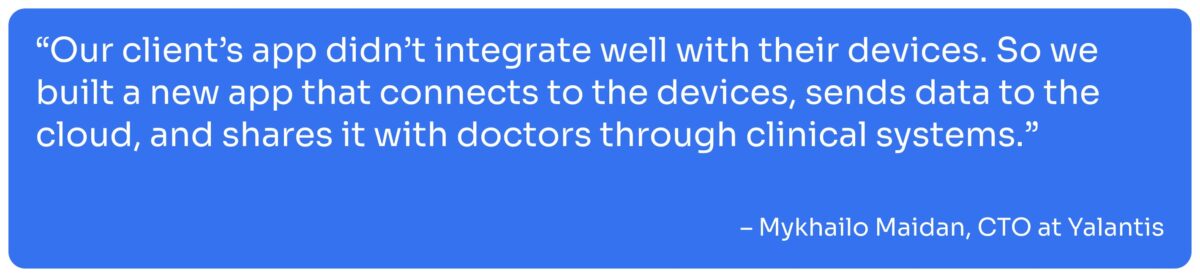
One of our clients, a U.S.-based medical device manufacturer, had already developed high-quality ECG and pulse oximeter trackers. But their existing mobile app wasn’t pulling its weight. It lacked integration with hospital systems, didn’t meet FDA or HIPAA standards, and failed to deliver insights doctors could act on.
The problem:
Patients were only seeing raw data. Doctors had no access to real-time health information. And the company couldn’t tap into new B2B channels because the app didn’t meet clinical or regulatory expectations.
What Yalantis did:
- Built a brand-new mobile app that is fully HIPAA and FDA compliant.
- Integrated a compliant ML model to detect health anomalies and provide predictive insights.
- Connected the app with major U.S. hospital EHRs using HL7 standards.
- Delivered real-time alerts and improved software maintenance processes to support ongoing compliance.
What the client achieved:
- 55% boost in patient engagement.
- 30% revenue growth through new B2B contracts with clinics.
- Solid increase in app usage.
This case shows how thoughtful development and medical device software compliance can turn artificial intelligence/machine learning in medical devices into something that works in real clinics.
Why partner with Yalantis for compliant AI/ML medical devices
If you’re building AI into a regulated medical device, one thing becomes clear fast: having a clever algorithm isn’t enough. What matters is how you build and manage it.
Even with a solid team and great tech, getting across the FDA or MDR finish line takes more than clean code. You need structure and airtight documentation. And you need a process that fits how real-world devices are built, updated, and used in clinical care.
And if your roadmap includes RPM, real-time analytics, or OTA updates? Then you’ll need partners who understand both the tech stack and the regulatory pressure that comes with it.
FAQ
What’s the difference between AI-enabled medical devices and traditional SaMD?
Traditional SaMD usually follows predictable logic, like rules, workflows, or standard calculations. AI-enabled medical devices are different. They involve learning systems that make predictions or decisions based on patterns in data. This adds complexity in development and validation. It also means regulators pay more attention to how the system was trained and how it behaves in real-world use.
How does the FDA regulate AI or ML-based medical devices?
The FDA treats AI or ML-based tools as medical devices when they impact diagnosis or treatment. That means they require approval. But there’s more to it. The FDA wants to see how you trained and validated your algorithm. And just as important, how you plan to control future changes. Transparency and repeatability are key. You need to prove your model works as expected every time.
What standards like ISO 14971 or IEC 62304 apply to AI or ML systems?
If you’re developing an AI-enabled medical device, these two are essential. ISO 14971 helps you manage risk. IEC 62304 gives you a clear process for documenting your software development. These are your baseline. Depending on your specific use case, other standards may apply too. It’s smart to map them early. That way, you stay ahead of regulatory expectations.