

Embedded and IoT devices operate in environments where every kilobyte of memory and every millisecond of response time matters. Yet most of them still rely on C or C++, languages powerful enough for low-level control but notorious for memory-safety flaws that can crash systems or expose them to security vulnerabilities. The issue is so widespread that around 70% of Microsoft’s and Google’s reported vulnerabilities stem from memory-safety issues. For connected devices running critical operations, such instability isn’t an option. However, a structured C++ to Rust migration addresses the root cause: it replaces unsafe memory handling with compile-time guarantees and predictable real-time performance.
Embedded environments leave little room for trial and error; therefore, experience and a clear roadmap make a big difference. For this purpose, companies often work with teams skilled in Rust development services and familiar with embedded software development. With the right expertise, you can introduce new Rust components gradually and safely without interruptions to the existing IoT ecosystem.
Now, let’s discover how to migrate from C/C++ to Rust, review the migration challenges and best practices to mitigate them, and analyze a success story of practical Rust migration for embedded systems.
Why consider migrating from C/C++ to Rust?
Modern embedded systems, especially IoT-based medical devices, put heavy pressure on safety, energy use, and long-term maintenance. Rust handles these demands better than traditional C or C++ thanks to its built-in memory safety, reliable concurrency model, and predictable real-time behavior. When organizations consider a C++ to Rust migration, these advantages quickly become deciding factors for modernizing connected devices. They also translate into more stable products and lower life cycle costs:
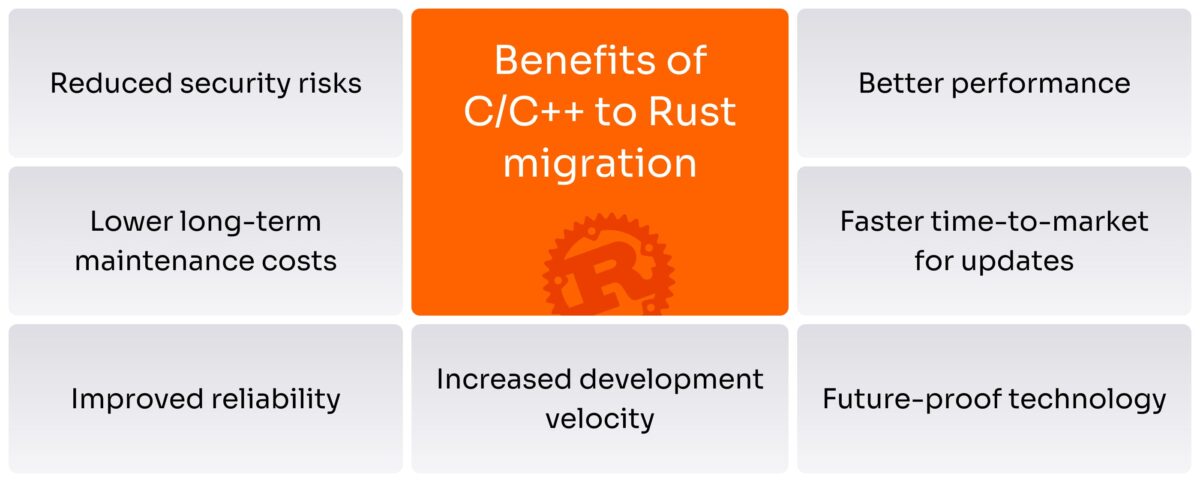
- Reduced security risks: Rust’s memory safety drastically lowers vulnerabilities, meaning fewer patches and less downtime for IoT systems.
- Lower long-term maintenance costs: Rust reduces bugs that emerge later in production, leading to fewer expensive fixes after deployment.
- Improved reliability: With Rust, IoT devices crash less often, which means more uptime and fewer disruptions for end-users.
- Better performance: Rust’s efficiency can lead to lower energy consumption, extending the life of battery-powered IoT devices and reducing energy costs.
- Faster time-to-market for updates: Rust’s safe concurrency allows quicker development of new features without compromising stability, which means you can roll out improvements to your IoT solutions faster.
- Future-proof technology: Rust’s growing popularity means a sustainable ecosystem, which ensures that your IoT product stays modern and well-supported for years to come.
- Increased development velocity: Rust reduces debugging time and makes the code easier to reason about, speeding up onboarding and increasing overall developer productivity.

Three common myths about Rust migration
Many organizations hesitate to begin migrating embedded systems from С or C++ to Rust because they expect major risks or disruptions. In reality, most of these concerns stem from common misconceptions rather than technical limitations in embedded software development. Understanding what Rust migration actually involves helps teams make confident, well-informed decisions. Let’s review the three most common misconceptions.
Myth 1: “We’ll have to rewrite everything”
You don’t need a full rewrite to begin a C++ to Rust migration. Many teams start small, moving one or two isolated modules that bring the most maintenance pain. Using the Foreign Function Interface (FFI), Rust can work alongside C or C++ within the same firmware. This feature makes it possible to modernize gradually while the rest of the system stays live.
Myth 2: “Switching to Rust will interrupt delivery”
Migration can happen without stopping production. With a structured approach, Rust modules are added one by one while existing CI/CD pipelines continue to run. Each new piece is tested, deployed, and benchmarked before the next one is introduced. The development cycle continues as usual, only the language inside changes.
Myth 3: “We’ll have to replace the entire engineering team”
Most C or C++ developers adapt to Rust faster than expected. The languages share similar low-level logic, which makes the learning curve manageable with proper mentoring and review. Once trained, the same team can handle both Rust and C++, maintaining delivery speed while building long-term expertise.
Three ways of C/C++ to Rust migration
There’s no one-size-fits-all approach to C++ to Rust migration. The right strategy depends on how your system works today, how critical uptime is, and what level of modernization you’re aiming for. When adopting Rust for IoT and embedded systems, companies typically choose one of three paths: gradual integration, full rewrite, or hybrid migration.
1. Gradual integration
This path is ideal for safety-critical or continuously running devices. Instead of rewriting everything, the developers introduce Rust gradually—one module at a time. Typical starting points include telemetry handlers, utility modules, or background services that can be tested in isolation.
The existing C/C++ softwre keeps running while new Rust components are integrated and validated. Over time, as more modules are proven stable, Rust takes over a larger share of functionality.
Interested in the migration roadmap and how long each step takes? Get a complete timeline with phase-by-phase deliverables in our migration guide.
2. Full rewrite
If you’re launching a new product or phasing out outdated firmware, a full rewrite may be the most efficient route. The development starts with Rust from day one. It covers firmware logic, communication layers, and testing infrastructure.
This scenario removes legacy constraints entirely and lets your team build clean architectures without legacy dependencies, design for memory safety from the start, and use Rust’s concurrency model to its full advantage. A full rewrite requires a skilled team, proven toolchains, and time for onboarding, but it also gives you complete control over the system’s design. Yalantis supports such transformations through end-to-end Internet of Things solutions, helping businesses develop secure, scalable, and future-ready connected products.
3. Hybrid approach
Many embedded systems can’t be fully rewritten due to vendor SDKs, licensed components, or hardware dependencies. In those cases, Rust and C/C++ coexist. Engineers connect both through FFI, so each language can do what it does best.
C++ handles hardware-level operations, while Rust manages business logic, safety-critical processes, or communication layers. This model works particularly well for medical devices, industrial equipment, and long-lifecycle IoT platforms, where reliability and compliance matter just as much as modernization speed.
Challenges and best practices by Yalantis for C/C++ to Rust migration
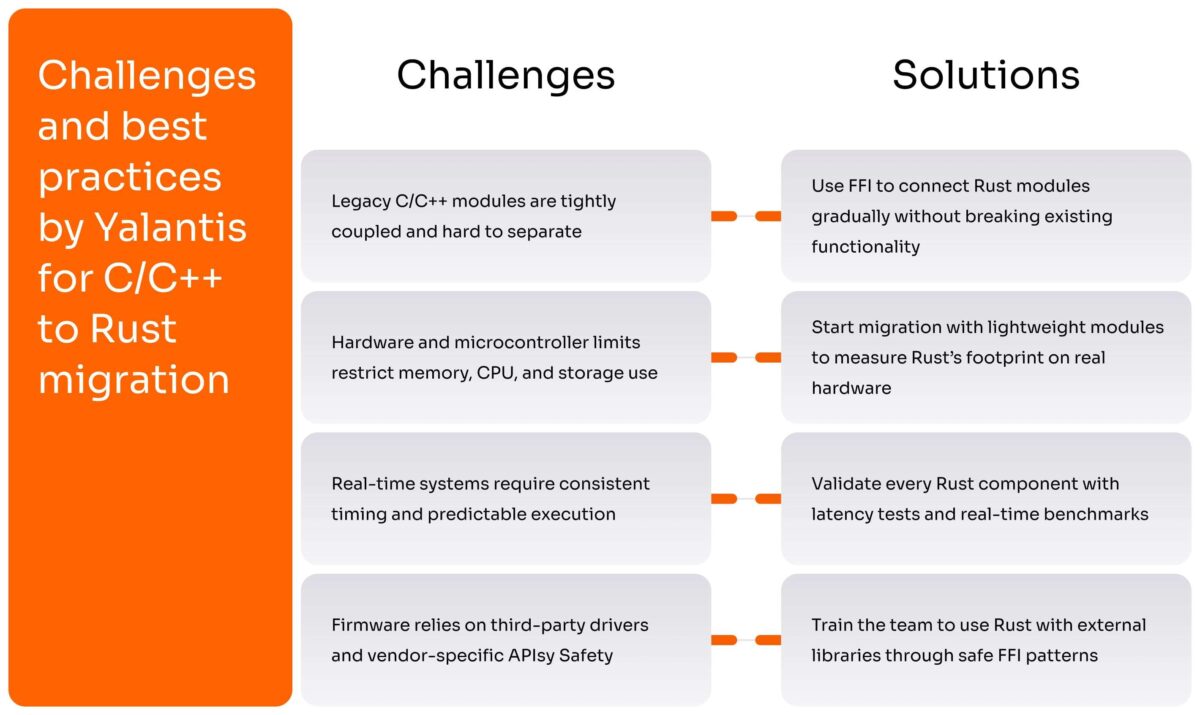
Before starting a full-scale migration, it’s important to understand the technical and architectural risks involved. Each challenge that appears during the embedded C++ to Rust migration can be handled through structured engineering practices. Below is an overview of key challenges migrating embedded firmware from C++ to Rust and the Rust migration best practices Yalantis uses to keep modernization predictable and low-risk.
Challenge 1: Maintaining compatibility with existing C/C++ code
Legacy firmware often has C++ modules woven tightly together. You can’t rewrite everything at once without risking device instability or unexpected regressions.
Yalantis tip: Keep C/C++ and Rust interoperable during transition
Yalantis connects new Rust modules to existing C/C++ code through FFI. This approach lets both languages run inside one firmware image without forcing a complete rewrite. Our engineers set up shared data models, implement consistent error-handling rules, and build scripts that treat Rust and C++ as one system. You can modernize core functionality gradually while all devices stay operational and CI/CD pipelines continue running as usual.
Challenge 2: Operating under hardware and microcontroller limitations
Most embedded devices run on minimal RAM, limited storage, and low CPU frequencies. A rushed migration can overload the hardware or increase latency.
Yalantis tip: Start with non-critical modules first
We begin with small, isolated components, such as diagnostic tools, telemetry modules, or low-priority services, and migrate them first. These early migrations show exactly how Rust behaves on your real hardware: memory footprint, CPU load, timing behavior, and power usage. You get measurable data instead of assumptions. After we prove Rust fits your constraints, our experts expand the migration to higher-impact modules.
Challenge 3: Ensuring deterministic behavior in real-time systems
IoT and embedded applications often have strict timing and reliability requirements. Even slight delays in execution can affect safety, user experience, or device coordination.
Yalantis tip: Use automated testing to catch regressions
We introduce continuous benchmarking and regression tests that track latency, interrupt handling, and timing accuracy. Every Rust module gets compared to your original C/C++ implementation to confirm that real-time behavior stays predictable.
Challenge 4: Integrating with external libraries and APIs
Embedded firmware relies on vendor drivers, communication stacks, and low-level APIs. Poor integration planning can cause instability or break device compatibility.
Yalantis tip: Train teams on Rust syntax and concepts
Yalantis provides hands-on training for in-house developers to master Rust’s ownership model, lifetimes, and safe FFI integration patterns. Understanding these concepts makes it easier to connect Rust modules with external libraries and maintain a clean, stable architecture throughout the migration. It also prepares your team to expand Rust adoption confidently in future releases.
Conclusion
Modernizing embedded and IoT systems requires predictable performance, strong security guarantees, and code that stays maintainable as the product evolves. Traditional C/C++ firmware often struggles with these demands. Rust solves many of these challenges upfront with built-in memory safety, reliable concurrency, deterministic execution, and a modern development ecosystem that reduces defects and speeds up delivery. A well-planned C/C++ to Rust migration strengthens product stability, lowers lifecycle costs, and gives you a foundation that scales with new device architectures and connectivity needs.
Achieving this level of modernization requires a team that understands both low-level Rust engineering and the realities of embedded and IoT product development. Yalantis brings over 17 years of engineering experience, a team of more than 500 specialists, and a portfolio of complex IoT and embedded projects delivered for global brands. Our expertise in Rust development, embedded firmware, and full-stack IoT solutions helps companies to adopt Rust confidently, minimize migration risks, and modernize their device ecosystems without
Do you have a project in mind?
FAQ
How long does a typical C++ to Rust migration take?
Timelines depend on code complexity and hardware constraints. At Yalantis, we start with a focused assessment of your system that usually takes up to two weeks. Once we understand where Rust will deliver the most value, we create a realistic migration roadmap. You’ll know which modules to target first, how to phase the work safely, and what the full timeline looks like for your product.
Can Rust improve the security certification process?
Rust doesn’t replace certification, but it removes entire classes of unsafe behavior early in development. Memory safety and strict typing help teams document risk controls faster, which often simplifies parts of IEC 62304, FDA guidance, or ISO 26262 reviews. Yalantis structures the codebase and testing pipeline so auditors see clear evidence of safe memory handling and deterministic execution.
How does Rust affect long-term firmware maintenance?
Rust reduces maintenance workload because many common firmware bugs can’t appear in Rust at all. Once key modules run on Rust, teams spend less time on regression fixes, patching, and emergency debugging. With each update, the firmware grows more stable, and Yalantis helps engineering teams keep both Rust and C/C++ components aligned.
Can Rust help extend device battery life?
Rust’s compile-time optimizations and predictable memory access patterns often reduce CPU wake-ups and unnecessary work. This feature leads to lower power consumption, especially in always-on IoT devices. During migration, Yalantis benchmarks Rust modules on actual hardware to confirm real battery-life gains before they go into production.