

Picture two product teams starting their sprints on Monday. One spends the week refining requirements and aligning in meetings. The other uses AI in product development to analyze inputs, validate constraints, and prototype early. By Friday, one is still preparing. The other is already testing.
As products become more data-driven and interconnected, late discovery becomes expensive. AI in PDLC shortens feedback loops and surfaces risks before they turn into delays. McKinsey puts the improvement at 5% faster time to market. That sounds modest until your competitor releases the product two weeks earlier than you and captures the first wave of users.
Here at Yalantis, we built an internal AI-enabled PDLC framework to capture these gains systematically. We use AI ourselves and provide AI development services for our clients to improve delivery speed and decision quality.
Real-world impact: What to expect from an AI-powered PDLC
Companies that apply the use cases of AI in product development with clear intent typically deliver faster, spend less, and generate stronger revenue outcomes.
Faster engineering delivery and better code quality
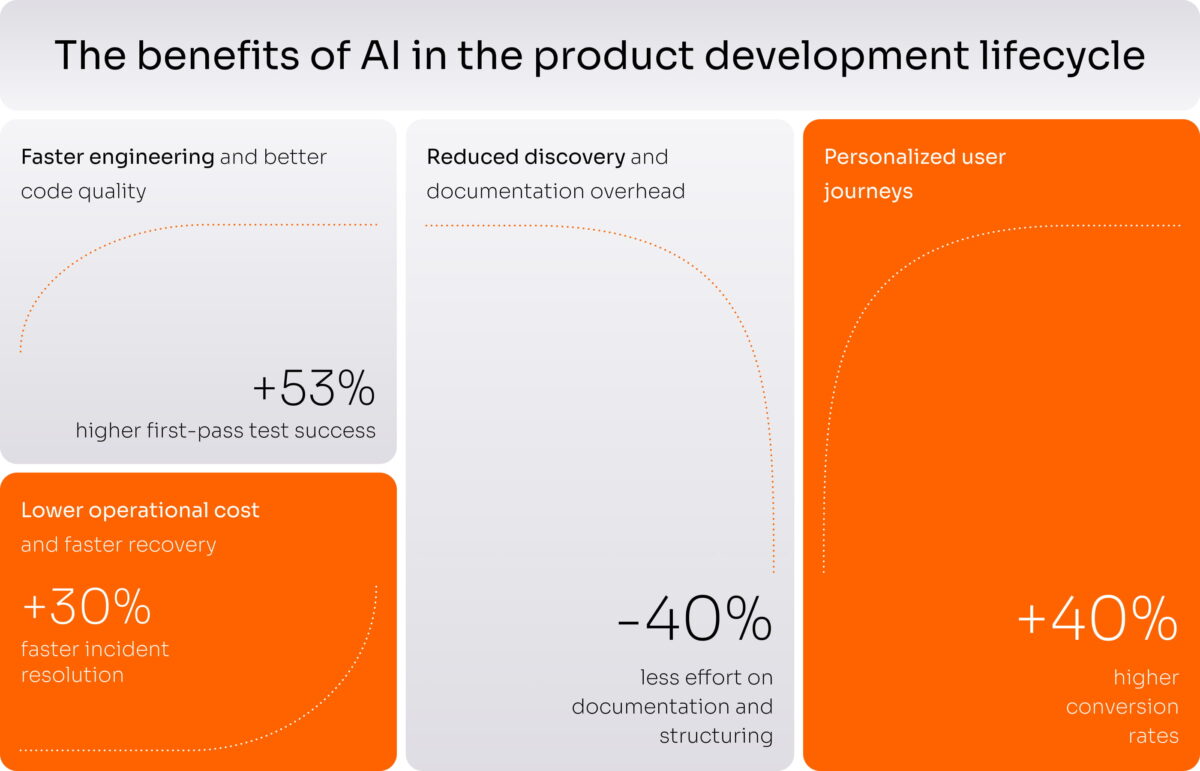
AI-assisted development reduces time spent on repetitive coding and integration work. Research by the GitHub team discovered that developers using Gen AI for programming tasks complete them considerably faster. What is more important, AI use improved the code quality, having a 53.2% greater likelihood of passing the unit tests on the first attempt. Fewer defects and less refactoring translate directly into lower development cost and more predictable releases.
Reduced discovery and documentation overhead
AI reduces the time teams spend producing and maintaining content during early product stages. McKinsey shows that generative AI cuts the time required for writing documentation by 40%. However, these gains extend far beyond product descriptions to activities like summarizing interviews, structuring requirements, resume screening, or preparing internal briefs.
Lower operational cost and faster recovery
After release, AI-supported monitoring and diagnostics can reduce the effort required to detect and resolve production issues. Research on Gen AI adoption shows a 30.13% reduction in mean time to resolution for operational incidents. Faster recovery means less disruption to service and lower maintenance overhead as the product scales.
Personalized user journeys
AI can influence revenue across the entire customer journey, from acquisition and onboarding to product usage and churn reduction. When applied to customer-facing decisions, AI-driven personalization and targeting can increase conversion rates by up to 40%. The effect comes from better alignment between user intent and what the product offers at each interaction point, whether that interaction happens in marketing flows, in-product experiences, or even your internal HR chatbots.
Planning to use AI in your product?
Start with realistic expectations. Discover where AI works, where it doesn’t, and what to expect from it in our whitepaper.
While all the examples above illustrate what AI can deliver, achieving these results consistently requires applying AI strategically across the PDLC. Now, let’s review how we structure the product development lifecycle with AI.
How Yalantis uses AI to accelerate the product development lifecycle
At Yalantis, we embed AI directly into our delivery workflows to accelerate routine work and keep teams focused on high-value engineering and product decisions. Below is how our teams apply AI at each stage of the product development lifecycle.
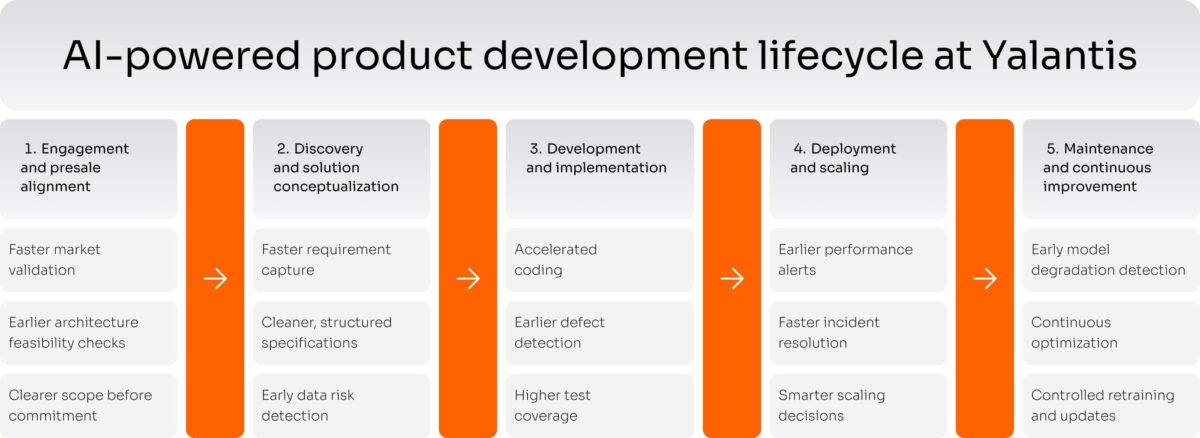
1. Engagement and presale alignment
Our teams use AI from the first client conversations to shape a realistic solution direction early.
We apply market and competitor intelligence tools such as Perplexity, Gemini, Claude, and GPT to run deep research on comparable solutions and find reference architectures together with well-known edge cases. In particular, we use cloud-compatible AI agents to validate early architecture ideas, identify infrastructure gaps, and test feasibility scenarios. This approach accelerates R&D exploration without pulling senior engineers into manual research.
In such a way, we rely on realistic benchmarks and validated assumptions before scope or architecture decisions are locked in.
2. Discovery and solution conceptualization
During discovery, we use AI to move faster from ideas to clear, validated requirements.
a. Requirements elicitation and validation
Our business analysts use AI-supported transcription and summarization tools, including Fireflies, during workshops and interviews. Removing the need to focus on note-taking allows teams to stay engaged in the discussion, clarify requirements early, and capture open questions as they arise.
For structuring early concepts and requirement drafts, teams also rely on tools such as ChatPRD, Claude, and ChatGPT. They allow our specialists to quickly outline product scope and challenge assumptions before they turn into formal documentation.
Beyond conversations and documents, we also examine the data itself. AI-driven data profiling helps surface data gaps and quality issues early. In such a way, we shape the requirements with real constraints in mind rather than guesses.
b. Technical solution architecture
AI supports early architectural thinking by generating and reviewing candidate solutions. It evaluates them against integration constraints and expected system behavior. We have tuned an internal LLM model on reference architectures and internal delivery experience to validate proposed structures and highlight improvement options before architectural decisions are finalized.
The model assists our architects by:
- comparing multiple architecture variants against performance, cost, and security considerations;
- identifying integration risks or missing components;
- suggesting technology stacks and service boundaries aligned with proven implementation patterns;
- highlighting potential bottlenecks or over-engineering.
Our goal is not to automate the decision-making process with AI; it is to accelerate the evaluation cycle and make it more transparent. Our architects still review the generated alternatives, challenge assumptions, and shape the final solution based on real project context and business priorities.
c. Product design and human-AI interaction
Design teams use AI-assisted prototyping tools such as Figma AI to quickly validate dashboards and workflows. Tools like Figma Make, V0, and Lovable help turn rough ideas into clickable UI drafts in minutes, which makes early feedback easier to collect and compare.
Early simulation of user behavior helps reveal usability issues early enough to influence design decisions.
d. Delivery and implementation planning
Yalantis’ internal AI agents help us turn the solution concept into a delivery plan with a clear scope and timeline. These tools compare tasks to our similar past projects and the delivery data to refine effort estimates and surface hidden complexity.
3. Development and implementation
During development, we apply AI where repetition slows teams down, and automation improves consistency. AI uses tasks and documentation as input, supports coding, and triggers testing workflows, so engineers don’t rewrite context or manually move information between systems.
Our engineers use AI copilots, including Claude, OpenAI-based tools, Cursor, and Windsurf, to accelerate coding tasks. These tools handle repetitive code and quick prototyping, while engineers stay focused on system logic, architecture decisions, and edge cases.
We use enterprise-grade AI tools with Zero Data Retention enabled, so client code and data never enter public training pipelines. For sensitive projects, teams deploy isolated or locally hosted models, including Llama and Mistral, to keep full control over data.
Our QA teams use AI to generate tests and simulate anomalies, which reduces manual effort and improves test coverage. Tools such as QAsphere and Claude help structure test scenarios and reveal weak points, while AI-driven code analysis identifies security risks and performance bottlenecks earlier in the pipeline. AI also supports code reviews through tools like CodeRabbit, which surfaces issues sooner and reduces manual inspection.
4. Deployment and scaling
As solutions move into production, we use AI to keep systems stable and responsive under real load.
AI helps us spot performance issues and unusual behavior earlier, before they turn into visible problems. It also gives clearer insight into how systems behave under different conditions, which makes scaling and optimization decisions more grounded as usage grows.
When incidents happen, AI helps to find the root causes, which helps teams restore normal operation faster.
5. Maintenance and continuous improvement
After launch, we use AI to keep systems performing well as real usage patterns change.
AI helps us spot degradation early and react before issues affect users. For data-driven components, automated retraining and optimization keep models aligned with the actual system usage.
AI tools also help us review user behavior and operational signals over time, highlighting where improvements make sense.
Need a team that can integrate AI into your product lifecycle without breaking delivery?
Explore our AI development services
Case in point: AIoT solution with predictive maintenance for a logistics company
One of the examples of how we use AI and machine learning in PDLC is a project for a US-based logistics company with a large vehicle fleet. The company faced unplanned breakdowns, which resulted in high maintenance costs. Fixed maintenance intervals and manual diagnostics gave only a partial picture of vehicle health.
Yalantis delivered a custom AIoT fleet management platform with AI-based predictive maintenance at its core. We used machine learning models to analyze real-time telemetry and historical data. Such a system allowed our client to identify early signs of component degradation and forecast failures before they affected operations. AI supported not only the product logic but also delivery decisions, helping us to refine predictive models based on live fleet behavior.
As a result, maintenance shifted from reactive to predictive. The client reduced cost per vehicle by up to 30% and improved fleet availability through earlier issue detection and better planning. Continuous learning from real-world usage allowed the system to adapt over time, creating a scalable foundation for long-term operational efficiency.
Challenges of implementing AI in product development and best mitigation practices
AI can strengthen the product development lifecycle, but it doesn’t simplify it automatically. Results depend on where AI is applied, how it is governed, and how well it fits into real delivery workflows. Let’s review some of the common challenges of AI-driven product development and how Yalantis addresses them.
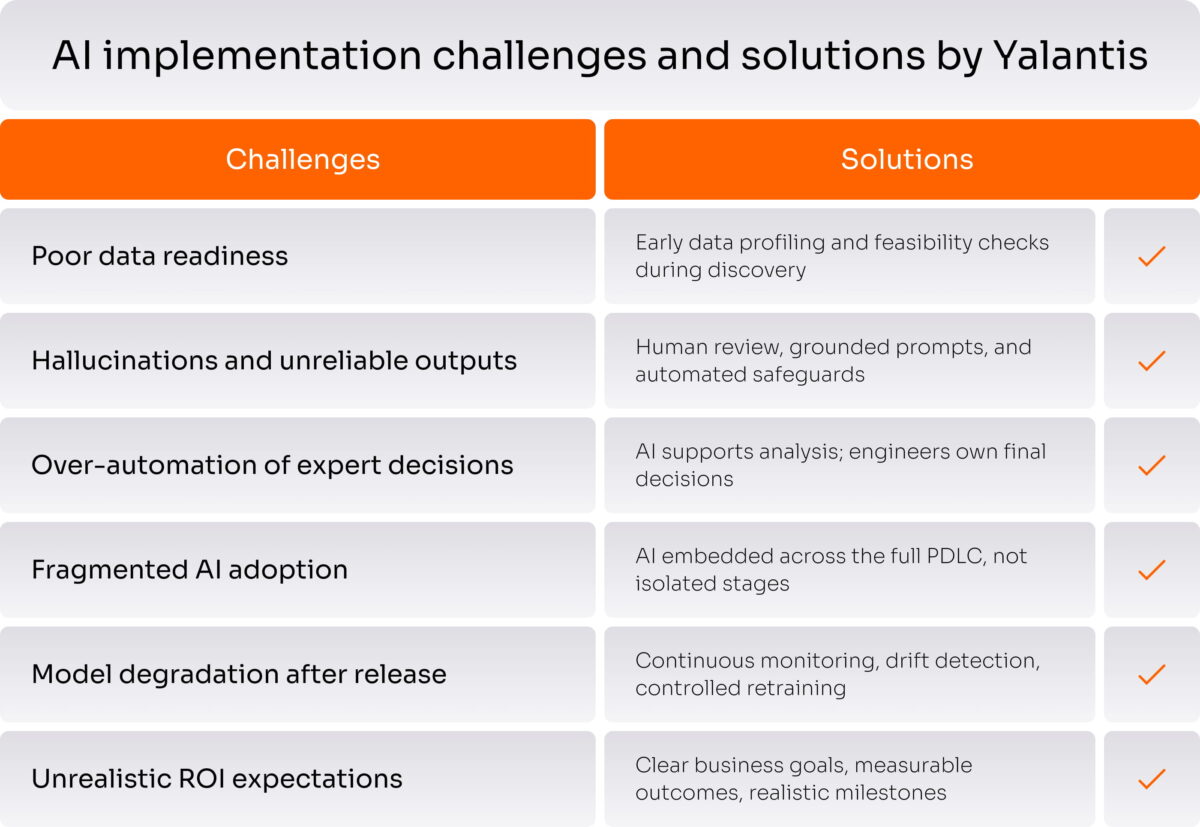
Poor data readiness and unclear feasibility
AI initiatives often start before teams understand whether the available data can support the intended outcomes. Gaps in data quality, labeling effort, or signal strength surface late and derail timelines.
Solution by Yalantis:
We run early data profiling and feasibility checks during the discovery phase. Teams get a clear picture of data limitations and risks of AI in product development early enough to adjust direction while change is still inexpensive.
Hallucinations and unreliable AI outputs
Generative models can produce confident but incorrect answers. In product development, these inaccuracies can lead to flawed requirements, incorrect code suggestions, or misleading analysis if outputs go unchecked.
Solution by Yalantis:
We treat AI output as a working draft, not a final decision. Engineers and domain experts review generated content before it influences architecture or code. For critical use cases, we constrain model scope and ground responses in verified project data. Automated tests and structured review steps act as safeguards, and in such a way, we detect incorrect outputs long before production.
Over-automation of decisions that require expertise
AI is sometimes applied too aggressively, replacing judgment instead of supporting it. That approach creates fragile systems and weak trust from stakeholders.
Solution by Yalantis:
We apply AI to the use cases that bring the most value, such as analysis and repetitive work. Yalantis uses AI to remove friction from the work, not to replace judgment. As a result, our teams make decisions faster because the groundwork is already done.
Fragmented AI adoption across PDLC stages
Teams often introduce AI in isolated steps, such as development or testing, without connecting it to the whole process. The result is local optimization without lifecycle impact.
Solution by Yalantis:
We embed AI across the full PDLC, from early validation to post-launch monitoring. Our approach ensures feedback flows continuously and improvements compound rather than reset at each stage.
Model degradation after release
AI models lose accuracy as data patterns change. Without monitoring and retraining, performance quietly degrades in production.
Solution by Yalantis:
We design systems with continuous monitoring, drift detection, and controlled retraining from the start. Yalantis treats maintenance as an active phase of the lifecycle, not a support task.
Unrealistic expectations about ROI and timelines
AI is often expected to deliver immediate returns without organizational or process changes. These expectations create frustration and stall initiatives.
Solution by Yalantis:
We align AI adoption with clear business goals and define measurable outcomes early. The project moves forward with clear milestones and realistic timelines.
Ethical and responsible AI use in product development
At Yalantis, delivery teams apply responsible AI the same way they apply secure coding or release management: as part of everyday work. Engineers and product teams decide where AI can be used, how data is handled, and what level of control is required at each stage. Due to this approach, AI-enabled features move to production without creating hidden risks.
Before development
- Solution architects and security leads review planned data usage against GDPR, HIPAA, and client-specific regulatory requirements before any model training or automation begins.
- Platform engineers and DevOps teams define data access rules, enforce role-based permissions, and design isolation or anonymization mechanisms for sensitive data.
- Data engineers and analysts run early data quality checks and bias scans to surface risks that could distort model behavior later.
During delivery
- Product owners and technical leads keep decision ownership. AI supports analysis and execution, but final calls stay with people responsible for outcomes.
- Engineers and QA specialists test, review, and version AI outputs using the same pipelines applied to production code and system logic.
After release
- Our engineers and platform teams monitor models in production to detect drift or unexpected behavior early.
- Release and operations teams ship updates through controlled, auditable processes that match enterprise release standards.
At Yalantis, AI stays reliable and secure because we define responsibility from the start and never hand over ownership to “the system.” Engineers and our other specialists remain accountable for the use of data, model behavior, and the impact of AI on the product and its users.
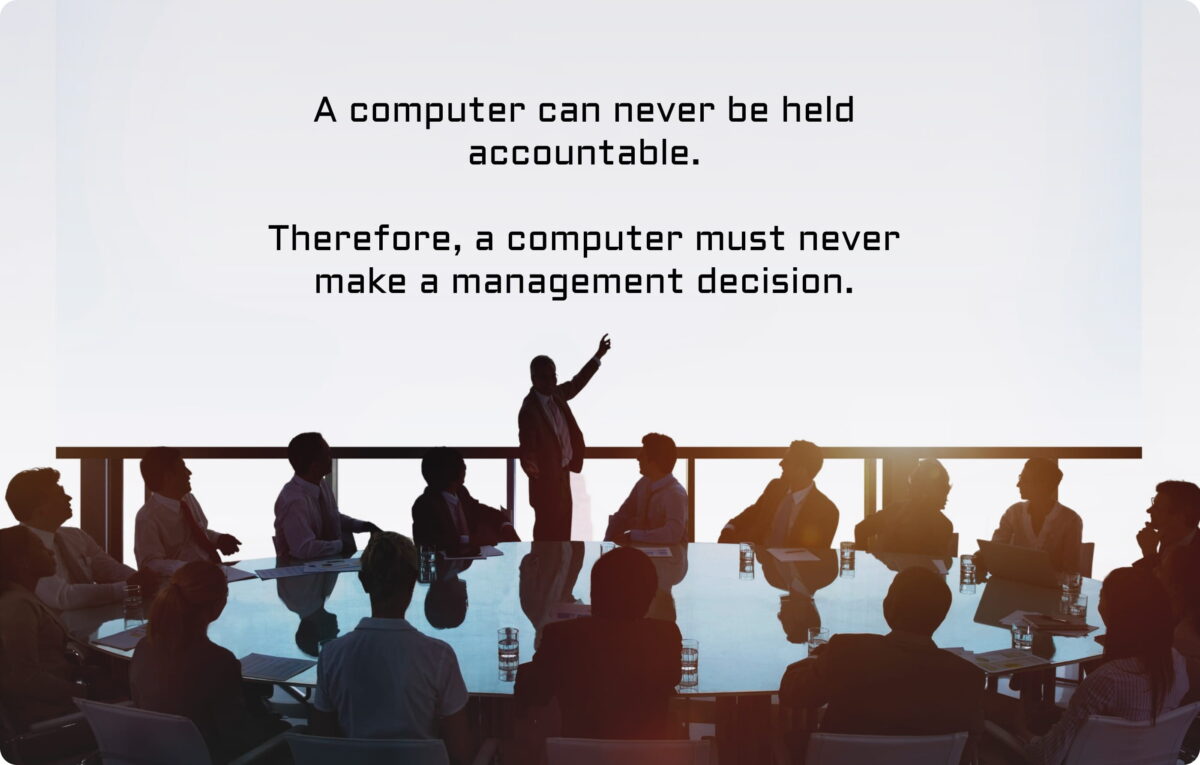
Simply speaking, we follow a principle that predates modern AI but remains highly relevant today. In a 1979 IBM presentation, one slide captured a rule that still defines how we treat intelligent systems in delivery environments. It is simple, direct, and hard to argue with:
Why choose Yalantis for AI-powered product development
AI changes how products are built, but it also raises the stakes. Unclear feasibility, fragile models, and disconnected delivery stages turn many AI initiatives into expensive experiments. Companies usually don’t need “more AI.” They need an AI consulting partner that understands where AI actually adds value in the product development lifecycle, and where it doesn’t.
Yalantis approaches AI-powered product development from a delivery-first perspective. We start by clarifying business goals and AI readiness early, so AI decisions are grounded in reality rather than ambition. This reduces late-stage surprises and keeps timelines and expectations aligned.
Have a use case in mind?
Let’s review how AI can reduce effort and accelerate your product delivery.
What differentiates us is how we integrate AI into the full PDLC, not as a standalone capability. We use AI throughout the whole chain of end-to-end services in use cases where it can successfully automate a part of the work. The result is faster iteration without losing control over quality, compliance, or long-term maintainability.
Clients work with us not because we promise shortcuts, but because we design AI-enabled delivery that holds up after launch. of speed and structure; of innovation and predictability is what turns AI from a risk into a competitive advantage.
FAQ
Why do speed and efficiency matter more in product development today?
In the current market, the cost of late learning has skyrocketed. Market signals and technical constraints surface faster than ever; speed determines how early a team can validate assumptions before the cost of change becomes too expensive. Efficiency allows teams to offload routine cognitive work to AI, redirecting senior talent toward high-value architectural decisions and product logic that drive competitive advantage.
What is the real-world impact of an AI-based product development?
When AI is integrated strategically, it transforms delivery from reactive to proactive. Based on industry benchmarks, organizations can expect:
- Faster Delivery: A 5% to 10% reduction in time-to-market.
- Higher Engineering Output: Tasks completed up to 55% faster with AI copilots.
- Lower Maintenance Costs: A 30% reduction in incident resolution time (MTTR).
- Revenue Growth: Up to a 40% increase in conversion rates through AI-driven personalization.
Where in the product development lifecycle does AI deliver the biggest impact first?
The most immediate impact is found in the Discovery and Development phases. AI-assisted research and documentation tools can cut early-stage overhead by 40%, while AI coding assistants provide instant velocity gains during implementation. These early wins create a compounding effect, reducing downstream rework and stabilizing the entire release schedule.
Does AI-powered PDLC require changing our existing Agile or Scrum processes?
No. AI-powered PDLC is designed to augment, not replace, established frameworks like Agile, Scrum, or Lean. AI enhances specific activities within those frameworks, such as refining backlogs, estimating effort more accurately based on historical data, and automating unit testing.
What parts of product development should not be automated with AI?
Strategic direction, architectural trade-offs, and final accountability must remain human-centric. AI is an analytical and execution partner; it lacks the business context and ethical judgment required to lock in high-stakes architecture or define a product’s core value proposition. At Yalantis, we use AI to do the “groundwork” so experts can make faster, better-informed decisions.
How long does it typically take to see measurable results from AI in PDLC?
Measurable gains in engineering velocity and discovery speed are often visible within the first 30 to 60 days. More complex ROI, such as significant operational cost savings or revenue shifts from AI-driven features, typically matures over 2 to 3 release cycles as models are refined with real-world usage data.
Can AI-powered workflows work with legacy systems and existing tech stacks?
Yes. AI integration is most effective when applied incrementally. Modern AI tools can analyze legacy codebases to identify technical debt, generate documentation for undocumented systems, and create modern wrappers or APIs. This allows teams to modernize their delivery process without the risk of a “rip-and-replace” overhaul of their infrastructure.
Can AI replace my development team?
No. AI changes the role of the developer rather than replacing it. It shifts the team’s focus away from repetitive or boilerplate code and manual QA toward system architecture, edge-case management, and user-centric innovation. A team empowered by AI is simply a higher-output version of your best talent.
Which AI tools should we use in our PDLC?
Tool selection should be driven by your specific bottlenecks rather than trends. At Yalantis, we utilize a tiered stack:
- Research & Strategy: Perplexity, Gemini, and Claude for market intelligence.
- Requirements: Fireflies for automated elicitation and summarization.
- Development: Cursor, Windsurf, and GitHub Copilot for engineering velocity.
- Quality & Ops: Custom AWS-compatible agents for infrastructure validation and predictive monitoring.