
99% of hospitals now operate at least one connected medical device with a known, exploited vulnerability. This highlights the central challenge of IoT in healthcare: the connectivity that lets a cardiologist monitor a patient’s heart rhythm remotely can also expose connected devices to technical failures and cyberattacks.
IoT-enabled healthcare is the use of internet-connected sensors, wearables, and medical devices to collect, transmit, and act on patient and operational health data in real time, linking that data to clinicians, hospital systems, and care platforms without requiring a person to manually record or relay it. This guide covers what it looks like in practice:
- The applications healthcare organizations are actually deploying
- The device types and concrete examples behind them
- The benefits and hard evidence behind the hype
- The security and compliance risks nobody should gloss over
- How healthcare IoT solutions get engineered end to end.
We work on this daily as a full-stack healthcare IoT and IoMT engineering partner. This guide is grounded in real IoT deployments, devices, platforms, and compliance packages we have shipped across the healthcare ecosystem.
What is IoT in healthcare? Medical IoT and IoMT explained
IoT in healthcare refers to the network of connected devices, components, and software that capture health and operational data and route it automatically to the people and systems that need it. It replaces manual charting and periodic in-person checks with a continuous data stream.
Internet of Medical Things (IoMT) vs. IoT
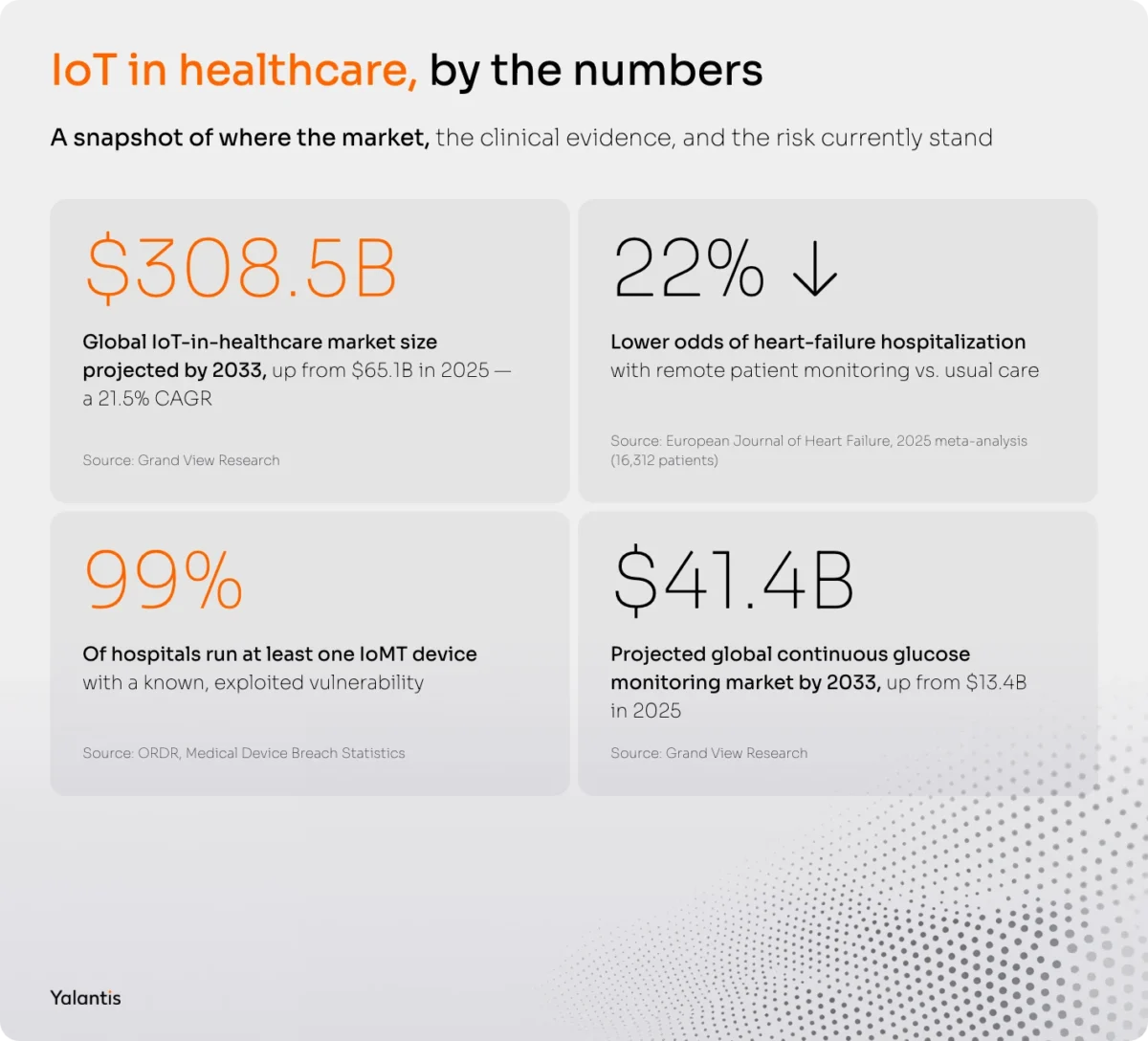
Internet of medical things, or IoMT, is the medical-specific subset of that broader internet of things. Every IoMT device is an IoT device, but not every facility IoT device is IoMT. A smart badge that tracks whether a nurse washed their hands is facility IoT. The wearable ECG patch that reports arrhythmias to a cardiologist is IoMT, because its data has a direct clinical use and typically sits under medical device regulation. The healthcare IoT market reflects this convergence, moving from $65.1 billion in 2025 toward $308.5 billion by 2033 as more of this IoT connectivity moves from hospital wards into homes.
That distinction matters more than it sounds like it should, because it determines the rules a device has to follow. A general-purpose IoT sensor tracking room temperature in a supply closet answers to ordinary IT security policy. An IoMT device measuring a patient’s glucose levels or heart rate answers to the FDA, to HIPAA, and often to IEC 62304 software safety classification, because a bug in that code can hurt someone. Not every device marketed as IoT in the healthcare space touches patient care directly, which is exactly why this distinction matters for compliance.
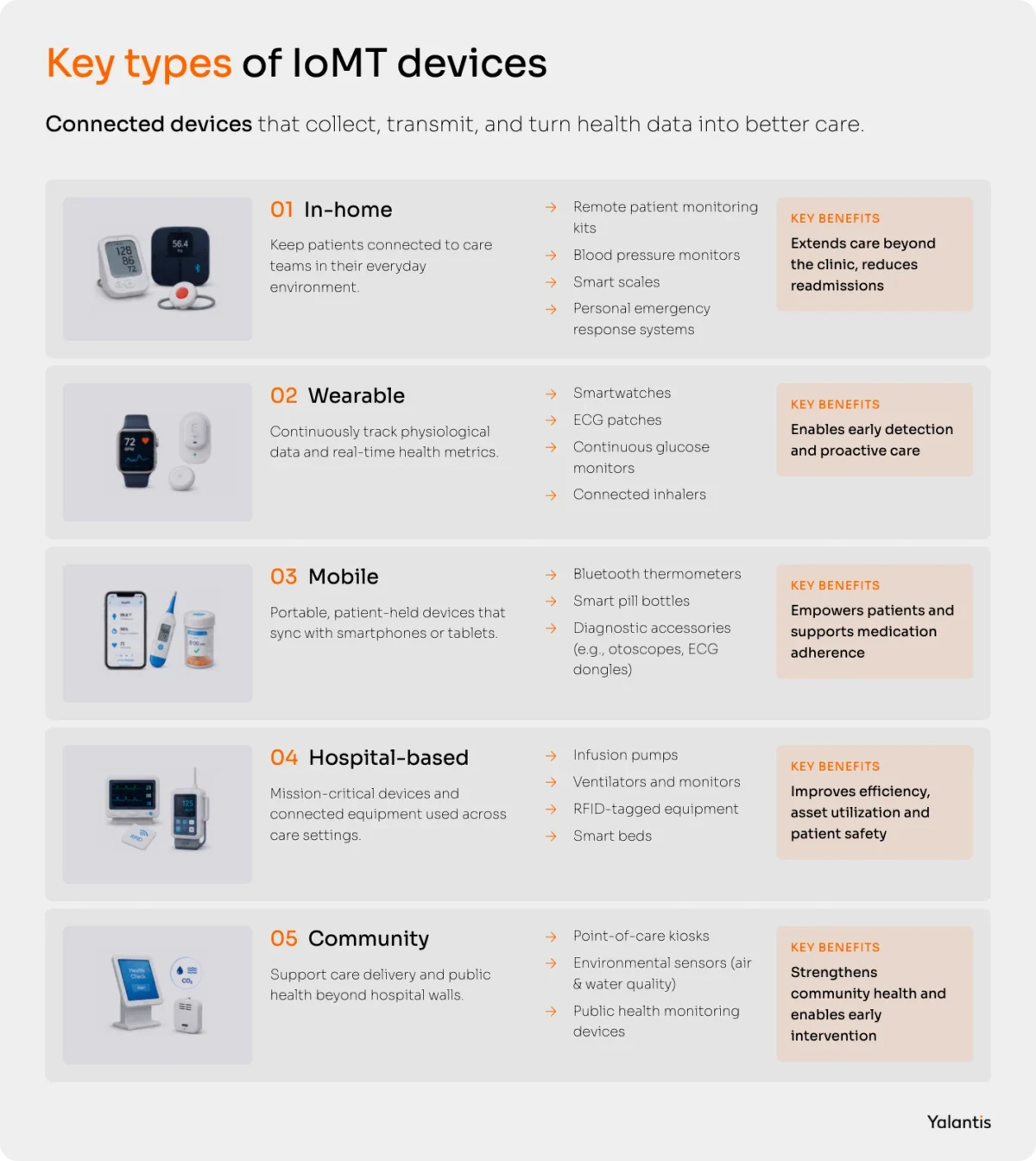
In practice, healthcare organizations use IoT devices across five environments, following the categories TechTarget’s IoMT breakdown uses:
- In-home, for remote patient monitoring devices and personal emergency response systems that keep discharged or chronically ill patients connected to their care team without a home visit.
- Wearable, for smartwatches and patches tracking pulse, blood pressure, and activity, plus medical-grade devices like continuous glucose monitors and connected inhalers.
- Mobile, for Bluetooth-enabled thermometers, smart pill bottles, and phone-paired diagnostic accessories a patient carries with them.
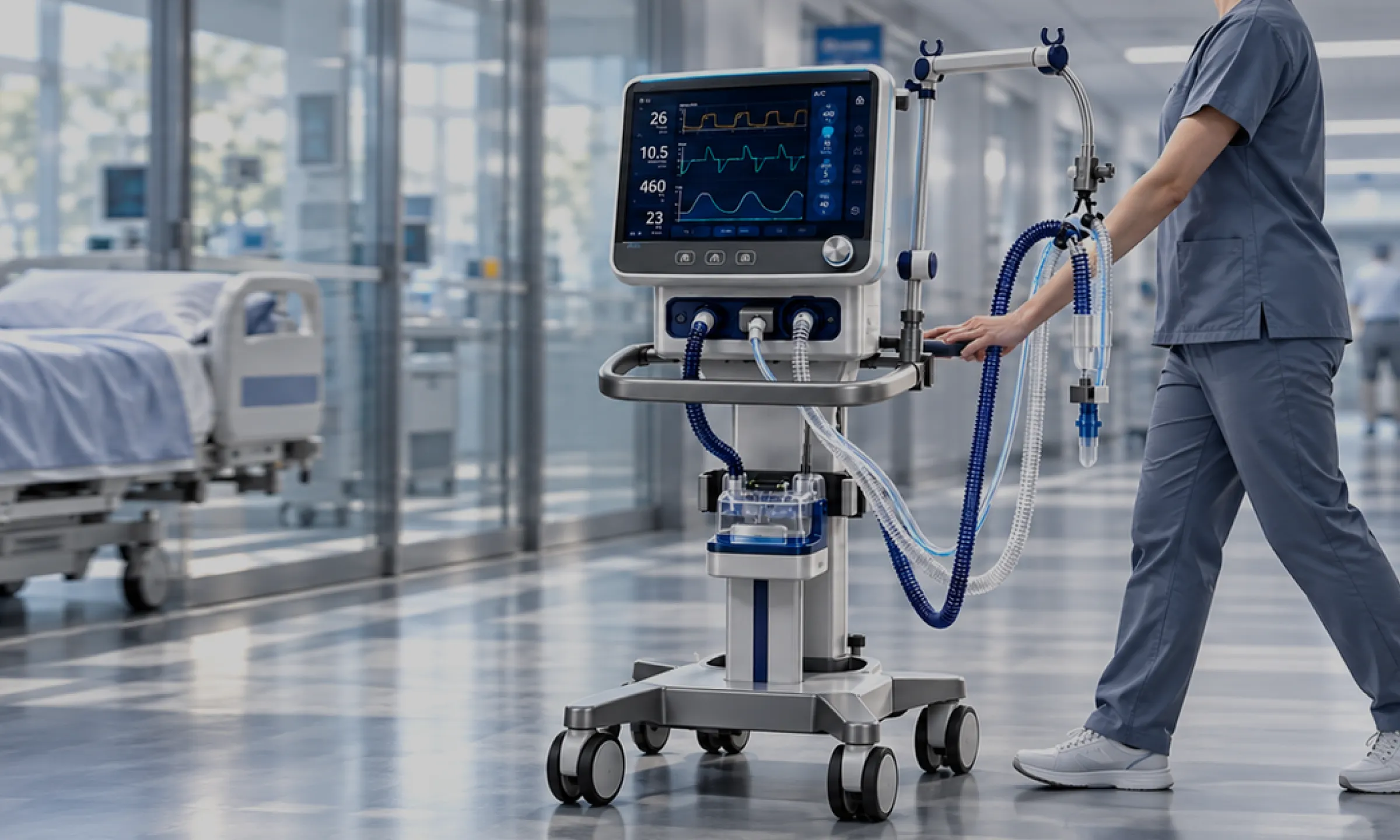
- Hospital-based, for infusion pumps, ventilators, and RFID-tagged equipment that a facility tracks and manages at scale.
- Community, for point-of-care kiosks and environmental sensors monitoring air and water quality in clinics and public health settings.
The common thread across all five is that a device “reads” data, a network moves it, and software turns it into something a clinician, caregiver, or healthcare operations team can act on without waiting for someone to write it down. For healthcare providers, that shift means less time spent on manual charting and more time spent on the readings that actually need a clinical decision.
Turn your wearable concept into a product people can rely on
Yalantis can engineer the full wearable ecosystem around your product – from device connectivity and real-time data to mobile apps and cloud infrastructure.
IoT applications in healthcare
In practice, IoT in healthcare offers care teams a way to act sooner: IoT in healthcare enables real-time visibility into a patient’s vitals, and IoT devices can help healthcare professionals to monitor more patients without adding headcount. The applications of IoT in healthcare fall into a handful of categories below.
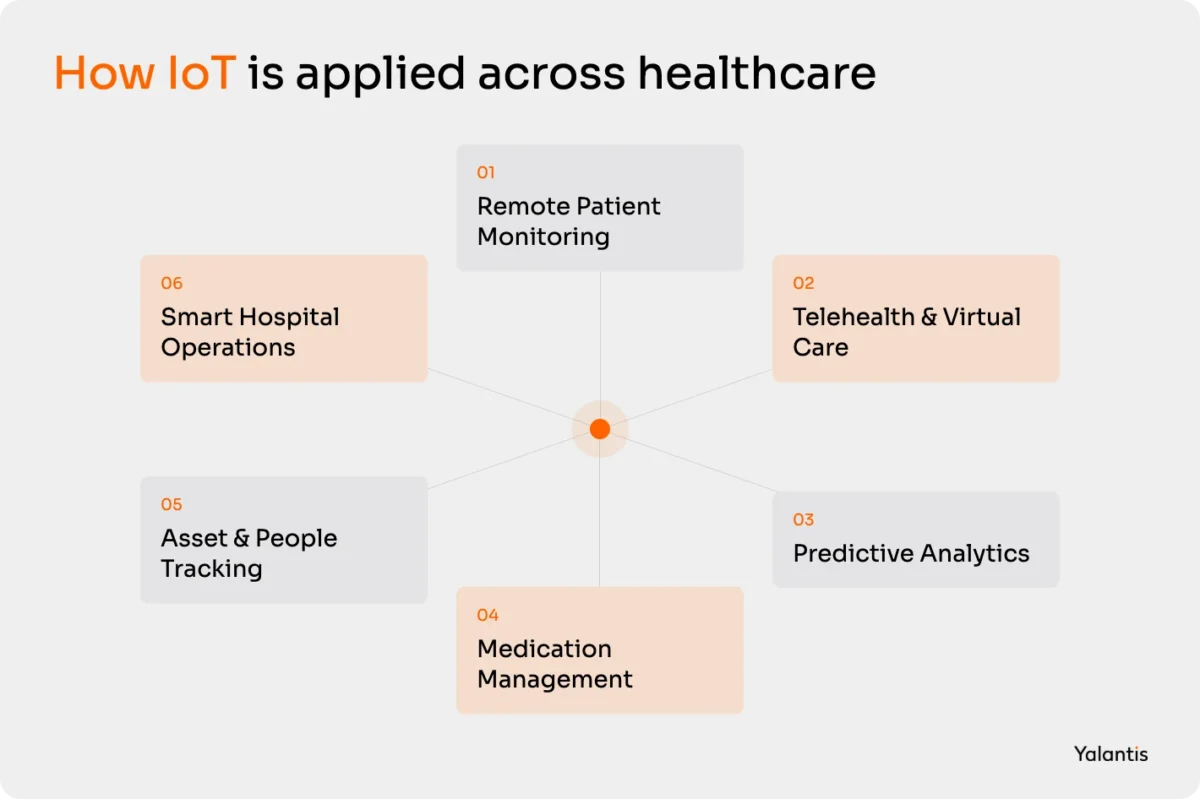
Remote patient monitoring (RPM)
This is the largest and most mature application of IoT in healthcare. Connected devices continuously capture vital signs, including heart rate, blood oxygen, blood glucose, and blood pressure, outside a clinical setting and stream them to a care team, so a chronic condition gets managed by exception rather than by a fixed monthly appointment.
We built exactly this kind of system for a US healthcare software provider, connecting a chest-worn ECG monitor and a wrist-worn blood oxygen and blood pressure tracker to their existing clinical platform.
Read our deep dive on remote patient monitoring solutions for the system components and compliance requirements.
Asset and people tracking
Real-time location systems (RTLS) using BLE or RFID tags let care facilities find infusion pumps, wheelchairs, and monitors instantly instead of having staff walk the floor. Equipment losses from theft and misplacement run an estimated $4,000 to $12,000 per bed every year in a mid-sized facility, which is the kind of cost that a tracking system pays for itself against within a single budget cycle.
Smart hospital operations
Beyond tracking objects, large healthcare facilities use connected devices to monitor hand hygiene compliance, room occupancy, and environmental monitoring of temperature and humidity in medication storage, plus patient fall risk through ambient sensors in a room, feeding a facility’s operations dashboard in real time.
Telehealth and virtual care
IoT devices are what make a video visit clinically useful rather than just conversational. A connected otoscope, stethoscope, or dermatoscope lets a remote physician examine a patient with something closer to in-person fidelity, and it is the single largest application segment in the IoT healthcare market by current revenue share.
Medication management
Smart pill dispensers and connected inhalers track adherence automatically, an area our team has shipped FDA-cleared devices in directly, and connected packaging can alert a caregiver the moment a dose is missed rather than a pharmacist discovering it at the next refill.
Predictive analytics
Once a device is streaming continuous data instead of an occasional snapshot, predictive healthcare becomes possible: machine learning models can flag a deterioration trend, like a slow rise in resting heart rate or a drop in daily activity, days before it becomes an emergency room visit.
Looking to put one of these applications into production?
Our team designs and ships full-cycle IoT healthcare solutions, from the connected device to the HIPAA-compliant platform behind it.
Key examples of IoT healthcare devices
Medical IoT devices and applications span a wide range of form factors, but they generally sort into six categories, each with its own connectivity, power, and regulatory profile.
A few of these are worth a closer look because of how far the underlying healthcare technology and sensor engineering have come. Moreover, they show how much overlap there already is between consumer IoT medical devices and clinical-grade ones.
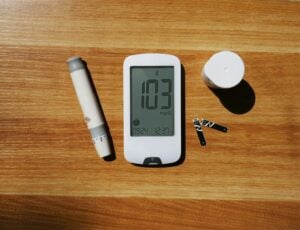
Continuous glucose monitoring (CGM) has gone from a niche diabetic tool to a fast-growing consumer and clinical category, with the global CGM device market valued at $13.4 billion in 2025 and projected to reach $41.4 billion by 2033. The clinical case is straightforward: a device that samples glucose levels every few minutes catches the highs and lows a quarterly A1C test cannot.
Wearable IoT devices for cardiac monitoring have similarly matured past step-counting into genuine diagnostic territory. Our team built a wearable integration platform for Healthfully, unifying data from Apple Watch, Fitbit, Withings, Google Fit, and iHealth into a single HIPAA-compliant clinical view, resolving the very real problem of five different device APIs each reporting the same patient’s heart rate slightly differently.
If you are planning that kind of integration, our walkthrough on wearable technology in healthcare covers the eight-step process for connecting wearable data to an EHR (Electronic Health Record).
Benefits of IoT in healthcare
The benefits of healthcare IoT break down into four categories that show up across the healthcare industry regardless of specialty: better clinical outcomes, lower costs, operational efficiency, and a better patient experience, reshaping healthcare delivery around continuous data rather than periodic visits.
Better clinical outcomes
A 2025 meta-analysis covering 41 studies and 16,312 heart failure patients found that remote patient monitoring cut the odds of heart-failure hospitalization by 22% and all-cause mortality by 19% compared with usual care, with self-management support and video check-ins as the components driving the strongest effect. That is not a marginal improvement; it is close to what a new drug class would need to clear regulatory approval.
Lower costs
Continuous monitoring catches problems while they are still cheap to treat, which is where most healthcare costs quietly compound. A patient whose weight gain or oxygen saturation trend triggers an early phone call avoids the ambulance ride, the emergency department bed, and the multi-day admission that a missed warning sign would have caused. On the operational side, RTLS-driven asset tracking (Real-Time Locating Systems) alone can eliminate thousands of dollars per bed in annual equipment loss.
Operational efficiency
IoT devices free clinical staff from manual data entry. A nurse who used to record vitals on paper every four hours now works from an automatically updated dashboard fed by connected IoT systems, and a facilities team that used to search for a missing infusion pump for twenty minutes now looks it up in seconds. That time returns directly to patient care.
Better patient experience
Patients recovering at home, managing a chronic condition, or simply trying to avoid an unnecessary clinic visit get to stay in their own environment while still being clinically supervised, which most patients strongly prefer to a readmission or a routine in-person check. Continuous device data enables healthcare teams to step in before a routine visit would have caught the problem.
Challenges and risks: security, interoperability, and compliance
Challenges of IoT in the medical field break down into three categories that have to be engineered around: security, interoperability, and regulatory compliance.
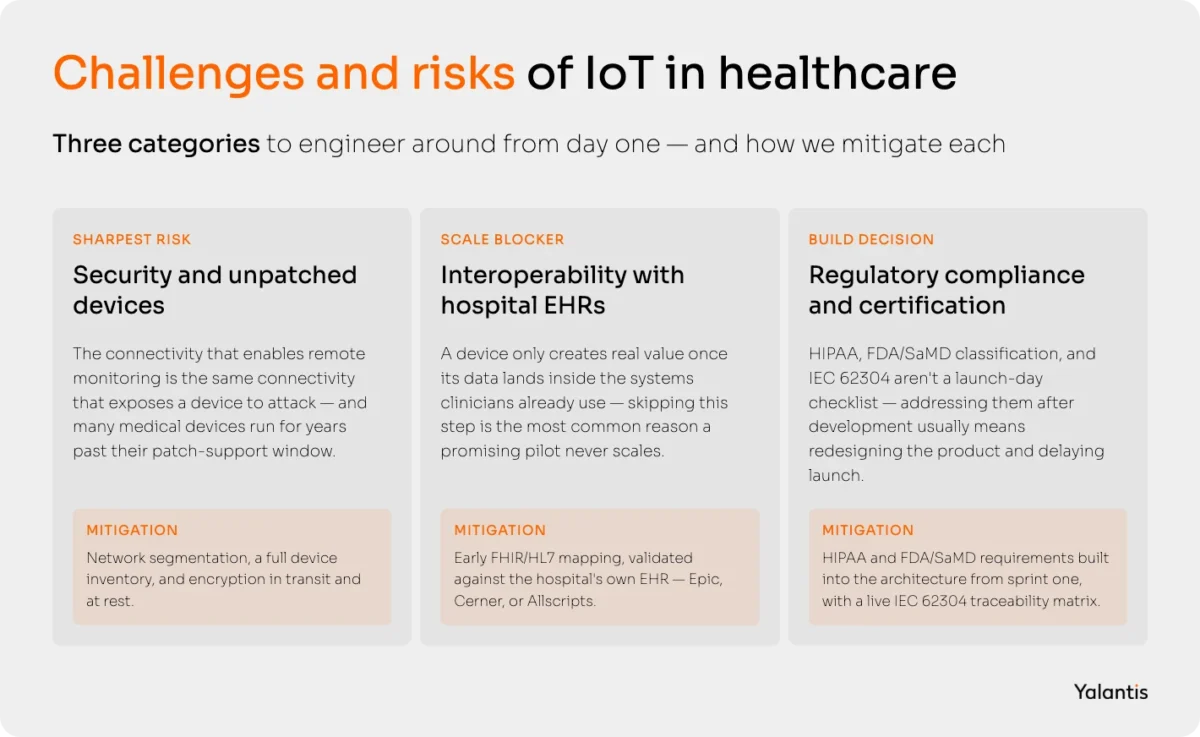
Security is the sharpest risk
IoT security is the sharpest risk here: 99% of hospitals run at least one IoMT device with a known, exploited vulnerability, and the average connected medical device carries 6.2 known vulnerabilities. 60% of medical devices in active use are past end-of-life, meaning no security patches are coming for them at all.
The financial exposure is not abstract: a US healthcare data breach now averages $10.22 million, the highest of any industry for fifteen consecutive years, and breached hospitals have measured a 29% increase in inpatient mortality in the aftermath, driven by the operational chaos a breach causes.
Interoperability determines whether a pilot survives in a hospital’s IT department
A connected medical device creates real value when its data flows into the systems clinicians already use.
This requires FHIR (Fast Healthcare Interoperability Resources) or HL7 (Health Level Seven) support to connect with EHRs such as Epic, Cerner, or Allscripts, plus consistent data formats across different devices. Skipping this step is the single most common reason a promising pilot never becomes a hospital-wide deployment.
Compliance shapes the build, not just the paperwork
IoMT products need to meet regulatory requirements from the start. HIPAA governs how protected health information is stored, transmitted, and accessed, while software that supports diagnosis or treatment may also fall under FDA oversight and standards such as IEC 62304.
Addressing these requirements after development often means redesigning the product, rewriting documentation, and delaying launch.
How we mitigate these risks
None of these three risks are reasons to stay away from healthcare IoT. Successful IoT adoption depends on treating IoT implementation as an architecture decision from the first review. Here is what that looks like in practice on our own engagements:
- Secure IoT starts with network segmentation that keeps medical devices separate from the general hospital network. A complete device inventory helps security teams know what is connected at all times. Data should be encrypted both in transit and at rest. Teams also need a clear process for security patches and vulnerability disclosure before the first pilot device ships.
- For interoperability, we map to FHIR or HL7 early and validate against the specific EHR a hospital partner already runs, whether that is Epic, Cerner, or
- Allscripts, so a pilot’s data lands inside the healthcare platform clinicians already use instead of a parallel dashboard nobody opens.
- For compliance, we treat HIPAA safeguards and FDA/SaMD classification as architecture inputs from sprint one, building the design-history file and IEC 62304 traceability matrix alongside the code so there is nothing to reconstruct retroactively before a submission.
Building a device that has to pass FDA review?
Our ISO 13485-certified team builds compliance into your product architecture from the first sprint, so you move toward regulatory approval with confidence.
How to build IoT solutions for healthcare?
An IoT solution for healthcare is built in three layers: the device, the connectivity and edge layer, and the cloud platform, with compliance and interoperability requirements running through all three rather than sitting on top as an afterthought.
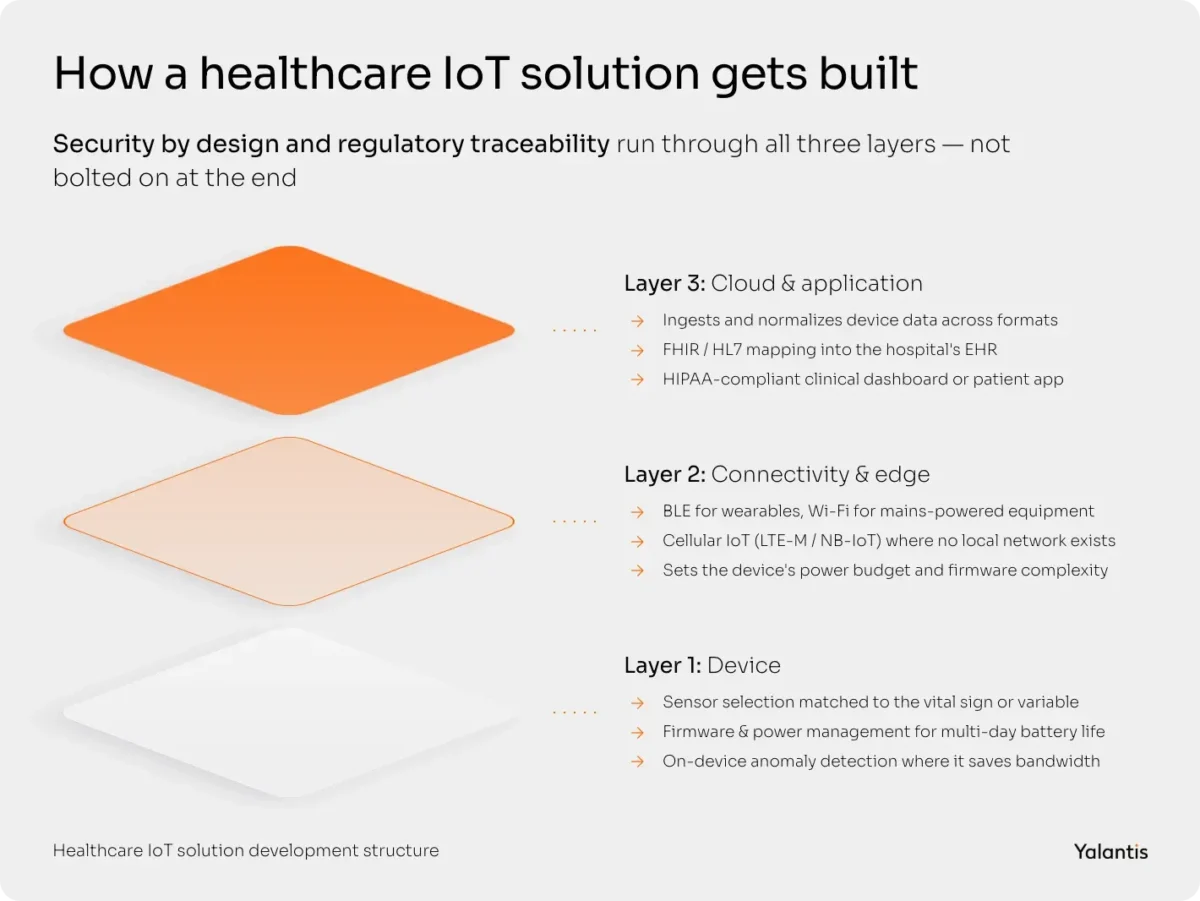
The device layer starts with sensor selection matched to the vital sign or environmental variable you are measuring, then a firmware layer that handles power management, since most wearable and at-home monitoring devices need to run for days or weeks on a small battery. Many IoMT devices now push basic anomaly detection onto the device itself, flagging an irregular heartbeat locally rather than streaming raw data continuously, which saves both battery and bandwidth.
The connectivity layer depends heavily on the use case. Bluetooth Low Energy dominates wearables and phone-paired devices because of its low power draw and short range. Wi-Fi suits mains-powered hospital equipment. Cellular IoT, especially LTE-M and NB-IoT, fits devices that need to work outside a hospital’s network entirely, like a home monitoring kit with no reliance on a patient’s home Wi-Fi. The stack you choose sets your device’s power budget and how much firmware you have to write and certify.
The cloud and application layer is where raw IoT data becomes a clinical or operational signal. This layer ingests data from multiple IoT devices, normalizes it across formats, and applies the FHIR or HL7 mapping needed to talk to a hospital’s EHR.
Then, it exposes results through a HIPAA-compliant clinical dashboard that plugs into existing clinical and healthcare systems rather than sitting apart from them. For a broader look at how these three layers come together outside of a single vendor’s stack, see our guide to connected healthcare.
Two engineering disciplines cut across all three layers when implementing IoT for healthcare:
- Security by design. Encryption in transit and at rest, device authentication, and a documented vulnerability disclosure process need to exist before the first pilot device ships, not after a security review flags their absence.
- Regulatory traceability. If any part of the system touches diagnosis or treatment decisions, the design and test records an FDA reviewer or auditor will eventually ask for have to be created as the software is written, not reconstructed afterward.
Need a partner who owns hardware, firmware, and the cloud platform as one system?
We build medical IoT devices and the compliant platforms behind them under one roof.
The future of IoT in healthcare: from connected devices to continuous care
Three trends are shaping where the adoption of IoT in healthcare goes next.
AI moves onto the device itself. Rather than streaming continuous raw data to the cloud for analysis, more wearables and monitors are running lightweight machine learning models directly on the device, catching an anomaly the moment it happens instead of on the next sync. This shift, often called edge AI or TinyML, cuts both latency and battery drain, and it is quickly becoming standard on newer cardiac and glucose monitoring hardware.
Predictive, not just reactive, care. As more patients carry continuous sensor histories, the next step is using that data to predict a decline before symptoms appear, rather than simply alerting after a threshold is crossed. This is the same shift that has already reshaped industrial maintenance, and healthcare is following the same curve.
Wearables keep absorbing capability that once required a clinical visit. Continuous glucose monitoring, once a niche diabetic tool, is now becoming a mass consumer product, as the underlying sensors get smaller, cheaper, and more accurate. Expect the same trajectory for cardiac monitoring, sleep apnea screening, and blood pressure tracking over the next several years, each one moving a diagnostic step out of the clinic and onto the wrist — a hallmark of modern healthcare.
The next phase of IoT in healthcare is less about connecting more devices and more about making the data they produce useful at the right moment.
Why choose Yalantis for healthcare IoT project
Hardware, firmware, cloud platform, and compliance packages for a healthcare device rarely succeed as separate workstreams handed to separate vendors — IoT hardware and software only work when they are built as one system.
Yalantis team has spent 17+ years delivering digital products for healthcare. We hold ISO 13485 certification and have taken devices through the FDA on the first attempt 90% of the time. We have shipped wearable integrations, continuous monitoring platforms, and FDA-cleared connected devices for clients from independent digital health startups to Fortune 500 technology companies. Our medical case studies reflect real regulatory and engineering work.
Building connected healthcare? Bring us your challenge
If you are weighing a build-versus-partner decision on a connected health product right now, we are glad to talk through it.
FAQ
What is IoT in healthcare?
IoT in healthcare is the use of internet-connected trackers, wearables, and medical devices to automatically collect and transmit patient and operational health data to clinicians, hospital systems, and care platforms, replacing manual charting and periodic checks with continuous, real-time data.
What are examples of IoT in healthcare?
Common examples of IoT in healthcare include wearable pulse and ECG monitors, continuous glucose monitors, connected inhalers, smart pill dispensers, RFID-tagged medical equipment, remote patient monitoring kits, and ingestible sensors that track internal health metrics without surgery. Explore our IoT healthcare success stories to see it in action. One clear example of IoT in healthcare is a chest-worn ECG patch that reports arrhythmias straight to a cardiologist.
What types of IoT devices are used in healthcare?
Healthcare IoT devices include wearable monitors, continuous glucose monitors, connected inhalers and medication dispensers, ingestible and implantable sensors, hospital equipment with RTLS tags, and multi-vital home monitoring kits, each suited to a different combination of connectivity, power, and regulatory requirements.
What are the security risks of IoT in healthcare?
The biggest security risks are unpatched and end-of-life devices, weak network segmentation that lets a compromised device reach the wider facility network, and poor device inventory visibility. 99% of hospitals currently run at least one IoMT device with a known exploited vulnerability, and breaches average $10.22 million in the US.
What is the future of IoT in healthcare?
The future of IoT in healthcare is moving toward on-device AI that flags problems in real time rather than after a cloud round-trip, predictive rather than purely reactive monitoring, and wearables that keep absorbing diagnostic capability once limited to a clinical visit, from glucose to cardiac to sleep monitoring.
About the author