

High bill of materials (BOM) costs eat directly into product margins, but cutting component prices without a clear strategy usually creates bigger problems than it solves. Teams that chase the cheapest parts often run into quality issues, certification delays, supply chain instability, and late redesigns that erase any initial savings.
The real challenge isn’t whether to reduce BOM costs, but how to do it without undermining reliability, compliance, or scalability. Effective BOM optimization starts during product design and architecture, long before procurement negotiations begin. It requires making cost-aware design decisions early, when those choices still determine how much each unit will cost to build.
Partnering with a hardware development company makes this process predictable. Experienced teams combine system architecture, component selection, firmware, and manufacturing constraints into a single cost model. Such an approach helps companies reduce BOM costs without sacrificing product quality or creating downstream risk.
What drives high BOM costs?
A bill of materials lists every component required to build a product, from major elements such as processors and displays to passive components like resistors and capacitors. BOM cost represents the direct material cost per unit and is one of the primary factors that determine product margins and scalability.
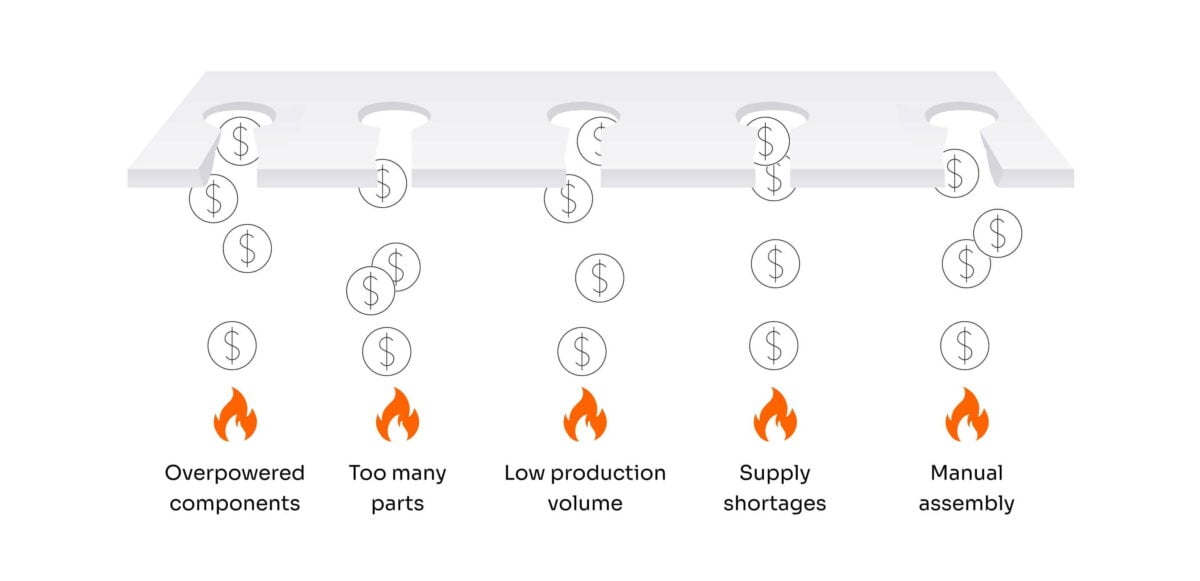
Several factors consistently influence BOM costs:
Component selection and specifications
Teams often choose microcontrollers with more processing power than required, specify tighter tolerances than the design actually needs, or pay for premium features that are never used. These decisions increase cost without adding product value and are usually made early, when they are difficult to reverse later.
Design complexity and part count
Higher component counts increase assembly time, testing effort, and the probability of defects. A board with 300 components does not just cost more than one with 150; it typically has lower manufacturing yield and higher rework rates, which amplify cost as production volumes increase.
Production volume and purchasing leverage
Component pricing and supplier options change significantly with volume. Ordering 500,000 units results in lower prices and better supplier terms compared to ordering 5,000. Reusing the same components across multiple products increases total volume and reduces BOM cost more effectively than optimizing a single product in isolation.
Supply chain constraints and component lifecycle
Component availability and lifecycle status directly shape BOM cost, as scarce parts drive up prices and end-of-life components force last-time buys or redesigns, which increase overall cost.
Manufacturing and test requirements
Some components introduce cost beyond their list price. Manual assembly steps, specialized processes, or additional testing increase labor costs and reduce yield. For instance, Dual In-line Package (DIP) or “through-hole” components require manual soldering by a technician. It is much more expensive than modern Surface-Mount Device (SMD) assembly, where high-speed robots place components directly onto the board surface in a fully automated, high-yield process. In many products, these indirect costs exceed the cost of the components themselves.
BOM cost reduction ≠ cheap parts
The fastest way to damage your product is to treat BOM cost management as a simple price-cutting exercise. Here are the most common mistakes:
- Switching to cheaper, unvalidated alternatives often creates unexpected outcomes. Components with identical specifications on paper can behave differently in real conditions, showing issues only after months of use.
- Ignoring the total cost of ownership creates false savings. A connector that costs $0,50 less but requires manual assembly instead of automated placement can increase per-unit costs. Component price is just one factor in reducing manufacturing costs.
- Cutting components required for certification introduces high downstream risk. Removing electromagnetic interference (EMI) filtering or safety features to save a few dollars per unit can trigger certification failures, leading to re-testing costs, redesign effort, and months of schedule delays.
- Single-sourcing critical components increases supply risk due to price increases. The cheapest supplier today may be unavailable tomorrow. The 2020-2022 chip shortage showed how price-optimized sourcing left many companies unable to ship products at any cost.
- Over-optimizing before validating real requirements leads to field failures. Switching to lower-spec components that “should work” without proper testing often results in reliability issues, customer complaints, and warranty costs that exceed the original savings.
Key strategies Yalantis applies to reduce your BOM costs
While negotiating better prices with suppliers matters, the real opportunity lies much earlier in the product development cycle. Effective BOM optimization strategies approach cost reduction as an engineering and strategic task, not a purchasing one. By the time your procurement team starts negotiating component prices, the most impactful decisions have already been made.
At Yalantis, we focus on removing architectural inefficiencies and reducing unnecessary complexity to design products that scale cleanly from prototype to mass production. Each strategy below addresses a specific weakness that typically inflates BOM cost and demonstrates how we can strengthen manufacturability and long-term supply stability of your product.
1. Design with fewer parts from the start
Modern system-on-chip (SoC) solutions consolidate what used to require multiple discrete components into a single integrated circuit. A wireless-enabled product that once needed a separate microcontroller, Wi-Fi module, Bluetooth chip, and power management IC might now use a single SoC that integrates all these functions.
Yalantis is a hardware design and development company that helps organizations identify consolidation opportunities early in system architecture, when these decisions still shape cost and manufacturability. Reducing the number of components speeds up assembly and decreases the number of failure points. A single integrated chip might cost more on paper than the discrete components it replaces. However, it saves money through reduced assembly labor and lower defect rates.
2. Move logic from hardware to firmware
This is where engineering expertise delivers the most dramatic manufacturing cost reduction, often 30% or more. Instead of relying on external specialized chips, Yalantis designs systems around modern general-purpose microcontrollers (MCUs) that already include built-in hardware accelerators and signal-processing capabilities. Our firmware controls and coordinates these capabilities, eliminating the need for separate components.
Take digital signal processing (DSP) as an example. A dedicated DSP chip might cost $10 and handle filtering, noise reduction, or data compression. Instead of this specialized chip, you may run the same logic on a $2 general-purpose microcontroller. For this purpose, Yalantis engineers develop firmware that orchestrates the MCU’s built-in DSP instruction sets and integrated IP cores, such as hardware math accelerators and Direct Memory Access (DMA) controllers.
In such a way, Yalantis engineers use the full capabilities of your existing MCUs, and you don’t have to pay for redundant hardware. The same principle applies to hardware motor controllers, dedicated communication processors, analog calibration circuits, and precision timing components. Modern 32-bit microcontrollers are powerful enough to implement these functions in software at speeds that were impossible a decade ago.
The ROI is compelling. If moving to a software-defined approach saves $8 per unit in component costs, you pay for R&D once but save $800,000 over a production run of 100,000 devices.
3. Design for component availability
The 2020-2022 global semiconductor shortage taught expensive lessons about designing for price alone. Components that had been readily available for years suddenly had 52-week lead times. Distributors sold out completely. Broker prices spiked 10x normal costs. Products that relied on single-source components simply stopped shipping, regardless of how much companies were willing to pay.
Bill of materials optimization fails when products depend on components that are cheap today but fragile in supply. That is why Yalantis designs hardware with availability as a first-class constraint, selecting critical components such as microcontrollers and memory with validated, pin-to-pin compatible alternatives from multiple vendors. If a primary component becomes unavailable or its price spikes, the board can switch to an equivalent part without a full redesign, keeping production running.
4. Move from prototype to mass production with chip-down design
Many hardware products start on development boards or ready-made modules to speed up prototyping and reduce early risk. For instance, you may have built a prototype on a Raspberry Pi or a system-on-module (SOM) that costs $50 per unit. If you decide to scale to 10,000 units, that convenience turns into a major cost liability, locking you into a BOM that was never designed for production economics.
Yalantis helps companies transition from working prototypes to production-ready, chip-down designs optimized for volume manufacturing. We replace generic modules with custom hardware built around only the required components, preserving product functionality while radically improving unit economics. In typical cases, this approach reduces BOM cost to around $15 per unit, making large-scale production financially viable.
How engineering teams approach BOM optimization
Effective BOM cost reduction requires collaboration across departments. The companies that achieve 30%+ cost reductions without compromising quality bring together hardware engineers, firmware developers, manufacturing specialists, and procurement from the project’s start.
- Hardware teams make the architectural decisions that determine baseline costs. Their choices of part count, component selection, and PCB complexity lock in most of your manufacturing expenses.
- Firmware developers identify where expensive, specialized chips can be replaced with optimized code on cheaper microcontrollers. A skilled embedded team turns hardware cost problems into software engineering solutions.
- Manufacturing engineers provide reality checks on what’s practical to build at volume. They flag tolerance specifications that will cause yield problems, recommend component packages that improve assembly speed, and identify design choices that will create bottlenecks in production.
- Procurement specialists bring market intelligence: which components have volatile pricing, which suppliers are reliable, and where long lead times create risk. This real-time data shapes component selection before designs are locked.
At Yalantis, we structure projects around this cross-functional approach. Our hardware engineers, embedded developers, and manufacturing consultants work as integrated teams, not sequential handoffs. Weekly design reviews ensure cost implications are understood before decisions become expensive to change. Our goal is to engineer products systematically for sustainable manufacturing economics.
When to start BOM cost reduction in a product lifecycle
Timing matters enormously in BOM cost optimization. The earlier you address costs, the more options you have and the less expensive the changes become. Here’s what you can achieve during different stages of the project:
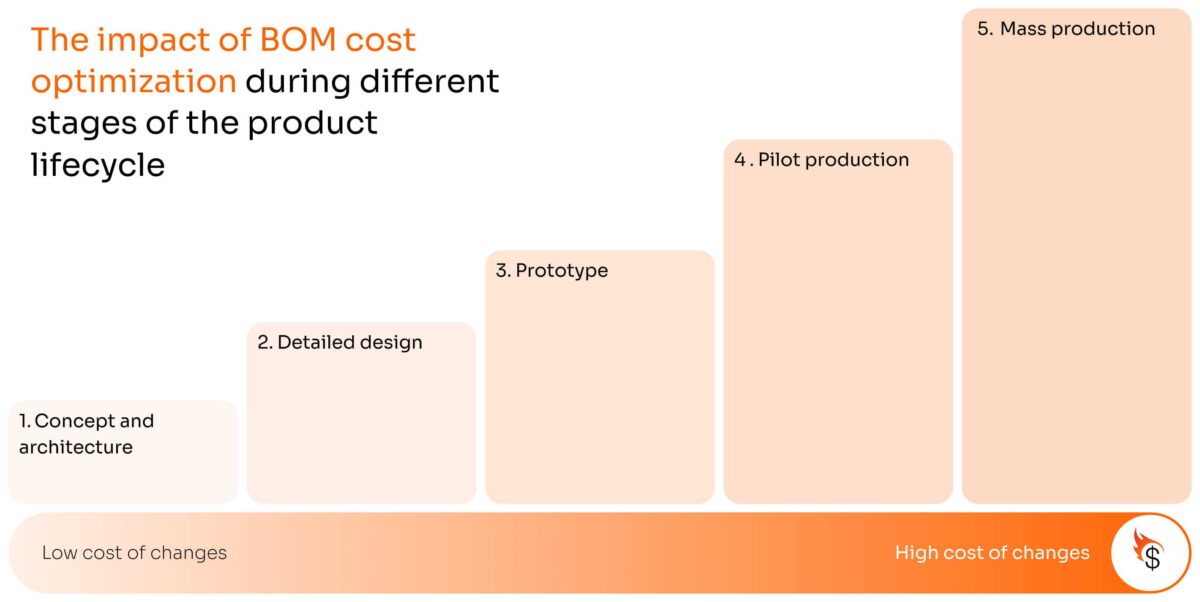
- During concept and architecture (maximum impact, minimum cost): This is where you make the highest-leverage decisions. Choosing between architectures, determining core component platforms, and establishing design principles costs nothing to change but determines 70-80% of your eventual BOM costs. Ask fundamental questions: Do we need this feature? Can we consolidate these functions? What’s the minimum viable component set?
- During detailed design (high impact, low cost): Component selection, tolerance specification, and PCB design decisions still have high cost impact and remain relatively inexpensive to change. Swapping a $4 component for a $2.50 alternative takes minutes in schematic capture. Regular cost reviews during this phase catch inefficiencies while they’re trivial to fix.
- During prototype (moderate impact, moderate cost): Prototype builds reveal real-world issues: assembly challenges, yield problems, or performance gaps that require different components. Changes are more expensive now because you’re iterating physical boards, but you’re still working with small quantities and haven’t committed to tooling. This is your last good opportunity for significant component changes.
- During pilot production (lower impact, higher cost): You’re building with production tooling and processes. Changes require procurement coordination, manufacturing updates, and careful revision control. The focus shifts from component selection to manufacturing optimization. Major component changes are expensive and risky.
- During mass production (lowest impact, highest cost): Changes are expensive and disruptive. You’re managing supply chain commitments, production schedules, and potentially multiple product versions in the field. Cost reduction at this stage focuses on volume negotiations, second-source qualifications, and incremental process improvements. Major redesigns typically wait for the next product generation.
The optimal strategy is aggressive BOM cost analysis before pilot production. Lock down your design after thorough validation, but before committing to volume manufacturing. Companies that rush to production without adequate validation end up making expensive changes under pressure. Those that validate thoroughly upfront spend more time in development but far less money over the product’s lifetime.
Plan your BOM optimization timeline backward from your production date. If you need to be in mass production in 18 months, allocate time for three prototype iterations with cost reviews after each. Build pilot production into your schedule as a deliberate validation gate, not something you rush through to hit dates.
Conclusion
Reducing BOM costs without sacrificing quality requires treating the process of cost optimization as a core engineering competency, not a procurement afterthought. The most significant cost drivers are introduced early through architectural choices, component selection, and assumptions about manufacturing scale and supply availability. Once those decisions are locked in, late-stage cost-cutting usually increases risk instead of improving margins.
Yalantis helps companies achieve lower BOM costs by aligning hardware design, embedded software, manufacturing constraints, and sourcing considerations from the start. Our system-level approach eliminates redundancy and addresses architectural weaknesses, which turns BOM optimization into a lasting economic advantage rather than a recurring problem.
FAQ
How much BOM cost reduction is realistic for my product?
Most products see 10-30% BOM cost reduction when optimization starts at the design or redesign stage. Larger reductions are possible when replacing specialized hardware with firmware, reducing PCB complexity, or moving from prototype platforms to custom designs. The exact outcome depends on production volume, current architecture, and how early cost decisions are addressed.
At what production volume does BOM optimization actually pay off?
BOM optimization usually starts paying off once production reaches a few thousand units. At lower volumes, engineering changes may not justify the upfront effort. At 10,000 units and above, even small per-unit savings compound quickly and often justify deeper architectural and hardware redesigns.
Is BOM optimization possible for legacy products?
Yes, but the scope is different. Legacy products can benefit from component substitution, PCB optimization, and firmware-driven improvements without changing core functionality. The highest-impact changes are typically scheduled for the next hardware revision rather than applied mid-production.
What are the common mistakes to avoid with BOM cost reduction?
The most common mistakes include switching to cheaper components without validation, optimizing for unit price instead of total manufacturing cost, single-sourcing critical parts, and making late-stage changes after certification or tooling is complete. These approaches often increase risk and long-term cost instead of reducing them.
Can Yalantis reduce BOM costs for regulated industries like medical or automotive?
Yes. BOM optimization in regulated industries focuses on architectural efficiency and manufacturability, not removing required safety or compliance features. Yalantis works within regulatory constraints, ensuring changes preserve certification, reliability, and documentation while still reducing unnecessary cost drivers.
About the author