
Twelve manufacturing software development companies sit in this guide, and although one category label covers all of them, they do not do the same job. Three will program a controller on your line, while five would rather that part already worked, and the distance between those two answers is where plant software budgets tend to disappear.
All twelve sell software development for manufacturing companies, and every profile here starts by saying which layer of the plant a given one actually owns, then fills in the certifications and client names, along with the point where that shop runs out of road. If you would rather shortlist first and read second, the table further down puts all twelve on one screen.
What manufacturing software development companies build
A manufacturing software development company builds the software that runs production, along with the connections that get data out of machines never designed to share it. Some of that work happens on the control network and the rest inside software systems running in a data center, which is the first thing to establish about any vendor you call.
Search results for the term mix three trades that staff differently and quote differently, and only one of them fields manufacturing software developers who have stood on a plant floor:
- Platform vendors license a product. Siemens Opcenter, Rockwell FactoryTalk, AVEVA, and Ignition by Inductive Automation are all software you buy, which leaves the job of making it fit your plant either to you or to somebody else’s contract.
- Control system integrators put that product on your line. They program the controllers and build the panels, and they are the ones standing at the cabinet when a deployment goes live during the second shift.
- Software development firms write what does not exist yet. That might be a custom MES for a manufacturing process with no product matches, an IIoT and analytics platform, edge software, or the gateway work that finally makes a controller from 2009 readable.
One piece of vocabulary makes these calls much faster, since ISA-95 divides a plant into numbered levels running from sensors at the bottom to business planning at the top. Ask a vendor which levels it works at, because specific numbers mean the team has been there, whereas a pivot to capability slides usually means it has not.
Two things then predict whether a program lands, and neither of them appears on a services page. The first is whether the team can lift data off a certified controller without editing its logic, which matters because re-validating a line costs more than most of the software involved. The second is whether security turns up in the architecture session or in a penetration test booked three weeks before go-live.
How we ranked them, and what the ranking misses
Five criteria, weighted toward connected-factory work rather than software delivery in general.
- Reach across the OT and IT boundary. A mixed fleet of controllers has to go in and clean data has to come out the other side, with nothing broken in between.
- Industrial security on the record. Certified information security management and engineering to IEC 62443, plus an answer ready for the moment a customer asks about EU Cyber Resilience Act obligations.
- How much of the stack one contract covers. Whether that runs from the board on the machine through firmware and edge up into the cloud, or stops at some point along the way.
- Client work that survives a phone call. Named accounts and published manufacturing case studies, rather than a wall of logos with no project history behind them.
- Bench and geography. Headcount that can absorb a multi-site rollout, together with enough daily overlap with your plant to actually run one.
Order here reflects fit for a connected-factory industrial software development engagement, which is a specific bet rather than a general verdict, so a firm at number ten can still be the obvious answer for a narrow scope. Rates and notice periods shift the picture further, as does the question of which engineers happen to be free in March, and none of that is public information.
The manufacturing software market moves quickly, so figures were gathered in September 2026 from vendor sites, public registries, standards bodies, and review platforms. Eight of the twelve are companies in the USA, which matters for time zones and for rates. Several of these companies publish different headcounts in different places, which is why the table notes the spread instead of pretending to a single number.We also rank ourselves second, and that deserves a sentence rather than a footnote. RoviSys took first place because it fields several times our headcount on plant-floor engineering and has been doing control system integration since 1989, which is a real gap rather than a modest one. Entry two sets out what we do differently, and since the other eleven profiles are written to the same template, you can weigh it on the same terms.
Top manufacturing software development companies in 2026
The fact card repeats the same fields every time, so you can scan one column down the page and ignore the prose until something matches, and each entry closes with the situation that makes that company the right call.
1. RoviSys

Nobody in this guide has more people standing on plant floors, which is the plainest reason RoviSys takes the top line. It has worked as an independent control system integrator since 1989, and it now fields more than 1,000 engineers, developers, and project managers across roughly 20 offices, with over 2,500 control, test, and manufacturing systems installed behind them.
Independence is the pitch, and it survives checking, because senior partner status across Rockwell Automation, Siemens, AVEVA, Beckhoff, and Inductive Automation’s Ignition means the recommendation you get follows your equipment rather than a quota. That breadth carries into scope as well, covering distributed control systems, SCADA, MES and MOM, industrial networks, and the IIoT layer stacked above them, all delivered under CSIA certification. The verticals run just as deep, from life sciences and chemicals through glass, metals, power, and battery production.
Where you should push harder is on anything happening away from the floor, since custom electronics and market-facing cloud products are not what this bench was built for. Delivery also leans heavily toward the US, with smaller footprints in Europe and Asia.
2. Yalantis

Yalantis sells one contract covering the hardware and software systems in a plant, which in practice means the industrial board, the firmware running on it, the gateway that lifts data off the PLCs you already own, and the MES or analytics layer that reads it. Because all of that sits with one team, there is a single accountability line from the first schematic through to the last site brought online.
Two specifics are worth holding against the rest of this list. The first is our Warsaw R&D lab, where industrial board design and prototyping happen in house, so the engineer choosing the silicon is also the one writing the Rust firmware for it, and one of those edge orchestrators now carries more than 50,000 sensor tags at 99.999% uptime. The second is how we treat equipment you already run, reading it through non-invasive gateways over Modbus, Profinet, and OPC UA so that certified control logic stays untouched while the shift keeps moving.
On paper that comes with ISO 9001:2015, ISO 27001:2022, ISO 13485, and ISO 27701 certification, alongside engineering to IEC 62443, IEC 61508, ISA-95, and the EU Cyber Resilience Act. In production it looks like an automated optical inspection system holding 99.7% defect detection for a tier-one automotive supplier, which paid back in eight months, and an FPGA edge AI system that took a steel plant’s monitored accident rate to zero. Behind both sit 200+ delivered projects, a 93% satisfaction score, and 4.8 on Clutch from 79 verified reviews.
What we are not is a panel shop or a commissioning contractor, so when a program needs field commissioning or volume production, we bring in a local integrator or a manufacturer and stay on the software and the hardware design.
Want the whole path under one contract, from the board on the machine to the dashboard on the wall?
3. SoftServe

SoftServe brings the largest bench in this guide, roughly 10,000 people, and it aims that bench above the control layer rather than at it. Manufacturers come here for automated visual inspection, robotics enablement, and digital twin execution, while commissioning equipment stays off the menu entirely.
The perception work runs on NVIDIA infrastructure, using DGX systems to train models, OVX servers to simulate them, and Jetson modules to run inference at the edge, all delivered under ISO/IEC 27001:2022 with ISO 27701 for privacy management. The company has been trading since 1993 from 58 locations across 14 countries, which is what lets it staff several streams of this kind at once.
Economics then decide the fit, because enterprise rates and program-sized minimums rule out a single-line trial, and every engagement assumes your automation layer already works. If the problem is a controller from 2009 that nobody left understands, that is an integrator’s job before it is SoftServe’s.
4. N-iX

Manufacturing is a standing practice at N-iX rather than a logo on a slide, and the numbers show it: more than 300 domain specialists working around 23 active industrial accounts, inside an engineering company of roughly 2,400 people.
What that practice sells is embedded software, sensor fusion, edge computing, computer vision, and the data platforms sitting above them, supported by cloud alliances across AWS, Microsoft, SAP, and Mendix and certified to ISO 27001 and ISO/IEC 27701. The client list backs the industrial claim, since Bosch and Siemens have been on the books for years alongside Fluke Corporation, AVL, and Messer.
The caveat is that this same delivery model also serves finance, retail, telecom, and healthcare, so the question worth asking on a first call about its manufacturing work is which named engineers have shipped industrial work, and on which account.
5. Grantek

For a food, beverage, or pharma plant in North America, Grantek is often the shortest route from a problem on the line to a line that works again, and it ranks among the longest-standing smart manufacturing integrators on the continent. Four decades of manufacturing IT and automation sit behind that, with an industrial safety practice attached to it.
The mix pairs shop-floor engineering with the information layer above, covering MES implementation, control system and panel design, plant safety assessments, KPI dashboards, and round-the-clock support. Verifying the client roster is unusually easy here, because Mondelez, Molson Coors, Coca-Cola, Kraft Heinz, and Brita all appear in the company’s own hiring material.
Everything is staffed onshore across the US and Canada, which buys time-zone overlap and site visits while pricing accordingly, and it leaves no offshore bench to fall back on when a budget tightens. Cloud product work belongs somewhere else on this list.
6. Kalypso

Rockwell Automation bought Kalypso in 2020 and runs it as its digital services arm, which explains the strength and the caveat in equal measure. The work centers on what the firm calls the digital thread, meaning one unbroken data path running from product development through manufacturing and into service.
Roughly 450 consultants operate out of Milwaukee, and the deepest capability among them is product lifecycle management on PTC technology, arranged alongside digital twin work, model predictive control, and autonomous manufacturing. Industrial AI capacity arrived with the Knowledge Lens acquisition in 2023, while the client base has stayed weighted toward life sciences and consumer products, along with industrial high-tech.
On a Rockwell or PTC stack that alignment saves months of discovery, though away from it, or on a program that needs somebody to own custom code for years, the fit gets noticeably thinner.
7. Itransition

Itransition approaches a plant from the ERP side of the building, which puts enterprise software development at the centre of what it sells, and that shapes what its industrial IoT practice actually does: auditing what is already deployed, designing the target state, and wiring new systems into the stack a manufacturer is paying for anyway.
The integration list carries the detail worth reading, spanning ERP, MES, SCADA, CMMS, PLM, and business intelligence tools, with Microsoft and AWS partnerships behind it and heavy Dynamics 365 capability on the finance side. Delivery holds ISO 9001 and ISO 27001, and since 1998 the company reports over 1,500 projects for more than 800 clients, run from US headquarters in Georgia with delivery centers across Europe.
Boards and firmware fall outside that scope, so a connected-equipment program will need a second supplier working in parallel, and reviewers occasionally flag friction in written communication across time zones.
8. Innowise

Few firms this size carry as many audited certificates, and that is the practical reason to look at Innowise, because ISO 9001, ISO 27001, ISO 27017, ISO 27018, and ISO 13485, together with SOC 2 and GDPR compliance, shorten the security review at manufacturers running formal supplier qualification.
Behind the certificates sit more than 3,500 in-house specialists across 60+ technologies, covering embedded software, custom ERP and production systems, computer vision, and data engineering. The company reports it can stand up a dedicated development center within days, and it works through partnerships with AWS, Microsoft, SAP, Databricks, and UiPath.
Certificates describe process, though, and they say nothing about shop-floor mileage, so ask for the manufacturing software projects by name and then confirm that those particular engineers are free for your dates.
9. ScienceSoft

Two dates say more about ScienceSoft than its size does, and both predate most AI practices: industrial IoT since 2011 and image analysis since 2013. That second one is why its machine vision work reads as engineering rather than a recent pivot, and the company has been doing manufacturing IT since it opened in 1989.
It runs 750+ in-house specialists, reports more than 4,300 delivered projects, and holds ISO 9001, ISO 27001, and ISO/IEC 27701, with plant-side work covering manufacturing analytics, IIoT software, supply chain systems, and vision-based quality inspection. Named clients include Walmart, Nestlé, IBM, eBay, and NASA JPL, which makes references straightforward to chase.
PCB design and firmware are absent from the offering, so a device build needs a hardware partner alongside, and the Texas headquarters put architects in US hours at US rates.
10. Softeq

Softeq offers full-cycle development spanning PCB design up to cloud software, a range very few software vendors will quote, which is why industrial buyers tend to use it as a device and firmware shop. Industrial automation and robotics both sit among its listed practice areas.
Houston has been home since 1997, and the company now runs 400+ people with development centers in Vilnius and Monterrey and an office in Munich, so onshore accountability comes with nearshore capacity behind it. The work covers firmware and drivers, hardware from bare boards through to finished devices, and the edge and cloud infrastructure underneath, backed by an in-house hardware lab and delivered under ISO 9001 and ISO 27001. Verizon, Epson, Lenovo, AMD, Intel, and NVIDIA all appear on the client list.
Production execution is not the business here, so an MES rollout belongs further up this list, and Houston rates sit above European equivalents for comparable scope.
11. Lemberg Solutions

Lemberg Solutions makes sense when a device needs a board, firmware, and a cloud backend from one team of roughly 200 engineers, since that arrangement removes the coordination tax of running three suppliers against a single product.
Embedded software development here covers RTOS and embedded Linux, embedded AI, and GUI development, and it sits alongside PCB design, prototype enclosures, and an in-house R&D lab, all under ISO 27001 and ISO 9001. Shipped examples make the range concrete, including battery management systems with cell balancing and CAN communication, plus embedded software for CELLINK bioprinters.
Portfolio work is where the size begins to show, because one focused device or IIoT program fits comfortably while several parallel streams across regions will stretch the bench thin.
12. Flexware Innovation

Ask Flexware Innovation which ISA-95 levels it covers and the answer is all of them, which it has been doing since 1996. Hitachi acquired the company in 2022, though the Indiana headquarters stayed where it was.
The bench is small and senior, about 100 people including 80 engineers, organized around industrial controls, systems integration, custom MES, business intelligence, and ERP work. It also holds Premier Integrator status with Inductive Automation, the top tier for the Ignition platform, and its LIFT orchestration platform was selected for Hitachi Rail’s factory in Maryland, which tells you the software goes well past configuration.
A hundred people covers a plant or a handful of sites rather than a global rollout running in parallel, and since North America is the delivery footprint, it is worth asking early who stays on your project and who gets pulled onto the next one.
How the twelve compare, and which differences actually narrow a shortlist
One table, our own row marked. The columns compress what the profiles say, so use this for the shortlisting pass and the profiles for the decision.
Which layer is your problem in?
A plant runs several layers of software at once, and vendor conversations get a great deal shorter once you can name the layer that actually hurts.
Manufacturing execution systems (MES)
A manufacturing execution system runs manufacturing operations on the floor, handling scheduling, dispatching, traceability, and downtime tracking against plan, which means it answers both what the line should be doing and what it is doing instead. A team with real MES mileage can name the platform it delivered, whether that was Siemens Opcenter, Rockwell FactoryTalk, AVEVA, or a system built from scratch to your process.
ERP for manufacturers
ERP software handles the commercial side, covering orders, inventory, costing, and planning, and the split that matters on a project is simple enough to keep in your head: ERP decides what gets made and when, while MES makes it happen on the floor. The interface between the two is where schedules quietly slip.
SCADA, HMI, and control software
SCADA and HMI speak to controllers and sensors, reporting what a machine is doing this second, which is why this automation software layer belongs to integrators and carries the strictest change rules in the building. A bad deployment here stops production outright, so nobody pushes to it on a Friday afternoon.
Industrial IoT and connectivity
Industrial IoT is the plumbing, made up of gateways, edge processing, protocol translation, and the pipelines that carry data upward. Brownfield programs almost always start here, because nothing in the layers above works while machine data stays stuck at the machine. Getting the data out is the first job, and structuring that stream so analytics can use it is the second one, which teams routinely underestimate.
Predictive maintenance
Predictive maintenance reads vibration and temperature to catch an asset before it takes the line down with it, and the business case is easier to defend than most. Siemens puts unplanned downtime at $1.4 trillion a year across the world’s 500 largest companies, close to 11% of revenue and reaching $2.3 million an hour on an automotive line. Most IoT predictive maintenance programs get funded on exactly that arithmetic, since a single avoided stoppage can cover the build.
Computer vision for quality
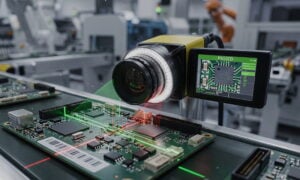
Computer vision inspection checks every unit at line speed instead of a sample, with the model running beside the camera rather than in a data center, which is what makes it fast enough to matter inside cycle time. Most of the budget in an automated visual inspection build goes on lighting and fixturing, plus the labelled images behind the model, rather than on the model itself.
Digital twins
A digital twin runs your machine or line in software off live data, so a change can be tested before production feels it. The payoff usually shows up in scheduling and commissioning, where a simulated line exposes the bottleneck that a spreadsheet keeps hidden.
Most stalled programs stall in the same place, with data that never leaves the machine. Getting it out does not require touching your control logic.
Seven questions to ask before choosing a manufacturing software development partner
Choosing the right manufacturing software development partner comes down to specifics, because capability lists all read the same. Evaluating software development partners is mostly a listening exercise, so take the following into a first call and judge the shape of each reply rather than its length.
- Which ISA-95 levels do you work at? A strong answer names the levels and the systems sitting at each one, whereas a weak answer describes end-to-end capability without going anywhere near the model.
- What does your ISO 27001 certificate actually cover? Ask for the certificate number and the scope statement, then check both with the issuing body, since scope can cover an entire delivery organization or a single office.
- How would you apply IEC 62443 on a plant like ours? Listen for network segmentation and threat modeling during design, because a penetration test booked for the week before go-live represents a very different level of commitment.
- Who carries our EU Cyber Resilience Act work? Reporting duties have applied since September 11, 2026 and the full requirements arrive on December 11, 2027, so a partner in this market should know both dates and what it costs to keep a software bill of materials current.
- Which brownfield site can I call? Greenfield references prove very little, so what you want is mixed protocols, at least one controller nobody documented, and a plant manager willing to pick up the phone.
- Who owns the source, the firmware, the design files, and the historical data? Get that answer into the contract rather than the proposal, including what happens to the data if the relationship ends early.
- What happens to the price when scope moves? Fixed scope suits a locked specification, while a dedicated team suits a program still learning what the data shows, and matching the model to the unknowns saves more than negotiating the rate ever will.
Controllers from another decade, a network with no route out, and a line that cannot pause for the upgrade. There is a way through that.
What it costs, and why the contract shape matters more than the rate
Two contract shapes cover almost every credible partner, and choosing between them follows how much is still unknown, since a locked specification suits fixed scope while a program that will learn as it goes suits a dedicated team.

What a first year usually looks like
The development process on a plant moves in phases, and each phase exists to retire one specific risk, which is also why sequencing them this way turns a budget conversation into something other than a guess.
What moves the number
Four factors matter more than the hourly rate.
- Integration surface. Every extra protocol and controller generation adds discovery time before anyone writes production code, and every undocumented system adds more on top of that.
- Where the code has to run. Air-gapped networks and deterministic timing cost more than a cloud deployment, and hardware built to survive a factory floor costs more again.
- When you are allowed to deploy. Shutdown-only windows bring rehearsal and scheduling overhead with them, along with a rollback plan that has to work mid-shift rather than in theory.
- Evidence as well as security. Segmentation and threat modeling are engineering hours, and the audit trail that a customer questionnaire demands is a good many more of them.
One rule holds across all of it, which is that the first large invoice should never depend on a document. Spend a pilot instead, and structure it so that failing stays both cheap and quick.
Six trends shaping manufacturing software development in 2026
Six manufacturing trends shifted over the last year, and each one changes what you should be asking a vendor, since taken together they are roughly what separated the twelve companies above.
Security stopped being a principle and became a calendar entry
EU Cyber Resilience Act reporting duties have applied since September 11, 2026, and the full requirements, CE marking and software bills of materials included, land on December 11, 2027. Large buyers have already started asking suppliers for compliance attestations, which turns the standard your software was built to into a commercial question rather than an engineering preference.
Inference moved onto the line
Vision models now run beside the camera instead of in the cloud, which pulls latency inside cycle time and lets a defect be caught in the same second it appears. An optical inspection system we built for a tier-one automotive supplier reached 99.7% detection accuracy and paid back in eight months, and since cameras and inference hardware have both got cheap, integration work has become the real constraint.
One data layer replaced the spaghetti
Plants are abandoning bespoke links between every pair of systems in favor of a single structured layer, usually MQTT with Sparkplug B organized along ISA-95. The consequence is cumulative, because adding the ninth system stops meaning eight new interfaces, and that is what makes every project after the first one cheaper.
Modernization stopped meaning replacement
Non-invasive gateways and protocol translation let a plant read from decades-old controllers while certified logic stays untouched, and virtualization keeps control systems alive that could never survive re-certification. That is why modernizing a plant without replacing its controllers now starts with reading the equipment rather than with a migration plan.
Downtime math got easier to defend
Downtime costs climbed 62% since 2019 even as the number of incidents fell, because leaner plants absorb a stoppage far worse than they used to. That arithmetic is why IIoT programs in manufacturing now get approved on avoided-loss math instead of efficiency promises.
AI claims started getting tested
Every vendor has an AI page, so what changed is the questioning: manufacturing buyers now ask which model runs where and what it was trained on, then follow up on what happens when it is wrong on a moving line. Partners who answer with a reference deployment and a latency figure are pulling away from the ones who answer with an architecture diagram.
Why partner with Yalantis for manufacturing software development
Rather than another pitch, here is the shape of a Yalantis engagement, so you can hold it against the eleven other profiles above.
We start by surveying what is actually on your floor, then propose a pilot on one line, and build out only once that pilot produces numbers you could take to a board. Along that whole path we cover industrial hardware, firmware, edge software, OT and IT integration, and the analytics layer under a single contract.
- One team, whole stack. There is no hand-off seam between a hardware vendor and a software vendor, because there is only ever one supplier to hold accountable.
- A lab in Warsaw. Industrial board design and prototyping happen in house, which means the engineer choosing the silicon is the same one writing firmware for it.
- Compliance during design. ISO 9001, ISO 27001, ISO 27701, and ISO 13485 certification sit behind engineering to IEC 62443, IEC 61508, ISA-95, and the EU Cyber Resilience Act, so audits become a formality rather than a scramble.
- Brownfield first. Non-invasive gateways over Modbus, Profinet, and OPC UA read your existing equipment while its certified logic stays exactly as it was commissioned.
- Rust where a crash is expensive. Memory-safe firmware runs on the edge nodes carrying production data, which is how one of our orchestrators holds 99.999% uptime across more than 50,000 sensor tags.
The record behind that runs to 200+ projects delivered, a 93% customer satisfaction score, 4.8 on Clutch from 79 verified reviews, and an average partnership longer than four years. Bosch and Toyota Tsusho both run formal supplier qualification, and both have kept multi-year engineering programs with us.
Point at the line that loses you the most time. Our engineers will come back with the shortest path to fixing it, and a pilot you can measure in weeks.
FAQ
How do I choose a manufacturing software development company?
There is no single best manufacturing software development company, so start by naming the layer your problem lives in, because that alone removes most of the market. Picking the right manufacturing software development company then comes down to evidence. From there, test five things: ISA-95 scope the team can state without prompting, certificate scope you verify with the issuing body, a brownfield reference who answers the phone, IEC 62443 practice that shows up in design rather than in testing, and a contract shape that matches how much is still unknown. Run a paid discovery or a single-line pilot before any plant-wide commitment, since that is where the assumptions get tested cheaply.
What types of software do manufacturers need?
There are four layers, plus what sits across them. ERP runs orders, inventory, costing, and planning, while MES and MOM run execution and traceability on the floor, and below those SCADA and PLC software run the machines themselves. PLM holds product and engineering data alongside all of it. Across those layers most manufacturers then add IIoT connectivity, predictive maintenance on critical assets, and vision-based quality inspection, in roughly that order.
What is the difference between custom and off-the-shelf manufacturing software?
Generic software wins when your process resembles the process it was designed around, and it arrives with vendor support and updates, plus people on the market who already know it. Custom software development for manufacturing wins where your plant is genuinely different, or where the integration you need simply does not exist. Most plants end up running both, which is why a straight partner will tell you which parts to buy instead of quoting a build for all of it.
How do manufacturing software development companies integrate with legacy OT, MES, and SCADA systems?
They read from the equipment instead of rewriting it. Gateways and protocol adapters sit beside the controller, translate Modbus, Profinet, and OPC UA into one stream, then pass it upward to MES, ERP, and analytics, so certified logic is never edited. That restraint matters because re-validating a line costs more than the integration did in the first place. Where a controller is too old to expose safely, virtualization or a staged migration takes the place of a forced upgrade.
What security standards matter for manufacturing software?
IEC 62443 comes first, and it is worth asking about by name, since it is the reference standard for security in industrial automation and control systems. Around it, ISO 27001 shows an audited information security program behind the vendor, and ISO 9001 shows quality management behind the engineering. Selling connected equipment into the EU adds legal duties under the Cyber Resilience Act as well, where reporting has been live since September 11, 2026 and the full requirements arrive on December 11, 2027.
Should manufacturers build in-house or outsource software development?
Keep what encodes your advantage, which is usually process know-how and the models tuned to your own equipment, then buy the work that is specialized or cyclical, such as industrial firmware, edge AI, or a plant-wide integration program. The arrangement that tends to hold is a small internal group owning architecture and vendor management, with an external development team supplying depth when a phase demands it.
How much does manufacturing software development cost?
Scope drives the number far more than the hourly rate does, and what moves it most is integration surface, edge and on-premise constraints, deployment windows, and the security evidence a customer will eventually ask for. For planning purposes, allow 2 to 4 weeks of discovery, 8 to 12 weeks for a pilot, 4 to 9 months for a full build, and 12 to 36 months phased for multi-site work. A bid sitting well below the others usually means the integration and security work has not been priced yet.
About the author