





|
Key takeaways
|
In 2025, developers named Rust the most admired programming language for the tenth year running. The Stack Overflow Developer Survey heard from more than 49,000 of them, and Rust topped the list again. On its own, that is a fun statistic. What turns it into a leadership conversation is who else started paying attention. The US government now urges software makers to move to memory-safe languages, and the EU’s Cyber Resilience Act attaches security obligations to anything sold with a digital component. Carmakers have gone further: they are shipping Rust inside vehicle control units.
If you are weighing whether Rust belongs on your three-year platform roadmap, this guide gives you the full picture. What Rust is, how fast it is really being adopted, what teams build with it, the industries moving first, the companies running it in production, and the trade-offs nobody should gloss over. Let’s start with the basics.
What is Rust? The trade-off it refuses to make
Rust is a statically typed systems programming language that delivers the speed of C and C++ with built-in memory safety and no garbage collector. That combination is the whole point. For decades you could pick raw performance or memory safety, and Rust refuses to make you choose.
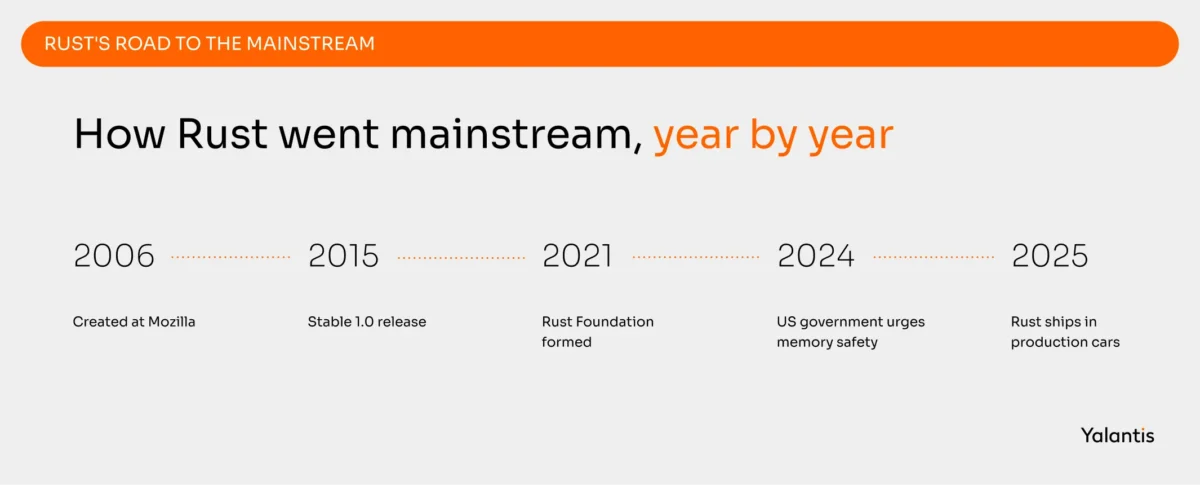
The language was created by Graydon Hoare at Mozilla in 2006, sponsored by Mozilla as it matured, and reached its stable 1.0 release in 2015. That short history matters: most of the Rust programming language history you care about as a buyer has happened in the last decade, which is why the ecosystem feels both modern and battle-tested at once.
In 2021, governance moved to the independent Rust Foundation, founded by Amazon, Google, Huawei, Microsoft, and Mozilla. Today the foundation stewards the Rust language on behalf of the companies that depend on it, which removes the single-vendor risk that worries enterprise architects. Rust’s design goals are easy to state and hard to engineer: memory safety and high performance at the same time. A third idea, zero-cost abstractions, lets you write expressive code that compiles down to machine code as lean as hand-tuned C.
What’s driving Rust’s growth in 2026
Rust’s momentum in 2026 comes from two forces meeting. Developers genuinely like working with it, and regulators now effectively require what it provides. Adoption is climbing in a steady, structural way, even though Rust is still a specialist language rather than a default like Python or JavaScript.
Here is the honest version of Rust programming language adoption, because the SERP and your engineers both reward honesty over hype.

Consistently high developer satisfaction
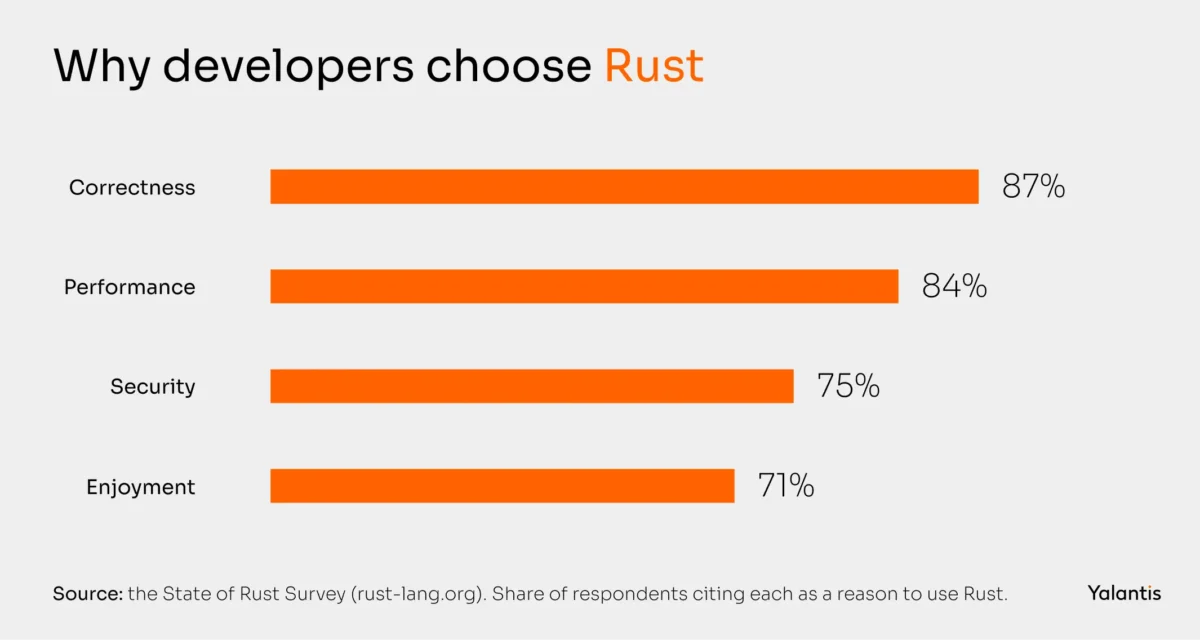
Developer satisfaction with Rust stays high, year after year. In the official State of Rust Survey, run by the Rust project every year since 2016, developers report high satisfaction and rising productivity. When asked why they reach for Rust, the top answers are correctness and performance, with security close behind.
That ordering tells you what Rust is really for. People do not pick it to ship a prototype faster. They pick it when being wrong is expensive, and they stay because the language keeps that promise in production. Enthusiasm follows from results, not the other way around.
A specialist language on a steady climb
Rust has not gone fully mainstream yet, and a roadmap decision deserves that honesty. In any ranking of Rust popularity, it still sits well behind defaults like Python and JavaScript, and it remains a specialist language rather than a general-purpose first choice. What matters is the direction of travel.
The survey team is careful about this too. They note their data reflects people who already use Rust, so it cannot be read as a snapshot of the whole industry. Treat Rust as a deliberate, growing choice for specific problems. The climb is steady and structural, not a hype spike that will fade next year.
Organizational adoption has crossed 45%
Adoption has crossed a meaningful threshold. In the State of Rust Survey, 45.5% of organizations now report non-trivial Rust usage, up from 38.7% just a year earlier, a jump of nearly seven points. The 2025 edition, the survey’s tenth, shows that level holding steady.
The individual trend matches. Around 38% of surveyed developers use Rust for most of their work, up from 34% the year before. WebAssembly and embedded targets are a fast-growing share of where that work happens, which points Rust squarely at performance-critical, production systems.
Deepening corporate backing behind the Foundation
Corporate backing keeps deepening. ARM upgraded to Platinum membership in the Rust Foundation in September 2025, joining founding members like Amazon, Google, Microsoft, Huawei, and Mozilla. That matters for a simple reason: the companies funding Rust are the same companies building the chips, clouds, and operating systems your stack runs on.
A deep and maturing crate ecosystem
The Rust ecosystem is one of its quieter strengths. The crates.io registry has grown into a deep, well-curated library of reusable packages, including more than 11,000 embedded-compatible crates, so your team rebuilds far less common functionality from scratch.
The language itself keeps maturing too. During 2025 it stabilized long-requested features such as let chains and async closures, and the survey found developers picked them up quickly. A growing ecosystem plus a stabilizing core is exactly the maturity signal an enterprise architect looks for.
|
💡 Pro tip Watch the admiration-versus-adoption gap, then use it. Start Rust where the cost of a memory bug is highest: a new networking daemon, a parser, a security-critical service. You do not need to rewrite your monolith on day one to get most of the benefit. |
The use cases where Rust earns its place
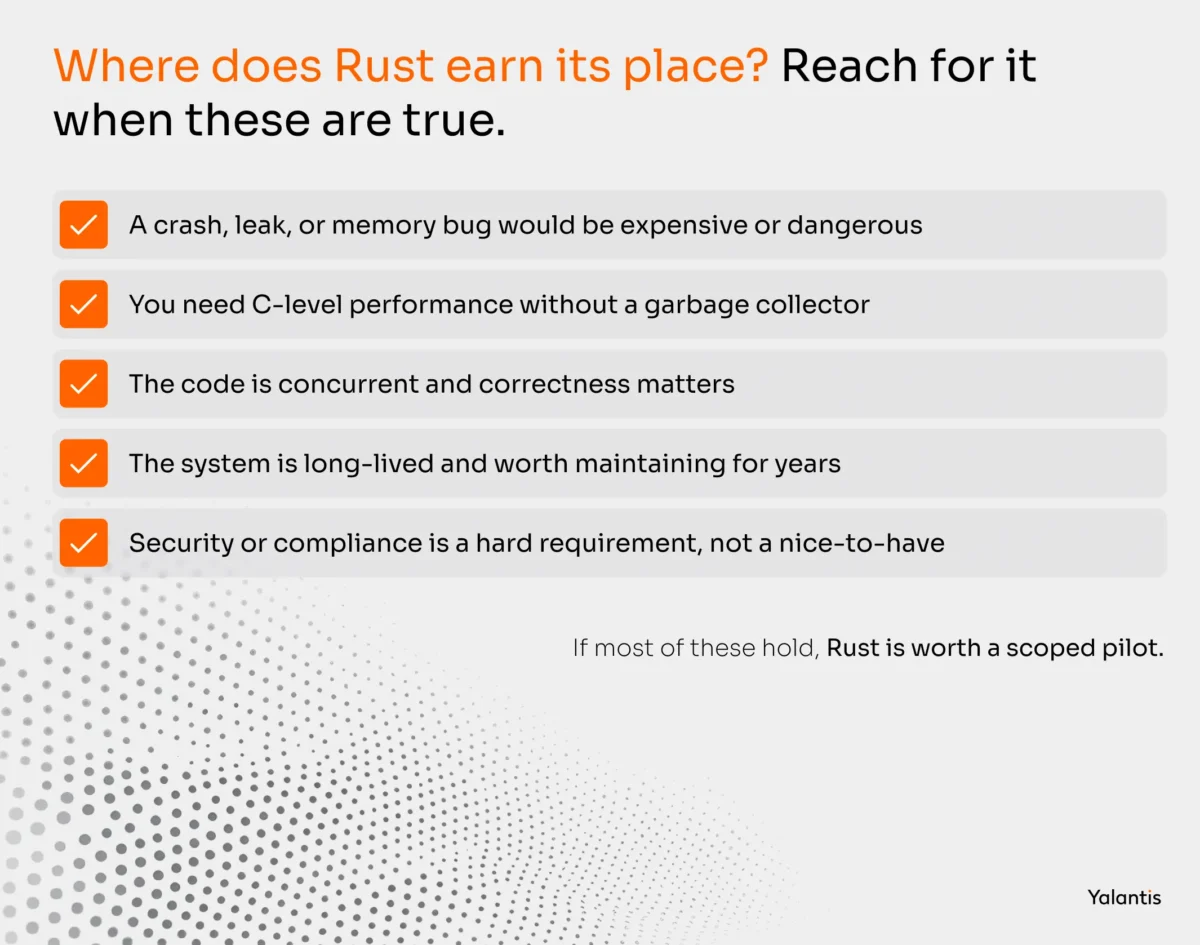
Rust is used wherever performance and reliability both matter and a failure is expensive. That covers operating systems, backend services at scale, embedded firmware, blockchains, developer tooling, and increasingly the infrastructure under AI workloads. Below are the Rust use cases that show up most often in production.
Systems programming and OS-level work
This is Rust’s home turf. Rust was merged into the mainline Linux kernel in 2022 and has been expanding ever since, with maintainers increasingly treating it as a permanent second language alongside C. Microsoft has rewritten Windows kernel components in Rust, and Google ships Rust across Android’s system layers. When the operating system itself adopts a language, the reliability argument is effectively settled.
Web and backend services
Rust web development has matured fast. Frameworks like Axum and Actix Web make Rust backend development practical, with web applications and APIs that hold low, predictable latency under heavy load. The most cited example is Discord, which moved a core service from Go to Rust to kill latency spikes caused by garbage-collection pauses. That kind of Rust versus Go trade-off is now a routine architecture decision rather than an experiment.
Embedded systems and IoT
Rust embedded development is one of the fastest-growing corners of the language. You can write bare-metal firmware for embedded devices that runs directly on a microcontroller, or build on a real-time operating system for products that need guaranteed response times. Chip vendors have noticed. Espressif officially supports Rust on its ESP32 family, and Nordic and STMicroelectronics parts have strong Rust support too.
Running hardware and embedded software in parallel?
Our embedded software team builds the on-device code that ships in lockstep with your hardware.
Safety-critical systems and medical devices
For software where a bug can hurt someone, Rust now has the paperwork to back the engineering. Qualified Rust toolchains such as Ferrocene carry certifications for ISO 26262 (automotive), IEC 61508 (industrial), and IEC 62304 (medical device software). That removes the old objection that Rust could not be used in regulated builds, and it is what makes Rust for medical devices a realistic engineering path rather than a research project.
Blockchain and cryptography
Rust dominates large parts of Web3. Polkadot, built by Parity Technologies, is written in Rust, and Solana’s validator software leans on it heavily. The reasons are predictable. Cryptographic and consensus code cannot tolerate memory corruption, and Rust eliminates that class of bug while staying fast enough for high-throughput chains.
Command-line tools and developer infrastructure
Some of the tools your engineers already use are Rust under the hood. ripgrep made code search dramatically faster, and uv, a Rust-based Python package manager, took off for the same reason. The pattern is telling. Developers reach for Rust when they want a tool to feel instant.
Game engines and graphics
Rust is gaining real traction in game development, led by the Bevy engine and a growing set of graphics crates. Studios value the same things everyone else does here, namely predictable performance with no garbage-collection stutter during a frame. This area is younger than the others, so treat it as promising rather than proven for large titles.
AI and ML infrastructure and high-performance data processing
This is where Rust application development is quietly winning. Rust rarely trains the model, and it increasingly runs the plumbing around it. Polars (a fast dataframe library), Hugging Face’s tokenizers, and a wave of vector-search and inference tooling are written in Rust so that Python and JavaScript developers get speed without touching C++. When data volume and latency both spike, Rust is the layer that holds.
The industries adopting Rust first, and what they have in common
Rust adoption moves fastest in industries where a memory bug becomes a safety or compliance event, not just a crash. That means automotive, medical devices, industrial automation, cloud infrastructure, and financial services. Here is how each maps to real engineering pressure.
Automotive and software-defined vehicles
The car is turning into a computer, and Rust is moving into the control software. Volvo and Polestar have shipped Rust-based code in vehicle control units, and Renault’s Ampere unit has used Rust for security and ADAS work. The standards body AUTOSAR began exploring Rust for its Adaptive platform in 2022, and the Rust Foundation launched a Safety-Critical Rust Consortium in June 2024. Crucially, STMicroelectronics and HighTec now offer a Rust compiler qualified to ISO 26262 ASIL D, the highest automotive safety level. The regulatory door is open.
Building firmware for a vehicle or connected device?
Our firmware engineers write safe, real-time on-device code for regulated automotive and IoT hardware.
Healthcare and connected medical devices
In healthcare software, correctness is a patient-safety property, and standards like IEC 62304 and FDA cybersecurity guidance set the bar. Rust fits because it removes the buffer overflows and use-after-free bugs that can corrupt diagnostic data or open a device to attack. The practical move is targeted: use Rust for the components where a memory fault would be most dangerous, then document it for the regulator.

Turning a medical device concept into a connected product?
We take connected medical devices from idea to compliant, market-ready hardware and software.
Industrial automation and Industry 4.0
Factories run on brownfield C and C++ code that was never designed for always-on edge computing. That is exactly where Rust earns its place. Industrial standards such as IEC 62443 raise the security bar, and Rust lets you modernize gateway, telemetry, and orchestration code without inheriting C++ memory bugs. The gateway that cannot crash is the one worth rewriting first.
Modernizing legacy code on the factory floor?
Our industrial IoT team builds reliable edge and gateway software for connected manufacturing.
Cloud infrastructure and developer tooling
The companies that build the internet’s infrastructure were early to Rust. Amazon Web Services, Cloudflare, and Microsoft Azure all run substantial Rust in production for performance-sensitive systems. When your cloud provider trusts Rust with its own foundations, the enterprise-readiness question mostly answers itself.
Financial services and fintech
In finance, two things are non-negotiable: low latency and correctness. Rust appeals to trading, payments, and risk systems because it delivers C-level speed while the compiler rules out whole categories of crashes. Adoption here tends to be quieter than in Big Tech, and the technical fit is strong.
The companies running Rust in production, and what that signals
Rust is widely used in production at Microsoft, Amazon, Google, Meta, Cloudflare, Discord, Dropbox, and Mozilla, and inside the Linux kernel itself. Here is what each of them actually does with it.
- Microsoft has rewritten Windows kernel components in Rust, shipped a Rust version of the sudo utility for Windows, and uses Rust across parts of Azure.
- Amazon Web Services built Firecracker (the microVM behind Lambda and Fargate), the Bottlerocket container OS, and components of S3 in Rust. AWS engineers have said plainly that they love Rust.
- Google uses Rust across Android’s lower-level system components and has made it a first-class language for new systems code, part of a broader industry move toward memory-safe languages in operating systems.
- Meta rebuilt internal source-control tooling for its massive monorepo in Rust and uses it server-side.
Cloudflare built Pingora, an in-house HTTP proxy that handles a large share of its global traffic, in Rust to replace an older C-based stack. - Discord switched a latency-sensitive backend service from Go to Rust and removed the garbage-collection spikes that had hurt performance.
- Dropbox wrote core parts of its file-sync engine in Rust.
- Mozilla, Rust’s birthplace, used it to build Firefox’s Stylo CSS engine, replacing roughly 160,000 lines of C++ with about 85,000 lines of Rust.
- The Linux kernel accepted Rust in 2022 and keeps widening where it is allowed, a milestone no other young language has reached.
AWS uses Rust extensively, and so does nearly every company you would consider an infrastructure leader. That breadth of real-world applications, across companies using Rust programming language for very different problems, is the clearest signal of staying power.
The main benefits of Rust, starting with safer code
The core benefit of Rust is that it eliminates an entire category of bugs, memory-safety errors, at compile time, while matching C and C++ on speed. That one property cascades into stronger security and higher reliability. It also lowers long-term cost. Here are the Rust programming language advantages that matter most to a technology leader.
Same performance tier. Far fewer ways to fail.
Memory safety without a garbage collector
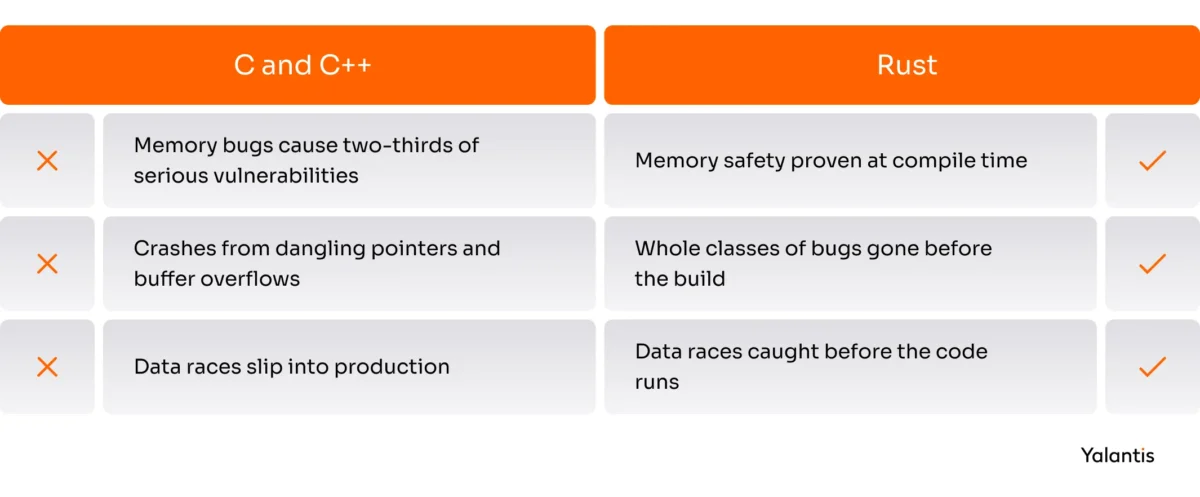
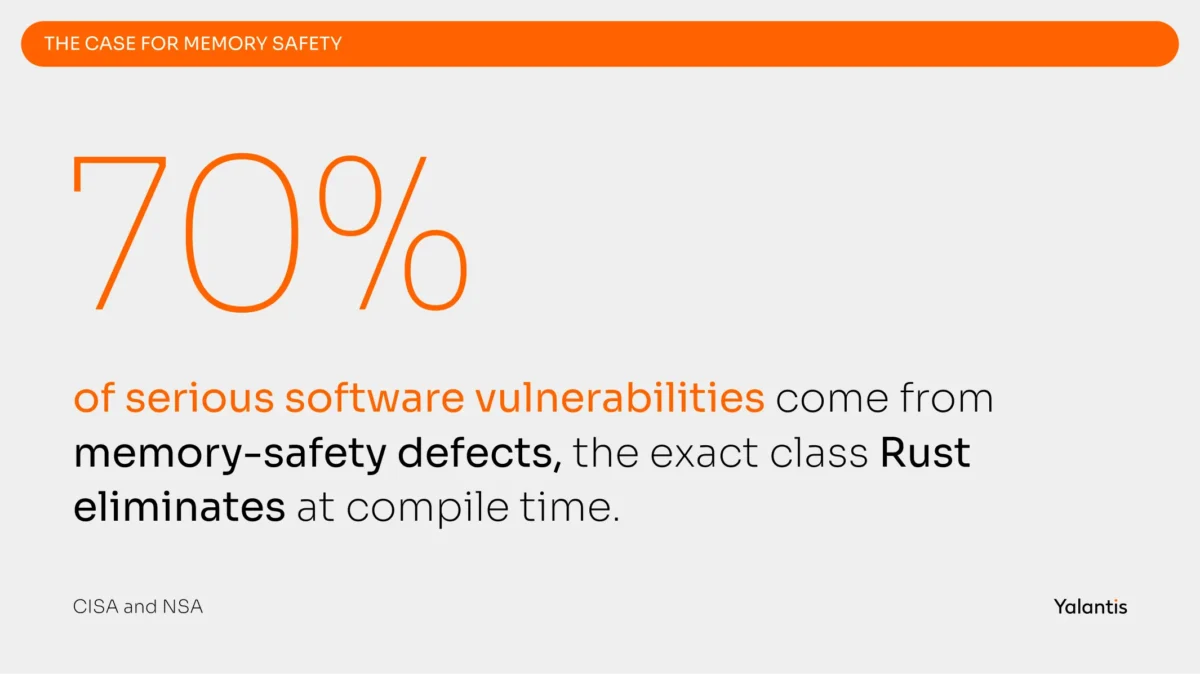
Among the Rust advantages, memory safety is the headline. Rust’s ownership model and borrow checker work at compile time, ensuring memory safety by proving your code has no dangling pointers, double frees, or buffer overflows. It achieves this with no garbage collector, so you get safety without the runtime pauses that slow down languages like Java. CISA and the NSA estimate that roughly two-thirds of serious software vulnerabilities come from memory-safety defects, the exact class Rust removes by design.
Fearless concurrency
Concurrency is where most languages let you shoot yourself in the foot. Rust catches data races at compile time, so the program will not build if two threads can touch the same data unsafely. That lets your team write aggressive multi-threaded code with confidence instead of fear, which is why fearless concurrency is a common phrase among Rust developers.
Performance comparable to C and C++
Rust runs at the same tier as C and C++. There is no virtual machine and no garbage collector stealing cycles, and zero-cost abstractions let the compiler optimize high-level code into tight machine code. As a bonus, Rust is among the most energy-efficient languages measured, which increasingly shows up on cloud bills and in sustainability targets.
A mature tooling and package ecosystem
Good tooling is a real benefit of Rust, not an afterthought. Cargo, the build and package manager, handles dependencies, testing, and builds in one tool, and rust-analyzer gives a strong experience in your IDE. Its tools and libraries are broad enough to be productive and curated enough to stay sane. For many teams, Cargo is the part of Rust they miss most when they go back to other languages.
Strong type system and compile-time guarantees
Rust’s type system catches mistakes that would be runtime crashes elsewhere. The practical effect is the one experienced Rust teams repeat constantly: if it compiles, it usually works. You pay more attention up front at the keyboard, and you get fewer 3 a.m. production incidents in return.
Long-term maintainability and total cost of ownership
This is the benefit that wins budget arguments. Rust code tends to need fewer revisions and reaches production with fewer defects, which means less firefighting and fewer emergency patches later. Higher upfront effort buys lower total cost of ownership across the life of the system. For software you will run for a decade, that math favors Rust.
Rust gave us memory safety at compile time and fearless concurrency. The garbage collector pauses and memory leaks that used to crash us in production are gone.

Mykhailo Maidan • CTO at Yalantis
The trade-offs worth knowing before you commit to Rust
Rust’s biggest costs are a steeper learning curve and slower compile times. The talent pool is also smaller than for C++, Java, or Python. None of these is a dealbreaker, and you should plan for all of them. The learning curve is real. Pretending otherwise helps no one.
- The learning curve. The borrow checker that makes Rust safe is also what frustrates newcomers in their first month of programming in Rust. Experienced C++ engineers usually become productive within a few weeks, and the early friction is real.
- Compile times. Rust builds can feel s-l-o-w, especially on large projects. Tooling like incremental compilation and faster check commands helps, and it is still a genuine cost to the development process.
- The talent pool. Fewer developers know Rust well, which is why Rust roles often command a salary premium and take longer to fill. Plan your hiring timeline accordingly, or partner with a team that already has the skills.
- Ecosystem gaps. A few niche domains still have thinner library support than the C++ or Python equivalent. Check coverage for your specific domain before you commit.
- Interop with existing code. You rarely start from scratch. Rust’s foreign function interface lets it call into existing C and C++ libraries, and getting that boundary right takes care.
The way to de-risk all of this is the same: start small and measure. Run a scoped pilot against real production conditions, prove the gains on one module, and only then commit to a wider rewrite.

|
💡 Pro tip Run a scoped pilot before you commit. One module, real production traffic, and a clean Rust-to-C++ boundary. You will learn more about whether Rust fits your team in three months than in any architecture-review debate. |
Hiring Rust developers from a smaller, senior talent pool
Hiring Rust developers means competing for a small, in-demand talent pool, so most companies blend upskilling existing engineers with specialist partners. The good news: strong C++ and systems engineers tend to convert into capable Rust programmers quickly, because the hardest Rust concepts are ones they already understand.
When you evaluate Rust talent, look past the syntax. Two things separate a hire who will ship from one who will struggle. First, real production experience, since toy projects hide the hard parts. Second, the right domain matches, because embedded Rust and backend Rust are different specialties with different mental models. Async runtime familiarity is the detail that often tells you how deep someone has actually gone.
On the build-versus-buy question, a hybrid usually wins. Keep ownership in-house and bring in a partner to seed the first project and set its patterns, then train your team through code review. That is how a Rust capability becomes self-sustaining instead of dependent on one or two heroes.
This is the work we do every day. Yalantis is a software engineering and IoT company that builds production Rust systems for regulated industries like automotive, medical, and industrial manufacturing. With an in-house R&D lab, ISO 27001 and ISO 13485 certifications, AWS Advanced Tier partner status, and an average client relationship measured in years rather than months, our Rust software development team helps you adopt the language without betting the roadmap on a single hire.
Need Rust developers who have shipped in production?
Access a dedicated team of Rust engineers experienced in embedded, backend, and safety-critical systems.
What’s next for Rust
The future of Rust runs through the Linux kernel, automotive software, and embedded AI, pushed along by memory-safety mandates on both sides of the Atlantic. The Rust adoption trends for 2026 are less about hype and more about policy and platform decisions catching up to what engineers already believed.
Government pressure is the accelerant. The US White House Office of the National Cyber Director called for a move to memory-safe languages in its 2024 report, and CISA and the NSA have since urged manufacturers to publish memory-safety roadmaps. DARPA even launched a program, TRACTOR, aimed at translating C code into Rust. In Europe, the Cyber Resilience Act will require manufacturers of digital products to meet new security obligations by 2027. Memory safety is becoming a procurement requirement, and that reshapes Rust language adoption from the top down.
On the technical front, watch three areas. The Linux kernel will keep widening Rust’s role. Automotive software-defined vehicle programs will move more safety code to qualified Rust toolchains. And TinyML, running machine learning on microcontrollers, will pull Rust deeper into edge AI, where its safety and footprint are a natural fit.
Why teams choose Rust, and Yalantis to build it
The case for Rust is concrete: the language gives you C-level performance with memory safety the compiler can prove, and that property pays off most in systems you cannot afford to have crash. Developers have known this for a decade. In 2026, regulators and platform owners are catching up.
You do not have to adopt the language everywhere to capture the benefits of Rust. You have to adopt it in the right place, with people who have shipped it before. If you are mapping where Rust fits on your roadmap, we can help you start with a scoped, low-risk pilot and grow from there, across hardware, firmware, and software under one roof.
Want one team to take your Rust project from pilot to production?
We deliver full-cycle Rust for performance-critical and regulated systems, from firmware to backend services.
FAQ
What can Rust be used for?
The main Rust use cases are systems programming, backend web services, embedded firmware and IoT, blockchain, command-line tools, game engines, and AI and data infrastructure. It fits anywhere performance and reliability both matter.
When was the Rust programming language created?
Rust was started by Graydon Hoare at Mozilla in 2006 and reached its stable 1.0 release in 2015. Governance moved to the independent Rust Foundation in 2021.
What companies use Rust?
Microsoft, Amazon Web Services, Google, Meta, Cloudflare, Discord, Dropbox, and Mozilla all run Rust in production, and the Linux kernel now includes it. Adoption is broad across infrastructure, automotive, and embedded systems.
What are the main benefits of Rust?
Rust’s main benefits are memory safety without a garbage collector and performance on par with C and C++. It also delivers fearless concurrency, catching data races before the code runs. Together these lower security risk and long-term maintenance cost.
Is Rust replacing C++?
Rust is not wholesale replacing C++, and it is increasingly chosen for new safety-critical and performance-sensitive code. Most teams adopt Rust alongside existing C++ through a foreign function interface rather than rewriting everything at once.
Why is Rust so popular with developers?
Developers like Rust because it prevents an entire class of bugs at compile time while staying fast, which means fewer production failures. In the annual State of Rust Survey, they consistently cite correctness and performance as the top reasons, with security close behind.
About the author