




A complete electronic platform integrated into the ventilation system.
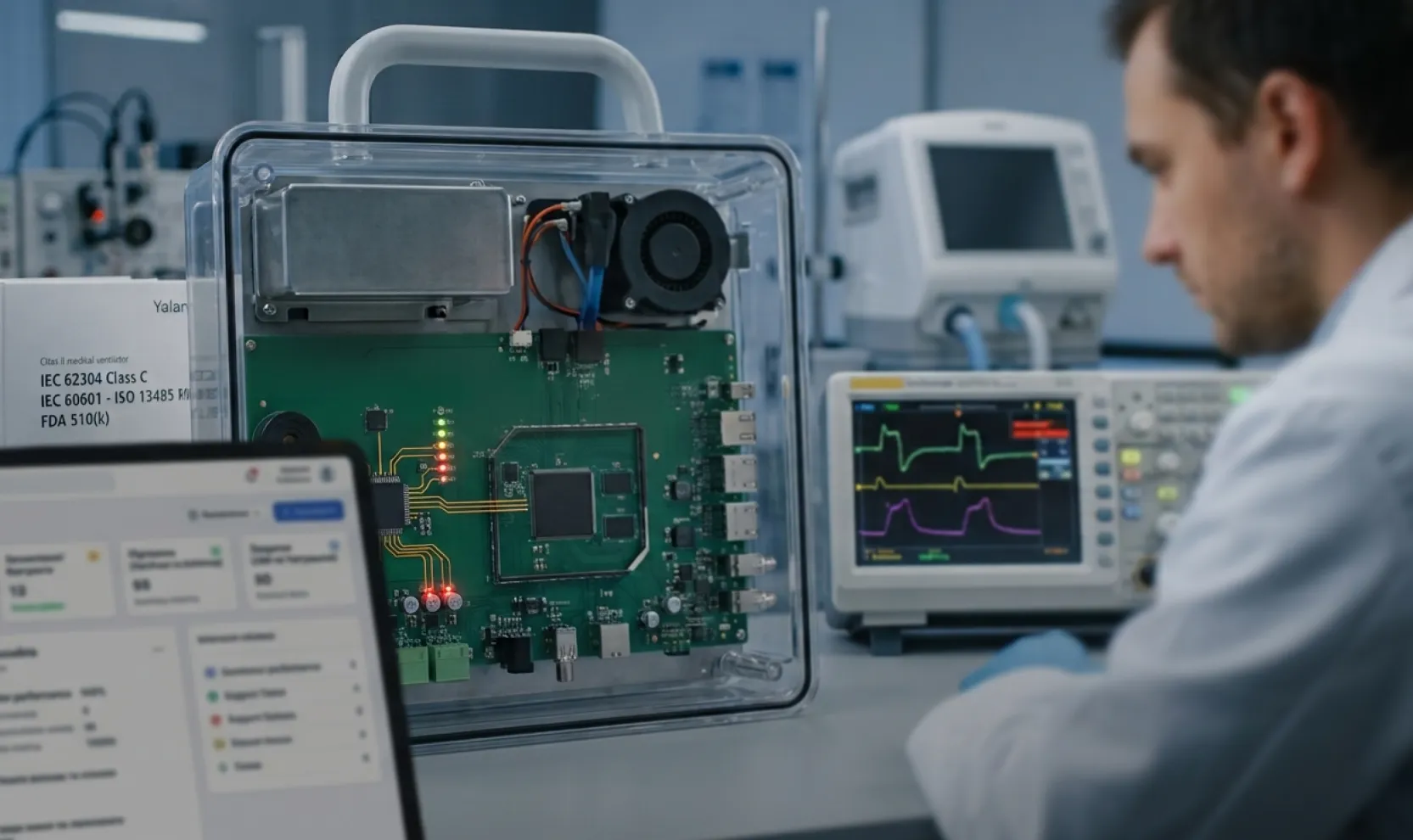
Engineering the Electronic Platform for a Life-Supporting Critical-Care Ventilator – 7 Boards, Compliant by Design, in ~13 Months
Yalantis designed, built, and tested the complete hardware, firmware, and software platform for a Class II ventilator – with a conservative safety architecture whose alarm path survives failure of the application processor.
13
Months to Alpha delivery
7
Electronic boards
C
Class IEC 62304 firmware


“In a life-supporting ventilator, the alarm has to sound even when everything else fails. That’s why we kept the clinical content strictly separated from the infrastructure running it, and gave the alarm path its own independent safety processor. The application processor can crash and the patient is still protected. That kind of conservative safety architecture isn’t a feature you add – it’s the foundation you design everything else around.”
– Denys Hukov, CGO at Yalantis
Building safety-critical medical hardware? We own the electronic platform end to end.
Regulatory path:

FDA 510(k)

ISO 13485
IEC 62304 (Class C)
IEC 60601-1 (2×MOPP)
IEC 60601-1-2 EMC
IEC 60601-1-8 alarms
ISO 14971
IEC 81001-5-1
A life-supporting device where an electronics failure could cost a life needed a partner to own the entire electronic platform
Client:
US medical-device company (identity withheld)
Device class:
Class II critical-care ventilator (life-supporting)
Care settings:
ICU
Emergency dept
In-hospital transport
Ventilation models:
MV
NIV
HFOT
Yalantis role:
Hardware (7 boards) + firmware + SW platform + pre-compliance
Team:
~10 specialists (Poland, Ukraine, Cyprus)
Our client is a US-based medical-device company building a next-generation critical-care ventilator – a life-supporting Class II device that continuously monitors and supports patient breathing. (Identity withheld at the client’s request.)
Ventilator electronics operate in a safety-critical environment where reliability, accurate sensing, and immediate alarm response directly affect patient safety. There is no margin for a silent failure. If a sensor misreads, if control logic stalls, if an alarm doesn’t sound – the consequences can be fatal.
The client had a target architecture, but needed a partner to own the electronic platform end-to-end: deterministic control, robust fault handling, and a certifiable, well-documented foundation. They would keep the clinical logic and certain hardware tasks in-house – industrial design, battery packs, and the ventilation algorithms themselves – but the electronic and embedded platform had to be someone else’s responsibility, delivered to medical-device standards.
This demanded a partner fluent in safety-critical embedded engineering and the full stack of medical device regulation – FDA 510(k), IEC 60601, IEC 62304 Class C, ISO 13485, and more. The client chose Yalantis.
Client:
US medical-device company (identity withheld)
Device class:
Class II critical-care ventilator (life-supporting)
Care settings:
ICU
Emergency dept
In-hospital transport
Ventilation models:
MV
NIV
HFOT
Yalantis role:
Hardware (7 boards) + firmware + SW platform + pre-compliance
Team:
~10 specialists (Poland, Ukraine, Cyprus)
Seven electronic boards integrated into a robust, compliant-by-design ventilation system
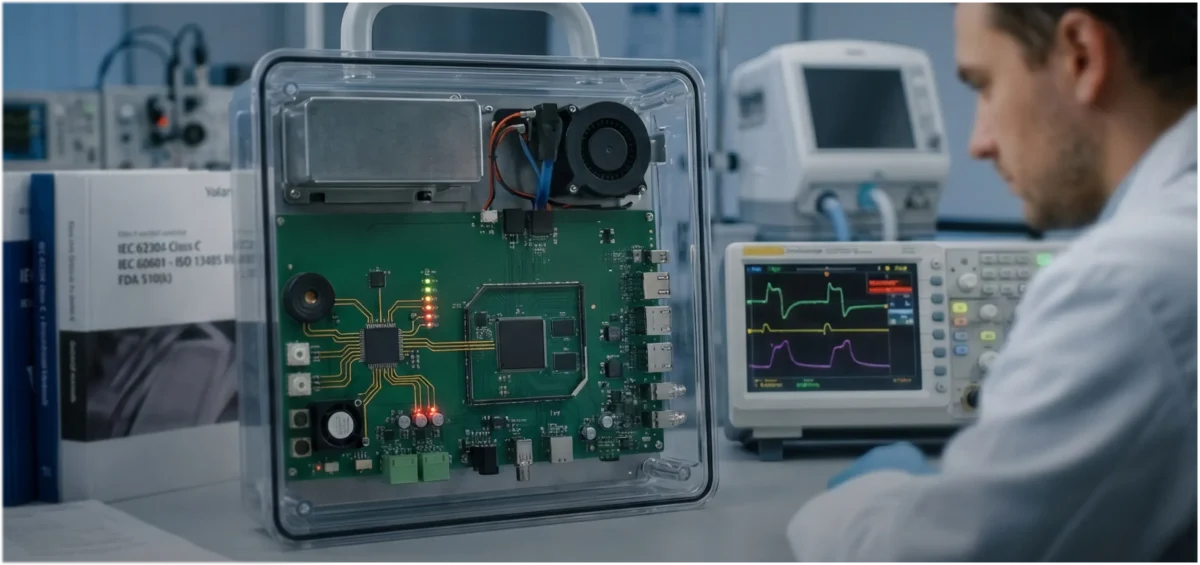
Yalantis designed, created, and tested seven boards that integrate smoothly into the ventilation system. The architecture is deliberately conservative: clinical content is strictly separated from the infrastructure that runs it, and the alarm path survives failure of the application processor. The key components:
1.
Main ventilator board
Dual-MCU design (primary plus independent safety), power management, Type BF isolation, actuator drivers, and sensor & communications. This is the heart of the safety architecture – the independent safety MCU is what keeps the alarm path alive if the primary processor fails.

2.
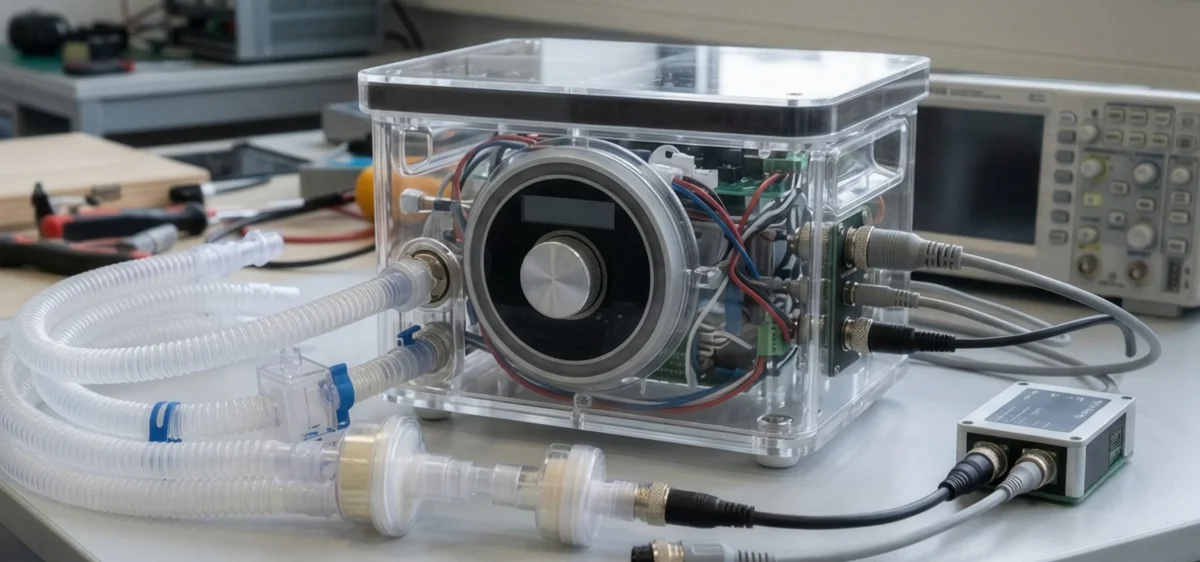
Pneumatic sensor board
Six pressure transducers with autozero solenoid valves. Accurate, drift-corrected pressure sensing is fundamental to safe ventilation – the autozero capability keeps readings trustworthy across long clinical sessions.
![Front panel display]](https://yalantis.com/wp-content/uploads/2026/10/Life-Supporting-Ventilator_solution-2-1.webp)
3.
UI carrier board
Embedded module (System-on-Module), Linux BSP, Qt runtime, peripheral drivers, and audio amplifier. This board runs the user interface and clinician-facing experience – kept architecturally separate from the safety-critical control path.

4.
Accessory interface board
Isolated pass-through for capnography (CO₂), pulse oximetry (SpO₂), and nebulizer. Galvanic isolation protects both patient and device while enabling the full suite of respiratory monitoring accessories.

5.
Status & 360° perimeter lightbars
Addressable-LED indicators and an alarm/status ring on the ventilator unit. Clinicians can read device status from any angle across a busy ICU – critical for fast response in an emergency.

6.
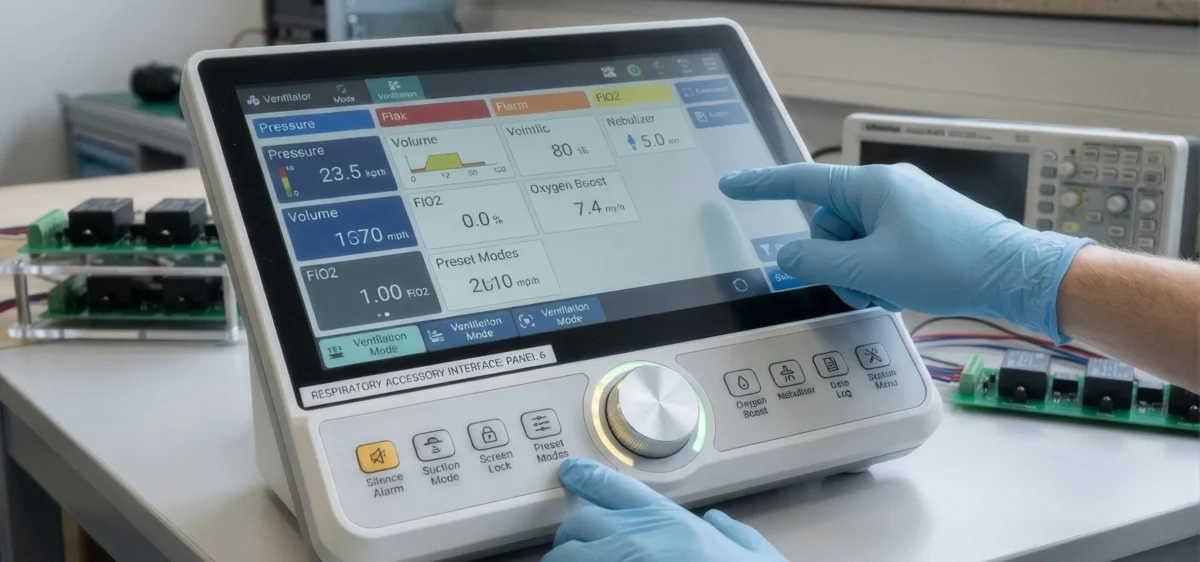
Front panel
15.6″ display, projected-capacitive touch, rotary encoder, and buttons. A responsive, clinical-grade interface that works reliably even when operators wear gloves. (The seventh board completes the integrated set.)
A clear division of responsibility between Yalantis and the client
The engagement worked because responsibilities were cleanly split. Yalantis owned the electronic platform; the client kept the clinical core and validation.
Gate-based delivery: five milestones from Discovery to Handover in ~13 months
Hardware development for a life-supporting device can’t be improvised. We structured the engagement around formal gates, each a validated checkpoint before committing to the next phase.

Discovery (6 weeks)
We aligned on the target architecture, safety strategy, and regulatory requirements – establishing the compliant-by-design foundation for everything that followed.
Gate 1 Schematic — all 7 boards
Complete schematic design for all seven boards, reviewed and approved before moving to physical layout.
Gate 2 Layout — prototype R1
PCB layout and the first prototype round, taking the design from paper into physical, testable boards.
Gate 3 Bring-up — integration
Board bring-up, firmware integration, and system verification – proving the boards work together as a coherent platform.
Gate 4 Handover — pre-compliance
Pre-compliance testing (including thermal and 30-day soak tests), full documentation, and handover to the client for FDA submission and clinical validation.
Yalantis delivered a complete, verified electronic platform ready for regulatory submission:
Seven boards designed, built, and tested
Conservative safety architecture
Clinical content separated from infrastructure; alarm path survives application-processor failure.
Class C firmware
RTOS, sensor pipeline, actuator and alarm frameworks, and independent Safety-MCU firmware.
Compliant-by-design foundation
Engineered to support the intended FDA 510(k) pathway and applicable requirements from IEC 60601, IEC 62304, ISO 14971, and the project quality system.
Pre-compliance testing completed
Including thermal and 30-day soak testing, with supporting documentation prepared for handover. with documentation ready for FDA submission.
Delivered in ~13 months
Five gates from Discovery to Handover, on a predictable schedule.
Discover the key milestones of our partnership
Be our next success story. Share details about your project and book a call with us to discuss your goals.
Certifications:

27001 2022 / 27001 2015 / 13485

Advanced IoT Core Delivery / Advanced RDS Delivery / Advanced Tier Delivery
From medical devices to industrial automation — we deliver complete enterprise solutions with regulatory compliance built-in. Everything under one roof.
Our offices

Poland
123 al. Jerozolimskie, Warsaw, 00-001

Cyprus
8 Athinon Street, Larnaca, 6023

Estonia
12 Parda, Tallinn, 10151

USA
1080 Ximeno Ave, Long Beach, CA 90804

Germany
Marienplatz 22, Munich, 80331

Let’s set up a call
Leave your info and a few words about the project. We’ll review it and reach out to book a call.
Welcome to Yalantis, please fill out the form and we’ll get back to you.

We are open for partnerships too
Check out our refferal program. Find out all benefits.