

Key takeaways
|
Building a modern medical device means balancing hardware engineering, regulated software, clinical integration, and strict compliance at the same time. If you miss any one of them, your timeline slips. More and more medtech teams now hand the build to a specialist instead. So we prepared this guide, where we compare the medical device development companies worth shortlisting in 2026.
We ranked vendors on the evidence that actually predicts a successful device program: full-cycle capability, regulated-domain experience, certifications with real scope, connectivity depth, and verified client work. If you want to see where each one is strong before reading the profiles, skip to the comparison table. If you are earlier in the process, start with what these companies do and how we chose them.
What medical device development companies do
A medical device development company is an engineering partner that designs and builds connected medical devices. It validates them too, from the physical hardware through the software that runs on it. They are not manufacturers in the OEM sense, and they are not generalist software shops.
The distinction matters when you are buying. A contract manufacturer takes a finished design and produces it at volume. A medical device engineering company works upstream of that: turning a concept into a testable, compliant, production-ready product. The best medical device product development companies also carry the design into manufacturing, which is where the useful overlap lives.
Two capabilities separate the serious players from the rest. First, they run a quality system that produces an audit-ready design history file, not just working code. Second, they can take a device from hardware to cloud software as a single continuous scope. That second point is the whole game in connected health.
How we selected the companies on this list
We selected companies on five criteria: full-cycle capability, regulated-domain track record, certifications with a stated scope, connectivity and IoMT depth, and verified client work. The list mixes broad medical device design companies with focused medical device engineering companies and a few medical device software development companies. Every one of them clears the regulated-domain and verified-work bar. Full-cycle reach and certification scope are where they differ, and each profile says so plainly.
Here is what each of those filters actually checks.
- Full-cycle capability. Can one partner own hardware, firmware, embedded software, and cloud, or will you be stitching three vendors together?
- Regulated-domain experience. Real Class II and Class III device programs, not adjacent consumer electronics work with a healthcare logo bolted on.
- Certifications with scope. ISO 13485 and IEC 62304 experience, checked against what the certificate covers rather than the badge alone.
- Connectivity and IoMT depth. Device-to-cloud data flows, remote monitoring, and clean HL7 or FHIR integration into clinical systems.
- Verified work. Named clients and published case studies you can actually check, rather than a logo wall.
One honest disclosure before the list. Yalantis is on it, and we placed ourselves second. The top spot went to a company that outscales us in pure engineering headcount and regulated-industry breadth. That deserves the number one line. What we bring instead is laid out in entry number two, so you can weigh it against the rest.
Top medical device development companies in 2026
Each profile pairs a fact card for fast scanning with a short, honest read on where the company is strong and where it is not. Every card uses the same fields, so you can compare like for like. We have ordered the list by overall fit for a full-cycle development engagement, so it doubles as a shortlist of the top medical device design companies and engineering partners working today.
1. Zuehlke

Zuehlke is a Swiss engineering partner that takes connected medical devices from concept through to production. It earns the top line as the strongest full-cycle regulated device engineering partner here, with an engineering bench several times ours and nearly six decades of regulated product work behind it.
The core strength is device and systems engineering run under an ISO 13485 certified delivery method, with in-house regulatory affairs and risk specialists who set the regulatory strategy and deal directly with notified bodies. Partner-owned since 1968, the firm runs roughly 1,900 people across 17 locations in Europe and Asia.
Cost and access are the trade-offs. A Swiss consultancy of this size prices accordingly, and a smaller program will not command its senior benches.
| Best for: Connected device programs that need full-cycle engineering under a certified quality system, from concept through production. |
2. Yalantis

Yalantis is a compliance-first engineering partner that builds connected medical devices and Software as a Medical Device end to end. We own embedded software, firmware, hardware integration, cloud platforms, and clinical-facing apps as one coordinated scope, so you move from R&D to deployment with a single team accountable for the whole stack.
Three things set the offering apart. We run an in-house R&D lab in Warsaw for PCB design, prototyping, and environmental testing, which removes the coordination tax of outsourcing physical work. We build safety-critical firmware in Rust for memory safety without giving up real-time performance. And compliance is designed in from day one, aligned to IEC 62304 and ISO 13485, so products tend to pass audits on the first attempt.
The credentials back it up: ISO 13485, ISO 9001, ISO 27001, IEC 62304, and TISAX, a 4.9 rating across 73 verified Clutch reviews, and 17 years of complex engineering. We work on Class II and Class III device software and connect it cleanly to EHRs through HL7 and FHIR. The honest limit: our center of gravity is the software and system layer plus hardware integration, not high-volume contract manufacturing. For production at scale we bring in manufacturing partners rather than pretending to be a factory.
Planning a connected device or SaMD build and want a full-cycle team that owns the hardware, the firmware, and the compliance path?
3. Velentium Medical

Velentium is a design and development firm that specializes in Class II and Class III active implantable devices, from neuromodulation to cardiac management. It is ISO 13485 certified and an FDA-registered manufacturer of record, and it keeps development and production tightly coupled so design decisions and production constraints stay connected.
The signature strength is embedded cybersecurity. Velentium weaves security through the whole development lifecycle, harmonized with ISO 14971 risk management and IEC 62304, and even trains other teams to do the same. For an implant, that discipline is not optional.
The narrow focus is the trade-off. They are deep specialists in active implantables and their accessories, not a broad digital-health shop. For a consumer wearable with a heavy app and cloud layer, a more software-weighted partner may fit better.
4. DeviceLab

DeviceLab is a design-led medical device design company that turns concepts into functioning, testable products, with a clear strength in wearables, mHealth, and connected IoMT devices. It is ISO 13485 certified, works to ISO 14971 and 21 CFR 820, and has more than 400 engagements and an MDEA Gold Medal to its name.
Its Apollo wireless platform has driven a dozen-plus products from concept to commercialization, which tells you the team knows how to ship connected hardware, not just prototype it. The focus sits in the early and middle stages of development, before large-scale manufacturing enters.
Scale is the main constraint. DeviceLab is a focused boutique, so a very large multi-stream program spanning several continents will stretch it. For a well-funded wearable or point-of-care device, that focus is a feature.
5. Suntra MedTech Solutions

Suntra MedTech Solutions, known as Sunrise Labs for its first three decades, is one of the more established medical device design and development companies in the US. It runs an ISO 13485:2016 certified process across systems engineering, mechanical, electrical, embedded software, and human factors, and has brought both Class II and Class III devices to market since 1992.
The team leans into complex electro-mechanical systems and medical imaging, including low-noise optical design. A good proof point: it took the RFID LOCalizer breast-lesion device from prototype to product under IEC 62304 and ISO 9000, after which the product was acquired by Hologic.
You do give up niche depth. The firm works broadly across medtech rather than concentrating on one category. If you want a partner that has done exactly your device before, that generalist strength can also mean less depth in any single vertical.
6. Vantage MedTech

Vantage MedTech is a newer name with old roots. It was formed in 2023 through the merger of Sterling Medical Devices and RBC Medical Innovations, bringing two engineering teams under one umbrella across New Jersey and Kansas. The focus is Class II and Class III devices, from system architecture through to product realization.
The draw is a genuine concept-to-manufacturing path under one ISO 13485 quality system. In-house clinical and commercial manufacturing lets development teams carry a design into production without a handoff to a separate vendor.
Integration is the open question. A recently merged organization is still combining its processes and tooling, so ask how unified the two sites really are on your program before you commit.
7. Innowise

Innowise is a Warsaw-headquartered engineering firm that brings unusual certification depth to connected device work. It holds ISO 13485 alongside ISO 9001, ISO 27001, ISO 27017 and ISO 27018, plus SOC 2, HIPAA and GDPR compliance, a wider audited footprint than most firms of its size carry.
The embedded practice covers firmware, board support packages, device drivers and embedded Linux, with RTOS and human-machine interface work alongside, and the published service list extends to PCB and hardware design. Founded in 2007, the company runs roughly 2,550 people from offices across the US, UK, Germany and the UAE.
Breadth is the caveat here. Innowise is a generalist engineering group rather than a dedicated medtech house, so ask which of its teams have actually shipped a regulated device and get that project history by name.
8. D&K Engineering

D&K Engineering sits at the intersection of product development and manufacturing. Active since 1999 in San Diego, it works on devices that need a real mix of mechanical design, electronics, and software. Projects usually begin with system-level design and move through prototyping and verification.
The useful part is what happens when a product is ready to scale: the same organization handles design transfer and manufacturing through its own facilities, supporting both pilot runs and commercial production. That keeps everything with one partner and cuts down on handoffs.
Domain breadth is where it runs thinner. D&K spans product categories rather than specializing, so if your device is deeply specialized, confirm relevant experience up front.
9. Softeq

Softeq is a Houston full-stack engineering firm that reaches from PCB design up to mobile, a rarer span than most software partners offer. In healthcare it builds connected medical devices, medical IoT systems, and the diagnostic software and apps that run alongside them.
It holds ISO 13485 for medical devices next to ISO 9001 and ISO 27001, and runs an in-house hardware lab covering board bring-up, peripheral driver development and wireless stacks. It also supports pre-certification work against ISO 13485 and IEC 62304, and its case work includes turning a heart simulator prototype into a working device.
US rates are the trade-off. A Houston base buys time-zone overlap and onshore accountability, and it prices higher than an Eastern European bench for the same scope.
10. Lemberg Solutions

Lemberg Solutions is a mid-sized European engineering partner working across embedded software, hardware and IoT. It holds ISO 13485:2016 alongside ISO 9001:2015 and ISO/IEC 27001:2013, an uncommon set for a company of roughly 200 people.
The range is the point: firmware, embedded software, hardware design and the cloud layer above them can sit with one team rather than three. Founded in 2007 and headquartered in Hamburg, it pairs that span with European delivery rates and named work for Astronics, Caltech and Freudenberg.
Scale is the constraint. A team this size suits a focused device program rather than a multi-stream portfolio running across several regions at once.
11. ByteSnap Design

ByteSnap Design is a British electronics and embedded software consultancy with an integrated hardware and software team. It carries medical electronics from feasibility study through full product design into production, with devices built for sample analysis, remote monitoring, and connectivity retrofits on existing clinical equipment.
The range under one roof is the draw: PCB and analog design, embedded Linux and board support packages, firmware, FPGA work, RF, and certification management. Founded in Birmingham in 2008, the team designs to IEC 62304 and IEC 62366.
Read the certification line carefully. ByteSnap holds ISO 9001:2015 rather than ISO 13485, so the medical quality system sits with you rather than the design house. For an electronics-led device that is often fine. For a Class III program, pick a partner that carries it.
12. ScienceSoft

ScienceSoft is a software-weighted partner for the medical device software development side of a program. It takes on software design for devices and full-cycle development, working to ISO 13485, IEC 62304, and IEC 82304-1, and produces the design history file and documentation for FDA 510(k) and CE marking.
The strength is regulated software engineering with strong verification and validation, an OWASP-based secure development lifecycle, and clean IoMT and HL7 or FHIR integration. Case work includes the AcuFlex clinician-ready movement-assessment platform and laboratory diagnostics software.
Hardware is where it stops short. ScienceSoft is strongest on the software and integration layers rather than physical device engineering and PCB work, so pair it with a hardware specialist if your device needs deep electronics design.
How the top medical device development companies compare
Here is the full list in one table for side-by-side scanning. Our own row is highlighted, and every profile above carries the detail behind these columns.
*Vantage MedTech was formed in 2023 by merging Sterling Medical Devices and RBC Medical Innovations; its engineering roots run back decades. Certifications and team sizes change, so verify details directly with each vendor before contracting.
How to choose a medical device development partner
Choose on evidence. The strongest signal is a certificate with a stated scope, backed by referenceable regulated projects, proven regulatory compliance, and a track record you can call and verify.
Run these seven checks before you sign anything.
- Confirm full-cycle capability. Decide whether you need hardware plus firmware plus software from one team, or a point capability. Mixing three vendors on a regulated device multiplies your integration risk.
- Verify certificate scope. Ask for ISO 13485 and IEC 62304 certificate numbers and read what they cover, then confirm with the issuing body.
- Check regulated references. Ask for real Class II or III programs and actually call them. Logos on a page are not references.
- Probe security by design. Find out how early the partner defines trust boundaries and threat models. On a connected device, security is architecture, not a final checklist.
- Settle IP ownership. Get in writing that you own the source, firmware, design files, and documentation at the end.
- Match the engagement model. Fit the model to your funding stage and timeline, whether that is a dedicated team or a fixed-scope build.
- Watch communication early. Time-zone overlap and clear reporting during the sales process are a preview. It rarely gets better after signing.
Not sure which standards and certifications your device actually needs? Our team maps your regulatory scope and turns it into a delivery roadmap.
Engagement and cost models for medical device development
Most credible partners work in one of two models, and the right one depends on how well-defined your device is. A fixed-scope engagement fits a clear, stable specification. A dedicated team fits an evolving product where requirements will change as you learn.
Dedicated team versus fixed scope
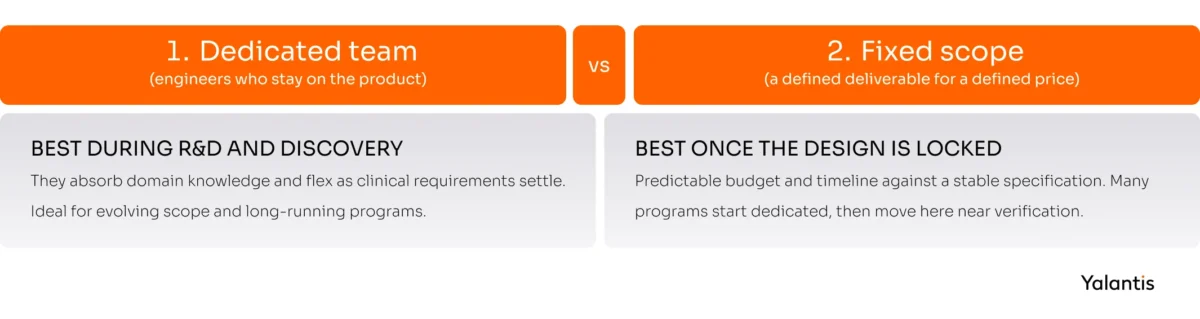
A dedicated team gives you engineers who stay on the product, absorb domain knowledge, and flex as priorities move, which matters when clinical requirements are still settling. Fixed scope gives you a defined deliverable for a defined price, which works once the design is locked.
By the way, many device programs start dedicated during R&D and shift toward fixed scope as they approach verification.
What actually drives the cost
Four factors move the number more than the hourly rate does.
- Hardware versus software. Physical device work, PCB design, and prototyping cost more than app or cloud work, and iterate more slowly.
- Compliance and certification overhead. Design controls, quality management, verification and validation, and documentation are real engineering effort, not paperwork you add at the end.
- Safety criticality and device class. A Class III implant carries a heavier process than a Class II wearable, and the process is where the cost lives.
- Safety criticality and device class. A Class III implant carries a heavier process than a Class II wearable, and the process is where the cost lives.
One principle holds across all of it: on a regulated device, the cheapest bid is usually the highest risk. Work built without compliance planning tends to fail an audit and need rework, and rework on a medical device is measured in months, not sprints.
Key trends shaping the medical device industry in 2026
Medical technology keeps shifting toward connected, software-driven, data-heavy products under tighter regulation, and digital health is now central to how devices are built. These are the capabilities that separated the companies above, so each trend leads with the one-line takeaway.
Edge AI runs the model on the device
Edge AI means running models directly on the device instead of the cloud, so data is processed the moment it is captured. That cuts latency for time-sensitive signals and limits how much patient data ever leaves the hardware, which helps both performance and privacy.
IoT and remote monitoring replace occasional check-ins
Connected devices send health data in real time and support patient monitoring on a continuous basis rather than periodic snapshots. A sensor or wearable can now keep care teams updated between visits, which enables more timely intervention. If you are building here, getting the architecture behind the Internet of Medical Things right pays off from the first prototype.
Digital twins predict failures and model patients
Digital twins mirror the real-world behavior of a device or a patient’s physiology using live data. On the equipment side they track wear and predict failures before clinical impact. On the patient side they can simulate disease progression or treatment response.
Digital therapeutics turn software into treatment
Digital therapeutics deliver structured treatment programs and collect patient outcomes data that manual tracking cannot capture. Their value is the feedback loop: every interaction informs the next step in care, so software becomes a direct therapeutic mechanism rather than an information channel.
Home-based devices have to work on consumer networks
More care happens at home, so devices must stay reliable and secure in everyday conditions. Patients need tools that are simple to operate, stay connected to their apps, and protect health data even on a home network. When they do, they cut unnecessary in-clinic visits.
Interoperability decides how fast a device gets adopted
Hospitals expect devices to feed EHRs and clinical platforms through HL7 and FHIR. Turning those standards into a working integration takes clean data structures, reliable APIs, and real understanding of clinical workflows. Devices that communicate well earn faster adoption because they reduce manual work.
Cybersecurity is now part of the core design
Every device that sends or receives data is a potential entry point, so security has to be designed in, not bolted on. Secure firmware, encrypted communication, and cloud environments built for regulated data reduce exposure, and strong compliance reassures both regulators and clinical buyers. This is the discipline that shows up in the way sensors are designed for medical devices from the first schematic.
Building a connected or IoMT device and want a partner who has shipped device-to-cloud systems in regulated healthcare?
Why partner with Yalantis for medical device development
Choosing a development partner for a regulated device is really a bet on one thing: can this team own the hard parts without dropping them between hand-offs. We built Yalantis around exactly that.
We take products from early concept and validation through to production-ready systems, covering embedded software, electronics, connectivity, cloud, and clinical-facing applications as one continuous scope. In practice, that ownership breaks down like this.
- Full-cycle development. One team for the whole stack, so accountability never slips between vendors.
- In-house hardware lab. Our Warsaw R&D lab runs PCB design, prototyping, and environmental testing under one roof, under the technical leadership of our CTO.
- Compliance and security by design. We hold ISO 13485, IEC 62304, ISO 27001, ISO 9001, and TISAX, aligned to FDA, MDR, and HIPAA from day one, with memory-safe Rust for safety-critical firmware.
- Enterprise-grade delivery. Dedicated teams and structured governance that scale without fragmenting ownership.
Put together, this is a partner you can keep for the life of the product, not just one phase of it. We design compliance in early, so audits become a formality rather than a scramble, and we keep the same team on the device as it grows.
That consistency is what the numbers reflect: 17 years of complex engineering and a 4.8 Clutch rating across 79 verified reviews. If you want your device owned end to end, from the first schematic to the cloud, start a medical device project with us.
This guide was written by the Yalantis medtech content team and reviewed for technical accuracy by Denys Hukov, medical device and IoT engineering lead at Yalantis. Facts in this article were compiled in July 2026 from company websites, public registries, and review platforms. We advise to verify details directly with vendors before contracting as team sizes and certifications change.
FAQ
What are medical device development companies?
Medical device development companies are engineering partners that design and build medical devices, then validate them, spanning the physical hardware and the regulated software that runs on it. They work upstream of pure manufacturing, turning a concept into a compliant, production-ready product, and many also carry that design into manufacturing.
How do I choose a medical device development company?
Choose on evidence in five areas: full-cycle capability, certificates with a stated scope, referenceable Class II or III projects you can actually call, security designed in from the start, and an engagement model that fits your funding stage. Shortlist three vendors and ask each for certificate numbers and reference contacts, then verify them.
What is the difference between a medical device development company and a medical device manufacturer?
A development company engineers the device: design, firmware, software, prototyping, and the documentation needed for approval. A manufacturer produces a finished design at volume. The overlap comes from partners that do both, taking a design from concept through to production under one quality system.
What certifications should a medical device development partner have?
Match the certificate to your product. ISO 13485 is the baseline quality system for medical devices, and IEC 62304 governs the software lifecycle for device software. ISO 14971 covers risk management, ISO 27001 signals an audited security program, and IEC 62366 covers usability. For US market work, note that from February 2, 2026 the FDA’s QMSR incorporates ISO 13485:2016 by reference.
Should I hire a full-cycle partner or separate vendors for hardware, firmware, and software?
For a connected regulated device, a full-cycle partner that owns hardware, firmware, and software usually lowers risk, because integration failures tend to appear exactly at the seams between vendors. Separate vendors can make sense when one layer is genuinely specialized, but you then own the integration and the combined audit trail yourself.
How much does medical device development cost?
Cost is driven more by scope than by hourly rate. The main factors are hardware versus software content, compliance and certification overhead, device class and safety criticality, and team scale and region. On a regulated device, treat the cheapest bid with caution, since work built without compliance planning tends to need rework measured in months.
How is AI changing medical device development in 2026?
AI is moving onto the device itself through edge computing, so models process data the moment it is captured, cutting latency and keeping more patient data on the hardware. It also speeds parts of the development lifecycle. The regulatory frameworks are adapting too, with the next edition of IEC 62304 expected to add provisions for AI and machine learning.
Do these companies handle EHR and HL7 or FHIR integration?
The stronger partners do. Experienced teams start with a data-flow map: which fields move, in which direction, and under whose authorization. They then build against FHIR APIs or HL7 interfaces and validate in production against real constraints like rate limits, rather than treating integration as an afterthought.
About the author