
By 2033, US healthcare spending will reach roughly $8.6 trillion under the latest CMS projections, and a growing share of that money now runs on software, from claims systems to connected devices. That makes choosing who builds that software one of the highest-stakes decisions a healthcare leader faces. We built this guide to compare the top healthcare software development companies of 2026 on compliance, interoperability, domain depth, and delivery record. Let’s get into it.
What healthcare software development companies actually do
Healthcare software development companies build custom medical software, from EHR integrations to software as a medical device (SaMD), under regulations like HIPAA and FDA quality rules. Their work covers everything from medical software development for healthcare providers to connected devices used at the point of care.
That last part is the whole difference. Any competent firm can ship a web app. Few can produce a risk management file that survives an FDA audit.
Two vendor types constantly get mixed up:
- Product vendors such as Epic or Oracle Health sell ready-made systems that you configure.
- Custom healthcare software development companies build software around your workflows, your devices, your data, and your constraints. This kind of custom software development describes every company on this list.
US healthcare spending reached $5.3 trillion in 2024, about 18 percent of the economy, per CMS. An increasing share of that money now flows through software: claims systems, virtual care platforms, connected devices, and AI tools.
How we chose the companies on this list
We ranked vendors on verifiable compliance evidence, interoperability depth, healthcare domain focus, and delivery track record, using public certifications, verified client reviews, company documentation, and press coverage as sources. These are the signals that separate serious players in the healthcare industry from generalist shops. The four filters below were applied to every candidate.
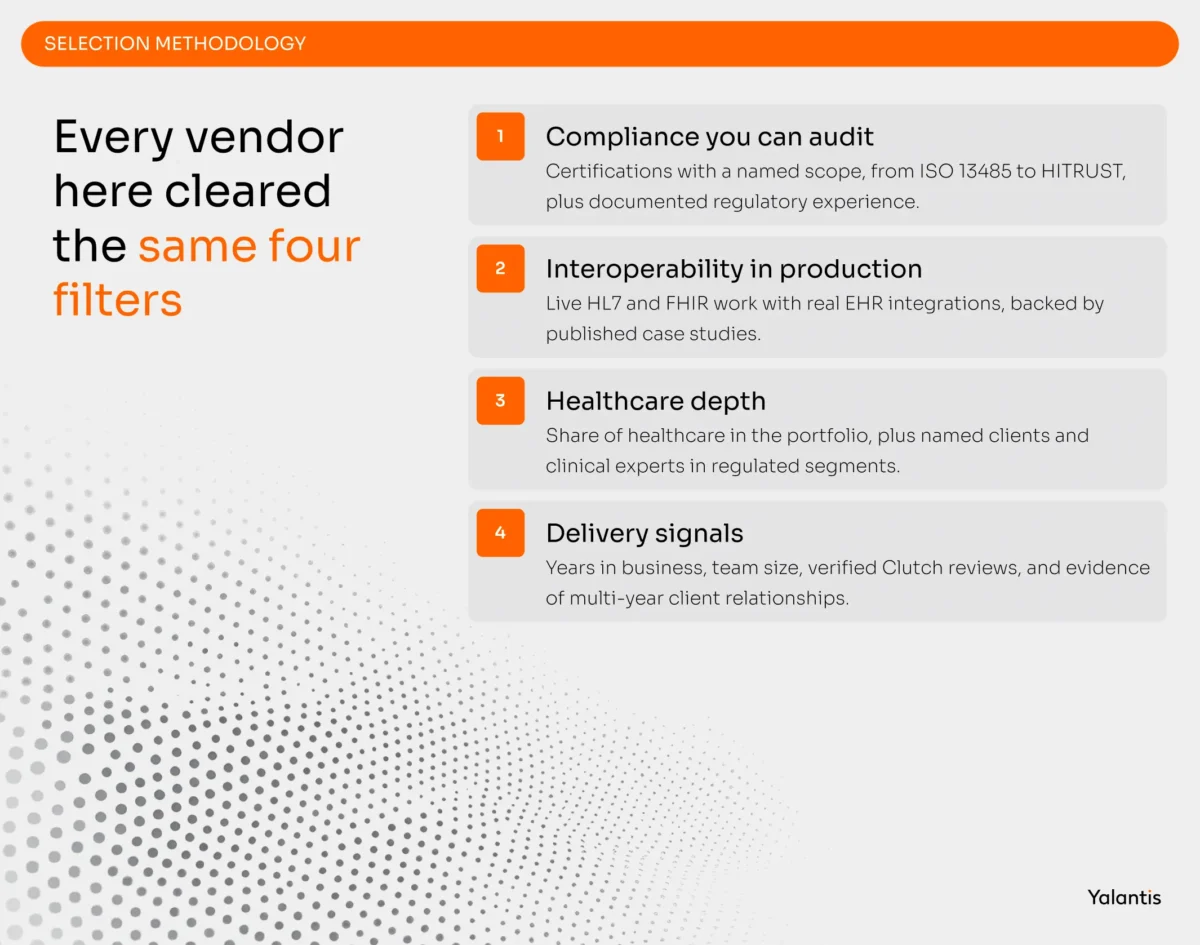
One honest disclosure before the list. Yalantis is on it, and we put ourselves second. The first position went to a vendor that is objectively stronger than us in pure healthcare scale: CitiusTech employs more than 7,700 healthcare technology professionals, while we employ just over 500 engineers. Numbers like that deserve the top spot. What we bring instead is spelled out plainly in entry number two.
Top healthcare software development companies in 2026
Each profile pairs a fact card for quick scanning with a short analysis of where the vendor genuinely shines and where it does not, closed by a one-line Best for verdict.
1. CitiusTech

CitiusTech is a healthcare-only technology company that has done nothing else since 2005, and that focus shows. The company has built one of the deepest FHIR and clinical data benches in the industry and co-developed Sentara Healthcare’s enterprise data platform on Microsoft Azure, and it now pushes into healthcare-native AI with its Knewron platform and an in-house AI lab.
Its standards work is anchored by long-standing affiliations with HIMSS, HL7, the CHIME Foundation, and AHIP, and the interoperability practice extends into clinical data integration and medical imaging. Delivery runs through consulting-led enterprise programs and managed services.
If you are a health system CIO or a payer executive, CitiusTech belongs on your shortlist by default. The trade-off: engagements are structured for enterprise scale, and smaller digital health companies will usually find the model heavier than they need.
2. Yalantis

Yalantis is a compliance-first engineering company that covers the full stack of a connected health product: electronics, embedded firmware, cloud, mobile, and AI. That end-to-end scope is our first differentiator. When a remote patient monitoring product needs a custom board, compliant firmware, a secure cloud backend, and a patient app, you do not have to coordinate three vendors and hope the interfaces line up.
The second differentiator is hardware. Our Warsaw R&D facility handles schematic design, PCB layout, prototyping, and component sourcing in house. Among healthcare software development companies this is rare, and it cuts both BOM costs and iteration time on device projects. We have taken more than 40 IoT products end to end, from concept to production.
The third is the certification portfolio. ISO 13485 and IEC 62304 cover medical device work, while ISO 27001 and ISO 27701 cover security and privacy, with ISO 9001 and TISAX on top. Our compliance consultants run HIPAA, FDA, HITRUST, and GDPR gap assessments, then implement the fixes in code. Few firms both write the remediation plan and write the software.
To be equally honest about limits: we are a 500-person company. If you need an army of Epic analysts for a hospital-wide rollout, positions one and three fit better. If you need a regulated product built from board to cloud, this is exactly what we do all day. Engagements range from short discovery phases to multi-year dedicated teams, and clients rate the work 4.8 out of 5 across 79 verified Clutch reviews.
Building a healthcare product?
See how Yalantis approaches regulated delivery from discovery through post-market support.
3. Emids

qEmids is a healthcare and life sciences technology firm that was born in healthcare in 1999 and never left. The company runs end-to-end Epic and EHR implementation programs alongside payer core platform replacements, with FHIR engineering across the payer and provider data stack. It also leads large data and cloud programs and has invested early in agentic AI, building on the Emids Healthcare Ontology and its Pacca AI Foundry.
The sweet spot is clear: US payers and providers with complex legacy estates and a mandate to modernize. Emids embeds senior healthcare engineers directly inside client teams, which suits multi-year transformation work. Device engineering sits outside its lane, so medtech OEMs will find better fits elsewhere on this list.
4. KMS Healthcare

KMS Healthcare is the healthcare arm of KMS Technology, an Atlanta company that has built and tested software for healthtech firms for over ten years. Through its CONNECT platform, which ships more than 75 pre-tested FHIR APIs and an HL7 conversion engine covering major EHRs, client teams plug into the systems they need rather than writing every integration from scratch. The company is HITRUST certified, and its teams are trained on US healthcare IT regulations, including HIPAA.
For Greenphire, a clinical trial payments platform, KMS cut the support backlog by 60 percent and accelerated release cycles by 40 percent. The Elsevier engagement has run for more than six years.
One consideration: engineering happens largely in Vietnam, which keeps rates competitive and works best when your side keeps strong product ownership.
5. Softeq

Softeq is a Houston full-stack engineering firm that reaches from PCB design up to mobile, a wider span than most healthcare software vendors offer. Founded in 1997, it builds connected medical devices, medical IoT systems, and the diagnostic software and clinician apps that run alongside them.
The compliance position is solid for device-adjacent work: ISO 13485 for medical devices alongside ISO 9001 and ISO 27001, plus pre-certification support against ISO 13485 and IEC 62304. The team navigates FDA, HITRUST, HIPAA, HL7 and DICOM requirements and runs an in-house hardware lab for board bring-up, driver development and wireless stacks. Published work includes turning a heart simulator prototype into a functioning device and hospital asset and patient tracking systems.
Healthcare is one vertical among many here. Softeq also works in industrial automation, robotics and AR/VR, so ask for the healthcare bench by name. US rates are the other trade-off, buying time-zone overlap at a higher price than an Eastern European team.
6. Star

Star is a global product consultancy whose healthcare weight comes largely from its 2021 acquisition of Pro4People, a Wroclaw team specializing in regulated medtech software. The result is a distinctive profile: design-led product thinking up front, regulated delivery behind it. That delivery runs on ISO 13485 and IEC 62304 quality processes with ISO 14971 risk management, plus ISO 27001 for information security.
The gMendel case shows the speed: Star designed and built Phivea, a genetic diagnostics platform, and helped it reach CE marking as an IVD on the Danish market in seven months. Clarify Health and Constant Therapy also appear among its healthcare references.
The trade-off: Star serves several industries beyond healthcare, and its design-led model sits at the premium end of the market.
7. ScienceSoft

ScienceSoft has been writing software since 1989 and building healthcare IT since 2005, with more than 150 medical projects delivered. Few vendors can match that combination of longevity and audited paper trail: quality systems certified to ISO 13485 and ISO 9001, ISO 27001 for security, and delivery aligned with HIPAA and GDPR as well as MDR and IVDR, with consulting available for FDA clearance and CE marking. A 4.8 Clutch rating with more than 150 published client testimonials backs the record.
A concrete example: for bioAffinity Technologies, ScienceSoft built software connected to flow cytometry equipment used in lung cancer detection.
The trade-off is focus: ScienceSoft serves more than 30 industries, so healthcare is one practice among many. Healthcare-only buyers should look at HTD Health or Empeek further down this list.
8. Itransition

Itransition brings sheer engineering capacity: more than 3,000 engineers inside a company that has delivered software since 1998. Its flagship healthcare engagement is a data suite for a US pharmaceutical multinational that manages 500 million patient records, a relationship now running past 12 years.
Analysts have noticed: the firm is recognized by Gartner, Forrester, Everest Group, and IAOP. Its Clutch profile carries around 40 verified reviews.
The catch: Itransition does not list ISO 13485 among its certifications. For data platforms and EHR integration programs, that gap rarely matters. For SaMD it does, so device makers should look at vendors that carry ISO 13485, such as Yalantis or Softeq.
9. HTD Health

HTD Health has worked only in healthcare since its founding in 2016 and has shipped more than 200 production applications, with software used by over 50,000 healthcare organizations. In 2023 the company added ISO 13485 certification, which opened the door to regulated SaMD work on top of its HIPAA-compliant delivery.
What stands out is the design DNA. HTD approaches clinical products through behavioral science and clinician workflows first, then engineers around them, with a dedicated interoperability practice serving provider and payer organizations.
Size is the natural limit: a 100-person firm cannot staff an enterprise transformation, and rates of $70 to $150 per hour sit above the cheapest options. For product quality per dollar, it remains one of the strongest boutiques here.
10. Empeek

Empeek is a healthcare-only company built for the stage where most digital health products live or die: from discovery to a working MVP and first paying customers. For VelloHealth, Empeek built a coordination platform for assertive community treatment teams that cut patient no-shows by 50 percent and helped grow billings by 109 percent.
The economics are the main draw. Dedicated teams from its Ukrainian engineering centers cost a fraction of US boutiques, and the 20 verified reviews on its Clutch profile consistently highlight responsive communication. The certification base covers ISO 9001 and ISO 27001, with HIPAA and HITECH alignment plus GDPR for EU data.
The trade-off mirrors Itransition’s: no ISO 13485 on record, so a regulated device product would need a separate quality system plan. For HIPAA-scope software, the credentials are solid.
How the top healthcare software development companies compare
Here is the full list in one table for side-by-side scanning. Our own row is highlighted, and each profile above carries the detail behind these columns.
Best custom healthcare software development companies
For custom builds specifically, the strongest options on this list are Yalantis, CitiusTech, ScienceSoft, and Star, because each pairs custom engineering with audited quality systems.
Choose custom development when:
- Your workflow is the product, and a packaged tool would flatten it
- Your product connects proprietary devices or hardware
- Packaged products cannot meet your data and integration requirements
- Your compliance scope is unusual, such as a SaMD pathway combined with HIPAA data flows
Off-the-shelf software wins for commodity functions, like standard scheduling or billing, and for cases where configuration gets you to market faster than code. In practice most products end up hybrid: buy the commodity layers, build the layer that differentiates you.
Leading healthcare software development companies in the USA
Nine of the ten companies on this list run US headquarters: CitiusTech, Emids, KMS Healthcare, Softeq, Star, ScienceSoft, Itransition, HTD Health, and Empeek. Yalantis is the one exception, an EU-headquartered company that delivers for US healthcare clients under the same regulatory framework.
HIPAA ties compliance to a signed business associate agreement and to audited safeguards, wherever the data lives. A vendor with those elements in place is compliant regardless of its mailing address. Hybrid models with US-facing account teams and distributed engineering are the industry standard; the practical thing to check is time zone overlap for daily collaboration.
How to choose a healthcare software development partner
Choose on evidence: certificates with scope statements, referenceable regulated projects, production EHR integrations, and a software development team whose engagement model fits your stage. Seven quick checks:
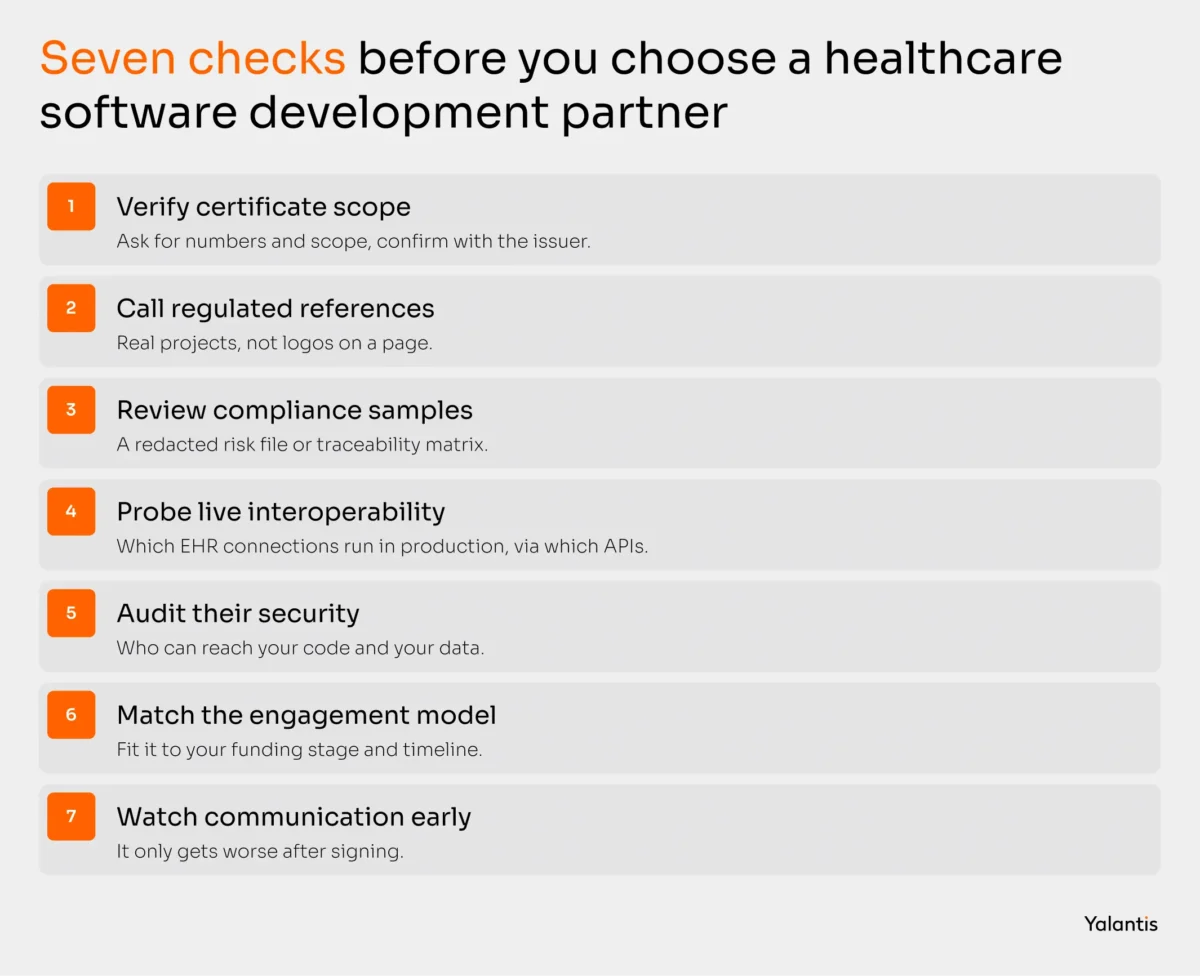
The same seven checks in detail:
- Ask for certificate numbers and scope statements, then verify them with the issuing body.
- Request references from regulated projects and actually call them.
- Review redacted samples of compliance documentation, such as a risk file or a traceability matrix.
- Probe interoperability: which EHR connections run in production, and through which APIs.
- Audit the vendor’s own security posture, starting with who can access your code and data.
- Match the engagement model to your funding stage and timeline.
- Watch communication quality during the sales process. It only gets worse after signing.
Unsure which regulations apply to your product?
Yalantis consultants map your regulatory scope and turn it into a delivery roadmap.
Compliance and security essentials for healthcare software
HIPAA. Any software touching protected health information in the US falls under HIPAA, one of the healthcare regulations that shape every build. The vendor signs a business associate agreement and implements safeguards across administrative, physical, technical, and organizational dimensions. Annual penalty caps now exceed $2 million per violation category. Yet, products sold internationally answer to healthcare laws in other countries, which set their own consent rules and data-residency requirements.
FDA and the new QMSR. Since February 2, 2026, the FDA’s Quality Management System Regulation incorporates ISO 13485:2016 by reference. A partner already certified to ISO 13485 now works inside the same framework the FDA inspects against.
ISO 13485 and IEC 62304. ISO 13485 governs the quality management system; IEC 62304 governs the software lifecycle for medical device software. A vendor holding both can slot directly into your design history file. Worth watching: the upcoming second edition of IEC 62304 is expected to add provisions for AI and machine learning.
HL7 and FHIR. Interoperability is regulated too. CMS requires payers to expose FHIR-based prior authorization APIs by January 2027, which turns FHIR fluency into a procurement criterion.
Healthcare software development costs and engagement models in 2026
Most companies on this list bill between $50 and $150 per hour. The visual below shows the market band and two verified reference points.
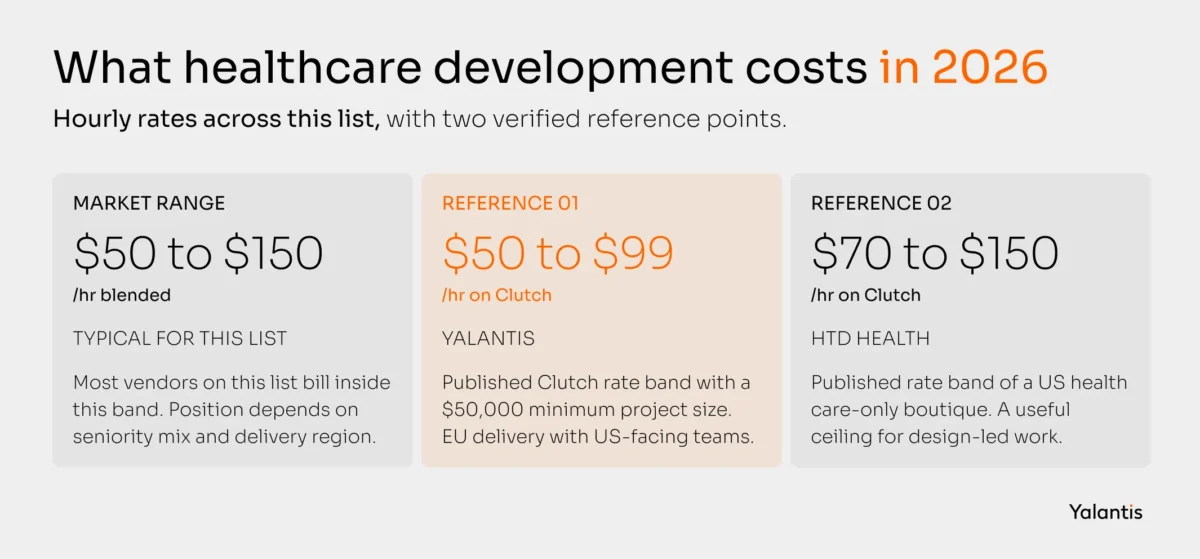
Engagement models you will encounter:
- Discovery phase. A short fixed-price engagement that de-risks scope and produces a costed roadmap.
- Dedicated team. A stable team billed monthly; the default for long-lived products.
- Time and materials. Payment for actual hours; fits evolving scope.
- Fixed scope. One price for a tightly defined deliverable; best kept for small, well-specified work.
Healthcare adds cost drivers that generic software does not have:
- Regulatory documentation and validation work
- EHR and medical device integrations, where budgeting for EHR integration work early prevents overruns
- Security hardening and independent audits
- FDA submission support
The cheapest bid is often the most expensive path. A meaningful share of the healthcare work Yalantis takes on is remediation: refactoring systems built fast without compliance planning that later failed an audit or stalled an FDA pathway. Building compliance in from the start always costs less than rebuilding for it.
Where healthcare software development delivers the most value
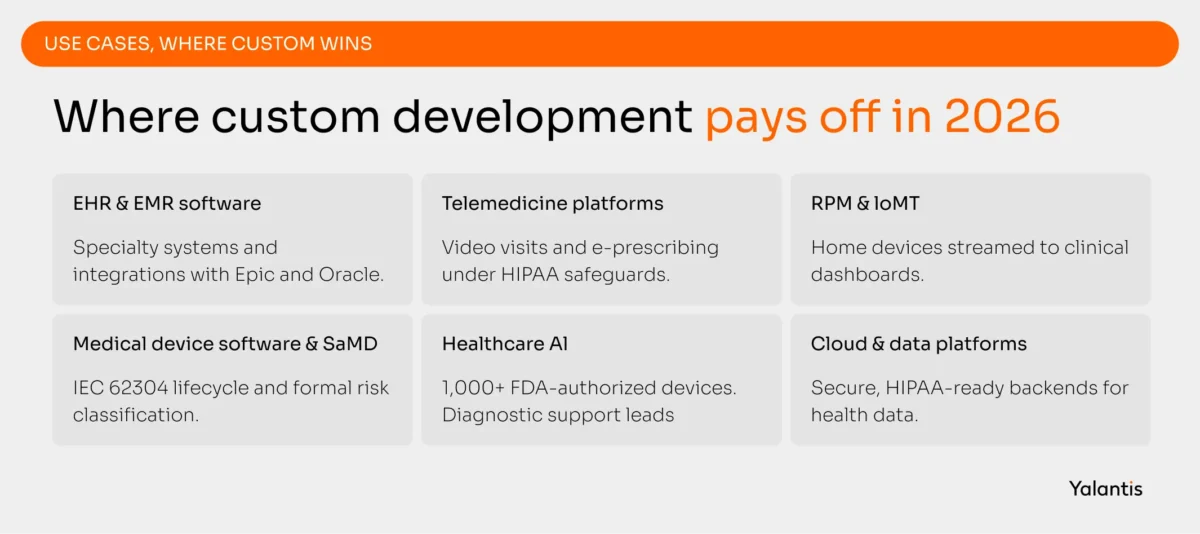
Where custom development delivers the most value in 2026:
EHR and EMR software development
Custom EHR and EMR work ranges from specialty-specific healthcare systems to integrations with major platforms like Epic and Oracle Health. Data migration quality and clinician workflow design decide whether these projects succeed.
Planning an EHR project?
See how Yalantis approaches EHR and EMR builds, from data migration to clinician workflows.
Telemedicine platforms
Virtual care is now standard infrastructure. Typical telemedicine software builds combine video visits and e-prescribing with scheduling and billing integrations, all under HIPAA safeguards.
Launching virtual care?
Yalantis builds telemedicine platforms with compliance designed in from day one.
Remote patient monitoring and IoMT
RPM connects home medical devices to clinical dashboards over the Internet of Medical Things (IoMT), the backbone of connected healthcare. The engineering spans device firmware and secure data pipelines, all feeding the dashboards clinicians actually work in.
Building a connected care product?
From device firmware to clinical dashboards, one team owns the whole data path.
Medical device software and SaMD
Software as a medical device runs on the strictest rails: IEC 62304 lifecycle processes and formal risk classification, followed by regulatory submissions.
Healthcare AI
The FDA has authorized more than 1,000 AI-enabled medical devices, and validation expectations keep rising. Current demand concentrates in diagnostic support and ambient clinical documentation, with healthcare data analytics close behind. Vendors are increasingly expected to prove model performance the way they prove software safety.
Why partner with Yalantis for healthcare software development
If your product combines regulated software with hardware or a data-heavy backend, this is the job Yalantis was built for. Since 2008 we have grown past 500 engineers and shipped more than 40 connected products for healthcare providers and digital health companies, with client engagements averaging over three years.
- End-to-end delivery. One accountable partner from board-level electronics through firmware and cloud to the patient-facing app.
- In-house hardware. Our Warsaw R&D facility handles schematics, PCB layout, prototyping, and component sourcing, which shortens device iteration cycles.
- Compliance and certifications. ISO 13485, IEC 62304, ISO 27001, and ISO 27701, backed by consultants who run gap assessments and then fix the gaps in code.
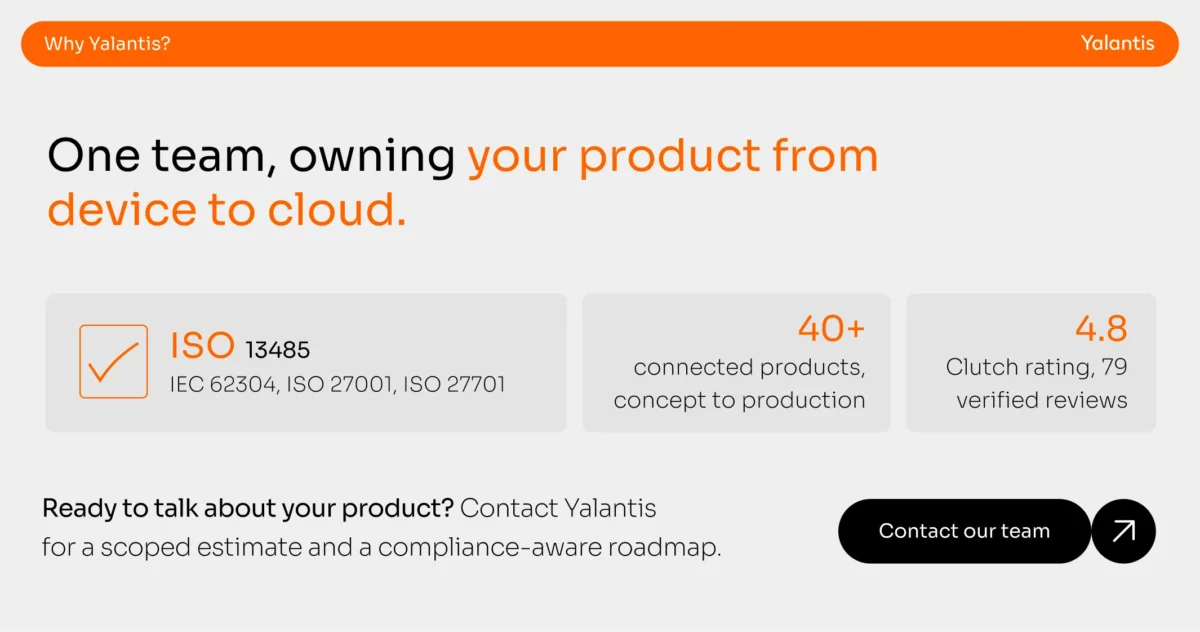
Ready to talk about your product? Contact Yalantis for a scoped estimate and a compliance-aware roadmap.
Facts in this article were compiled in July 2026 from company websites, public registries, review platforms, and press coverage. Team sizes and certifications change, so verify details directly with vendors before contracting.
FAQ
How do I choose a healthcare software development company?
Verify evidence in four areas: certificates with scope statements, references from regulated projects, live EHR integrations in production, and an engagement model that fits your funding stage. Shortlist three vendors and request redacted documentation samples from each. Treat their reaction to that request as part of the evaluation.
What is the difference between custom and off-the-shelf healthcare software?
Off-the-shelf software is a finished product you configure, like Epic. Custom software is built around your specific workflows, devices, data, and integrations. Custom wins when your workflow is a competitive advantage or when packaged tools cannot handle your requirements. Off-the-shelf wins for commodity functions like standard billing.
How do healthcare software development companies ensure HIPAA compliance?
Credible vendors sign a business associate agreement before touching any PHI, then implement technical safeguards: encryption in transit and at rest, role-based access controls, complete audit logging, and a documented breach response. Mature vendors also secure their own development environments and restrict which engineers can reach production data.
What certifications should a healthcare software development company have?
Match the certificate to your product category. For medical device software, ISO 13485 is the baseline and IEC 62304 process capability is essential. For any work with patient data, ISO 27001 signals an audited security program. For sales to US health systems, HITRUST or SOC 2 increasingly appears in procurement requirements.
How do these companies handle EHR/EMR and HL7/FHIR integration?
Experienced teams start with a data flow map: which fields move, in which direction, under whose authorization, and how errors are handled. They then build against FHIR APIs or HL7 interfaces and test in vendor sandboxes such as Epic’s. Production validation comes last, against real constraints like rate limits and downtime windows.
About the author