

|
Key takeaways
|
Choosing an embedded software development company in 2026 is harder than it used to be. Five years ago, engineering skill and price were enough to pick a vendor. Today a wave of new regulation has raised the bar: the EU Cyber Resilience Act demands security across a product’s whole lifecycle, and ISO/SAE 21434 is now table stakes for automotive ECUs. Add FDA QMSR for medical devices, and engineering talent alone no longer guarantees a safe choice.
So we compared the ten companies that pair real embedded expertise with the certifications and full-cycle delivery these rules demand. Each gets the same fact card, so you can read across them in minutes. Keep reading to see how they compare and which one fits the product you are building.
Why embedded development means more than writing code
Embedded development covers far more than writing code for a chip. An embedded software development company designs and builds the software that runs on dedicated hardware, including microcontrollers, sensors, gateways, ECUs, and medical devices, rather than on general-purpose computers. The category covers several distinct activities that buyers often confuse:
- Firmware development: low-level code that runs directly on a microcontroller (MCU) or system-on-chip (SoC), responsible for boot, hardware initialization, peripheral control, and power management.
- Embedded software development: higher-level application code that runs on an RTOS (FreeRTOS, Zephyr, ThreadX) or embedded Linux. Examples include HMI, edge analytics, secure communications.
- Embedded systems development: the combination of firmware, embedded software, and the underlying hardware design (PCB, schematics, mechanical enclosure) into a cohesive product.
The strongest vendors operate across all three layers, building hardware and software to fit together. They reduce integration risk because one team owns the specification from PCB up to cloud, which removes the blame cycle that breaks multi-vendor projects. Embedded and IoT work overlap heavily, and the top IoT development companies are judged on much the same full-cycle criteria, with extra weight on connected platforms and analytics.
Need firmware that behaves the same in the lab and in the field?
We write firmware in C, C++, and Rust, from bare-metal MCUs to embedded Linux, and test it on the hardware it will actually run on.
The six criteria that separate real vendors from the rest
Every embedded vendor claims expertise. Verifiable signals matter more than marketing language. We applied six criteria, each of which a candidate had to satisfy:
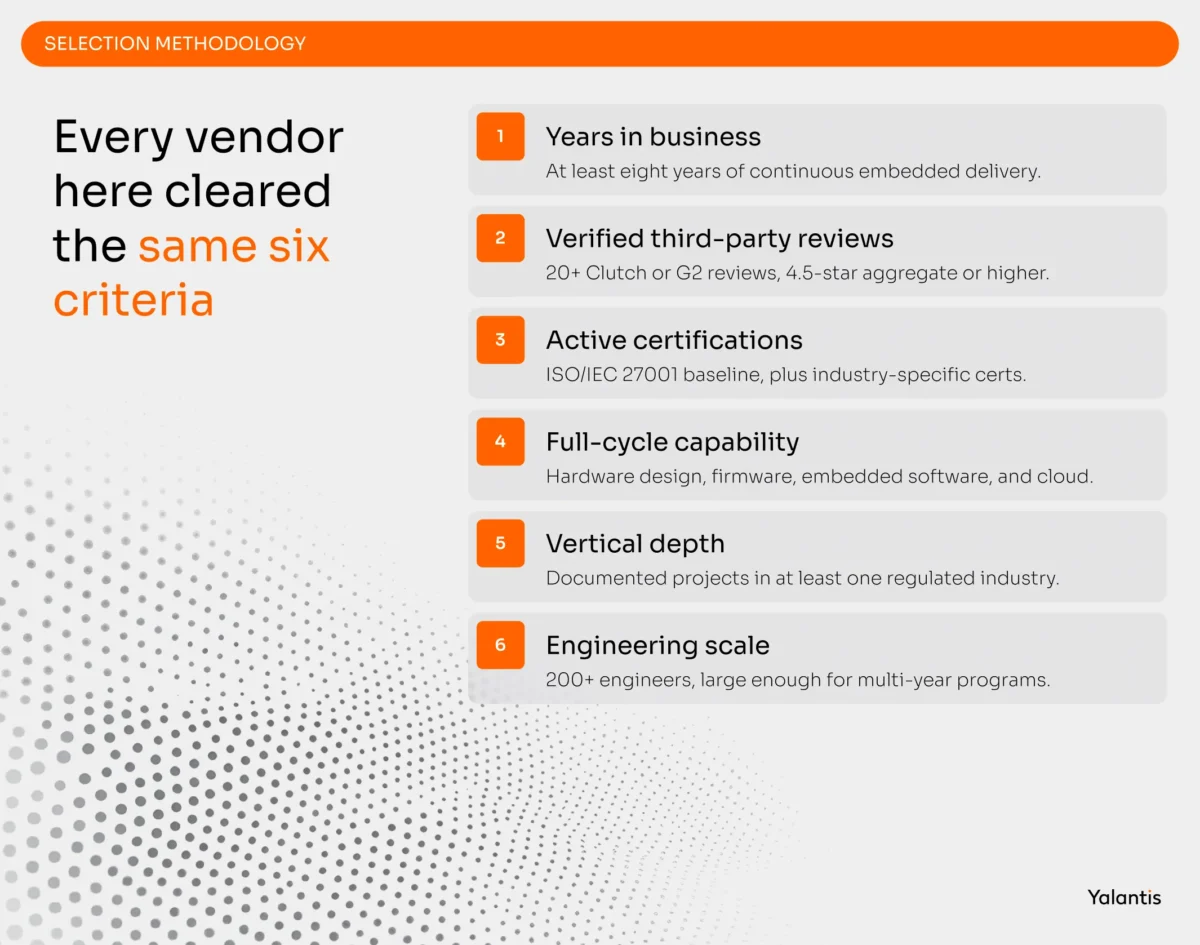
- Years in business: at least eight years of continuous embedded delivery.
- Verified third-party reviews: 20 or more reviews on Clutch or G2 with an aggregate score of 4.5 stars or higher.
- Active relevant certifications: ISO/IEC 27001 at minimum, plus industry-specific certifications where the vendor claims regulated-industry work (ISO 13485 for medical, IEC 62304 for medical software lifecycle, ISO 26262 for automotive functional safety, IEC 62443 for industrial cybersecurity).
- Full-cycle capability: demonstrated delivery across hardware design, firmware, embedded software, and cloud integration in published case studies.
- Vertical depth: documented projects in at least one regulated industry (healthcare, automotive, industrial, defense).
- Engineering scale: 200 or more engineers, large enough to staff multi-year programs without bench risk.
Sources include vendor case studies, Clutch and G2 reviews, public certification registries, and industry analyst rankings from IAOP, Forrester, and Everest Group.
10 best embedded software development companies in 2026
1. Yalantis

Yalantis differentiates on three fronts that map directly to where mid-market and enterprise buyers most often struggle. The company runs an in-house hardware R&D capability covering custom design of multilayer, HDI, and rigid-flex PCBs, with 85+ delivered hardware projects and more than 150 IoT and embedded projects behind it. The team is an early commercial adopter of Rust for memory-safe firmware, which materially reduces vulnerability classes in safety-critical code, the same move from C and C++ to Rust that memory-safety mandates are pushing across the industry.
The compliance footprint covers ISO 9001, ISO 13485, and ISO 27001, with delivery practice aligned to IEC 62304, IEC 62443, ISO 26262, FDA QMSR, EU CRA, and TISAX. Yalantis ranks first on Clutch’s IoT Development Leaders Matrix as of May 2026 and offers dedicated team, time and materials, and fixed-scope engagement models. In November 2025, the company announced a strategic pivot toward IoT as core business focus.
Industry focus: healthcare, industrial IoT, automotive, defense, logistics.
Best for: regulated, full-cycle embedded and IoT programs where one partner owns hardware, firmware, and cloud.
2. N-iX

N-iX has a proven track record in long-term embedded partnerships. Cardo Systems, a US-based intercom systems manufacturer, has been a partner since 2016. Weinmann Emergency, a Germany-based maker of ventilation and defibrillation solutions, partnered with N-iX to develop Linux firmware in C++ and Qt for the MEDUCORE Standard² platform.
The company holds ISO/IEC 27001:2013, ISO/IEC 27701:2019, and SOC 2 Type 2, making it a defensible choice for buyers whose procurement processes require third-party audited security and privacy controls. N-iX is recognized by Forrester and IAOP among the top outsourcing providers globally, with development centers across Europe and Latin America.
Industry focus: manufacturing, automotive, healthcare, financial services, robotics.
Best for: enterprise programs that require very large embedded teams spun up across multiple time zones.
3. Intellias

Intellias has built a defensible niche in automotive. The company holds expertise across the full automotive stack, from sensor firmware and Linux drivers to AUTOSAR-based ECU components and ADAS/AD safety functions, with engineering teams that validate against ISO/SAE 21434 criteria.
At CES 2026, the company demonstrated visual testing automation for in-vehicle infotainment together with Zeekr Technology Europe, part of a broader testing and quality assurance capability. The TISAX-certified Ingolstadt center is a meaningful credential because TISAX is effectively a hard prerequisite for working with German automotive OEMs. The company operates under ISO 27001 and ISO 9001.
Industry focus: automotive (primary), high-tech, mobility, transportation.
Best for: automotive OEMs and Tier 1 suppliers building software-defined vehicles and ADAS.
4. GlobalLogic

GlobalLogic occupies a distinctive position thanks to the Hitachi acquisition, which gave it direct access to industrial domain expertise across mobility, energy, and rail. Hitachi announced in early 2026 that GlobalLogic will integrate with Hitachi Digital Services to combine product strategy and software engineering with cloud modernization and managed operations.
The company operates under ISO 9001 and ISO 27001. For enterprise buyers consolidating embedded and digital programs under a single global vendor, few can match this global software engineering footprint.
Industry focus: automotive, semiconductors, industrial and energy, healthcare.
Best for: multi-year, enterprise-scale programs that benefit from a parent group with deep operational technology capability.
5. EPAM

EPAM’s automotive credibility comes from concrete platform work, backed by three decades of experience. The AosEdge vehicle-to-cloud platform, developed with Renesas Electronics, addresses OTA software delivery for connected vehicles. The company is a recognized contributor to Xen Hypervisor for embedded automotive open-source safety certification.
EPAM’s medical device practice operates under ISO 13485 and IEC 62304, with in-house electrical engineering lab capability. The company holds ISO 9001 and ISO 27001 alongside the medical-specific certifications and is listed on the S&P 500 and Forbes Global 2000.
Industry focus: automotive, life sciences, industrial, software and hi-tech.
Best for: buyers building software-defined vehicles or regulated medical platforms who want a Forbes Global 2000 vendor with mature enterprise procurement and security posture.
6. Sigma Software

Sigma Software is the rare firm on this list that can point to certification work rather than just claim it. Its embedded practice covers firmware, middleware, device drivers, and human-machine interfaces, and the team spent four years keeping a client’s braking system code compliant as US certification requirements shifted. That kind of long-running documentation work is what separates production embedded delivery from prototyping.
Founded in 2002 and headquartered in Stockholm, the company runs delivery from Ukraine and seven other locations with over a thousand engineers. It holds ISO 9001:2015 and ISO 27001 and is a Microsoft Gold Certified Partner, with clients including Volvo, Scania, Knorr-Bremse, and AstraZeneca. The team also runs pre-certification testing for security and power consumption before a device goes for formal approval.
Industry focus: automotive, aviation, energy, healthcare, telecom.
Best for: buyers who need embedded code certified for a regulated market and kept compliant as the standards move.
7. Softeq

Softeq’s range across hardware and software is one of its strongest selling points. The team works with semiconductors from Texas Instruments, NXP, Silicon Labs, and STMicroelectronics, and operates a Venture Studio that supports product development and validation for startups before scaling to production.
The company holds ISO 9001 and ISO 27001, is a Microsoft Gold Application Development Partner, and is an official member of Apple’s MFi Program. The Houston headquarters and Munich office make Softeq an accessible nearshore option for buyers in North America and DACH.
Industry focus: oil and gas, healthcare, consumer electronics, industrial.
Best for: US-headquartered buyers who need a single-vendor solution covering hardware, embedded, and IoT with onshore client management.
8. Innowise

Innowise is headquartered in Warsaw with offices in the US, UK, Germany, and the UAE, and its embedded practice covers firmware, board support packages, device drivers, and embedded Linux, with RTOS and human-machine interface work alongside. The certification stack is unusually deep for a firm of its size: ISO 9001, ISO 13485, ISO 27001, ISO 27017, and ISO 27018, plus SOC 2, HIPAA, and GDPR compliance. ISO 13485 is the one that matters if your product is a medical device.
Founded in 2007, the company has grown to roughly 2,550 people and reports over 1,600 delivered projects for clients including NTT DATA, HAYS, InterSystems, and Topcon. Clutch places it in the $50 to $99 band. For programs that need a large bench spun up quickly under audited quality and security controls, that combination is straightforward to verify.
Industry focus: manufacturing, logistics and supply chain, healthcare, smart building, agriculture, automotive IoT.
Best for: enterprise programs that need scale and audited compliance controls at Eastern European rates.
9. Lemberg Solutions

Lemberg holds ISO/IEC 27001:2013, ISO 9001:2015, and ISO 13485:2016. The ISO 13485 holding is notable for a company of its size; most mid-market vendors stop at ISO 27001 and ISO 9001.
The Hamburg headquarters and London office support direct engagement with DACH and UK clients, while delivery from Krakow and four Ukrainian centers gives access to a strong pool of embedded software engineers. Direct silicon-vendor relationships with STMicroelectronics and Digi-Key give an edge for hardware selection.
Industry focus: energy and cleantech, healthcare, automotive, industrial.
Best for: European buyers in regulated industries needing a mid-sized partner with ISO 13485 and direct silicon-vendor relationships.
10. ScienceSoft

ScienceSoft has been in business since 1989, which makes it the oldest firm on this list. The Texas-headquartered company holds ISO 9001, ISO 27001, ISO 27701, and ISO 13485, and its healthcare practice builds medical device software and HIPAA-compliant platforms. Its embedded practice delivers firmware and application software for real-time microprocessor-based products, and IoT work has been part of the portfolio for over a decade.
With 750+ engineers and consultants and more than 4,200 delivered projects, the client list runs to IBM, eBay, Walmart, NASA JPL, PerkinElmer, Baxter, and Ford. Over half the team is senior level. The firm is a better fit for the software layer of a connected product than for the board underneath it, so it works best alongside a hardware partner or an in-house electronics team.
Industry focus: healthcare and life sciences, manufacturing, financial services, retail, telecom, energy.
Best for: the software and cloud side of a connected product, particularly regulated medical software, where the hardware is already handled.
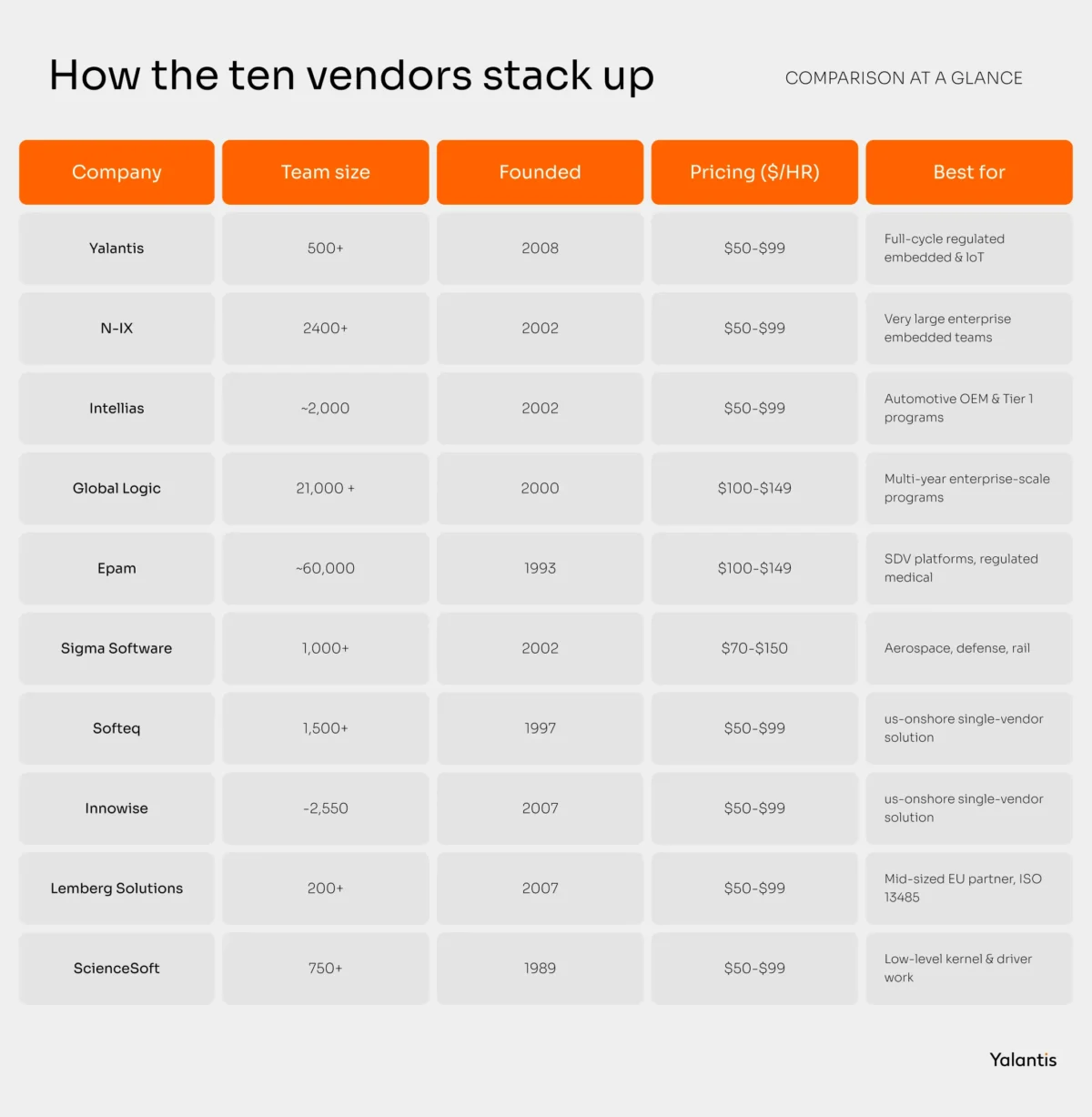
How the 10 vendors compare on what buyers screen first
Building an embedded product that has to work as one system?
We handle the full cycle, from architecture and firmware through to embedded apps and cloud, so every layer is built to fit the next.
Six questions that turn a long list into your shortlist
Choosing the right partner depends on your own situation, from whether you need custom hardware to which compliance regimes apply. Work through these six questions to turn a long list of vendors into a shortlist worth contacting:
Full-cycle capability vs. point capability. If you are designing a new connected device from scratch, you need an embedded software development partner with in-house PCB design, embedded firmware, prototyping, and cloud integration. Yalantis, Softeq, and Lemberg Solutions fit this scope. If you are building on top of existing devices, software-focused vendors deliver faster at a lower cost.
Domain compliance. Healthcare IoT and industrial IoT need different evidence. For medical devices, ISO 13485 and an established IEC 62304 software-lifecycle practice are baseline requirements, and navigating IEC 62304 and ISO 13485 for embedded medical software is a discipline in its own right. For industrial systems, IEC 62443 cybersecurity is increasingly mandatory. For automotive, ISO 26262 functional safety and ISO/SAE 21434 cybersecurity are both expected for production work.
Security-by-design. Embedded devices have an attack surface that grows exponentially with fleet size. Verify the vendor’s secure development lifecycle: threat modeling, secure boot, code signing, encrypted OTA, vulnerability disclosure process. Preventing firmware vulnerabilities across a deployed fleet is a discipline of its own, and a strong vendor can show exactly how they handle it.
IP ownership and source-code escrow. Confirm in writing that all developed IP transfers to you on payment, that the vendor does not reuse code across clients, and that source code is held in a repository you control or with an escrow agent.
Engagement model. Dedicated team models work well for multi-year embedded programs because they preserve team continuity. Fixed-scope contracts can fit small, well-bounded firmware features. Time-and-materials is appropriate for exploratory phases.
Communication and time-zone overlap. Embedded programs require frequent synchronous work with internal hardware and firmware teams. Confirm at least four hours of working-hour overlap with your engineering organization.
What embedded development actually costs in 2026
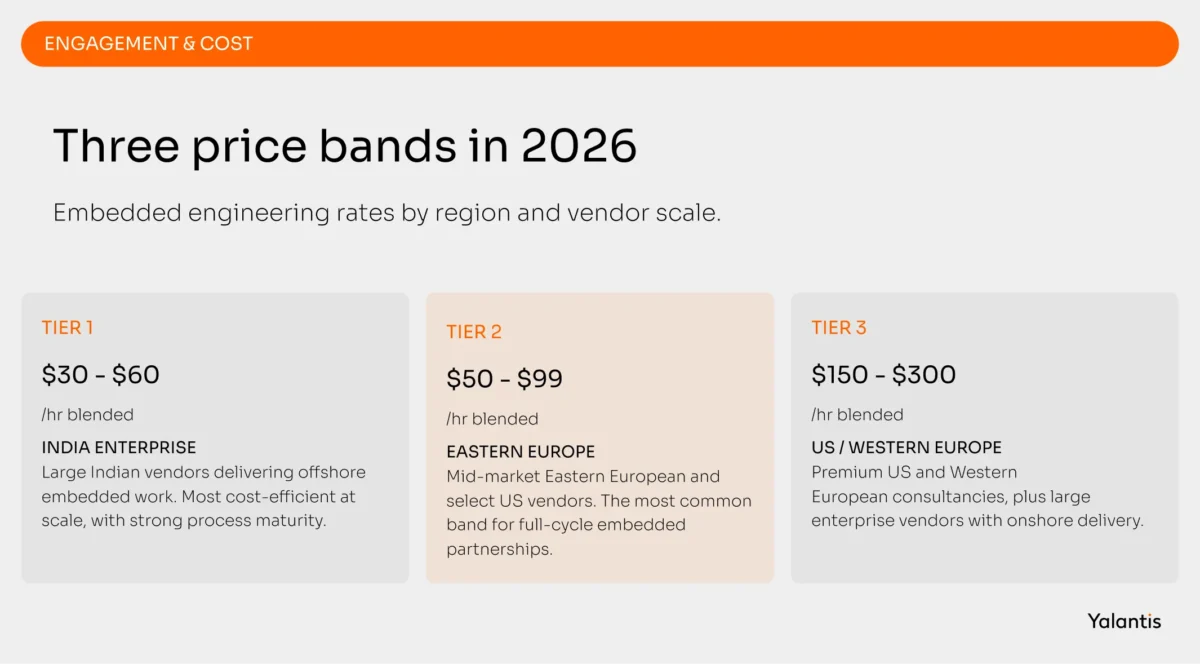
The three bands above set the baseline. Every vendor on this list sits in or just above the Eastern European band, and the outer tiers are here because they frame the market you are buying in. What moves a project up or down within them is predictable:
- Hardware vs. software only. Hardware design adds 30 to 50 percent to a program budget due to PCB prototyping cycles, certification, and tooling.
- Certification overhead. Programs targeting ISO 13485, IEC 62304, ISO 26262, or DO-178C require formal documentation, traceability, and verification artifacts that add 25 to 40 percent to engineering hours over an unregulated baseline.
- Safety-criticality. Class C medical software, ASIL D automotive, or safety-instrumented industrial systems require additional verification and validation effort.
- Region of delivery. Onshore US delivery costs two to three times offshore equivalents for comparable seniority.
A single warning applies across all embedded work: for regulated or safety-critical systems, the lowest bid carries the highest risk. The cost of a recalled medical device or a vehicle ECU failure dwarfs the engineering savings of a budget vendor. Vendors that produce ISO 13485 evidence on day one save money over the program lifecycle because compliance debt is the most expensive form of technical debt in embedded systems.
The technical capabilities production work demands
The 2026 embedded technology stack has consolidated around a recognizable set of languages, operating systems, and protocols. When evaluating vendors, look for demonstrated competence across the following, from system architecture down to the silicon:
- Languages. C and C++ remain the backbone for firmware and low-level embedded code. Rust is the most important new language in the stack: it is increasingly adopted for safety-critical and security-sensitive firmware because of memory-safety guarantees that eliminate buffer overflows and race conditions at compile time. Memory-safety vulnerabilities account for the majority of CVEs in C and C++ codebases. Vendors with documented production Rust delivery will increasingly hold an advantage; experimental side projects do not count. Migrating an existing codebase from C and C++ to Rust is a project in its own right, with a well-mapped path once the memory-safety gains justify it.
- Operating systems and frameworks. FreeRTOS and Zephyr dominate the real-time operating system (RTOS) landscape for resource-constrained devices. Embedded Linux (typically Yocto-based) handles higher-level devices with rich UIs and cloud connectivity. For automotive, expect AUTOSAR (Classic and Adaptive), Android Automotive, and QNX. For medical, expect FDA-recognized standards alongside IEC 62304-compliant lifecycles.
- Drivers and low-level expertise. Bare-metal programming, bootloaders, BSP development, device drivers, kernel customization. These skills are increasingly rare and command a premium, and few vendors keep dedicated kernel and driver engineers on the bench.
- Hardware engineering. Multi-layer PCB design (HDI, rigid-flex), signal integrity, power management and battery management systems for low-power devices, EMC/EMI design. Without in-house hardware capability, a vendor cannot deliver a production-ready device.
- Connectivity. Wi-Fi, Bluetooth Low Energy, LoRaWAN, NB-IoT, LTE-M, Thread, Matter. The right protocol depends on the use case, and sensor integration often drives the choice. A competent partner explains tradeoffs rather than defaulting to a familiar stack.
- Embedded security. Secure boot, firmware signing and verification, encrypted OTA updates, secure key storage (typically in a TPM or secure element), vulnerability management. This is the layer where firmware development for embedded IoT devices either holds up or falls apart as a fleet scales, so mature development practices matter as much as the tooling.
- Edge AI and machine learning. Increasingly, embedded devices run inference on-device on real-time data using quantized and pruned models. TensorFlow Lite Micro, ONNX Runtime, and vendor-specific frameworks (NVIDIA Jetson, Qualcomm AI Engine) are now part of the embedded stack.
Need a custom board that survives its environment and still hits the cost target?
Our hardware engineers design PCBs and electronics in-house, from the first schematic to a board that is ready to manufacture.
Why your industry decides which vendor fits
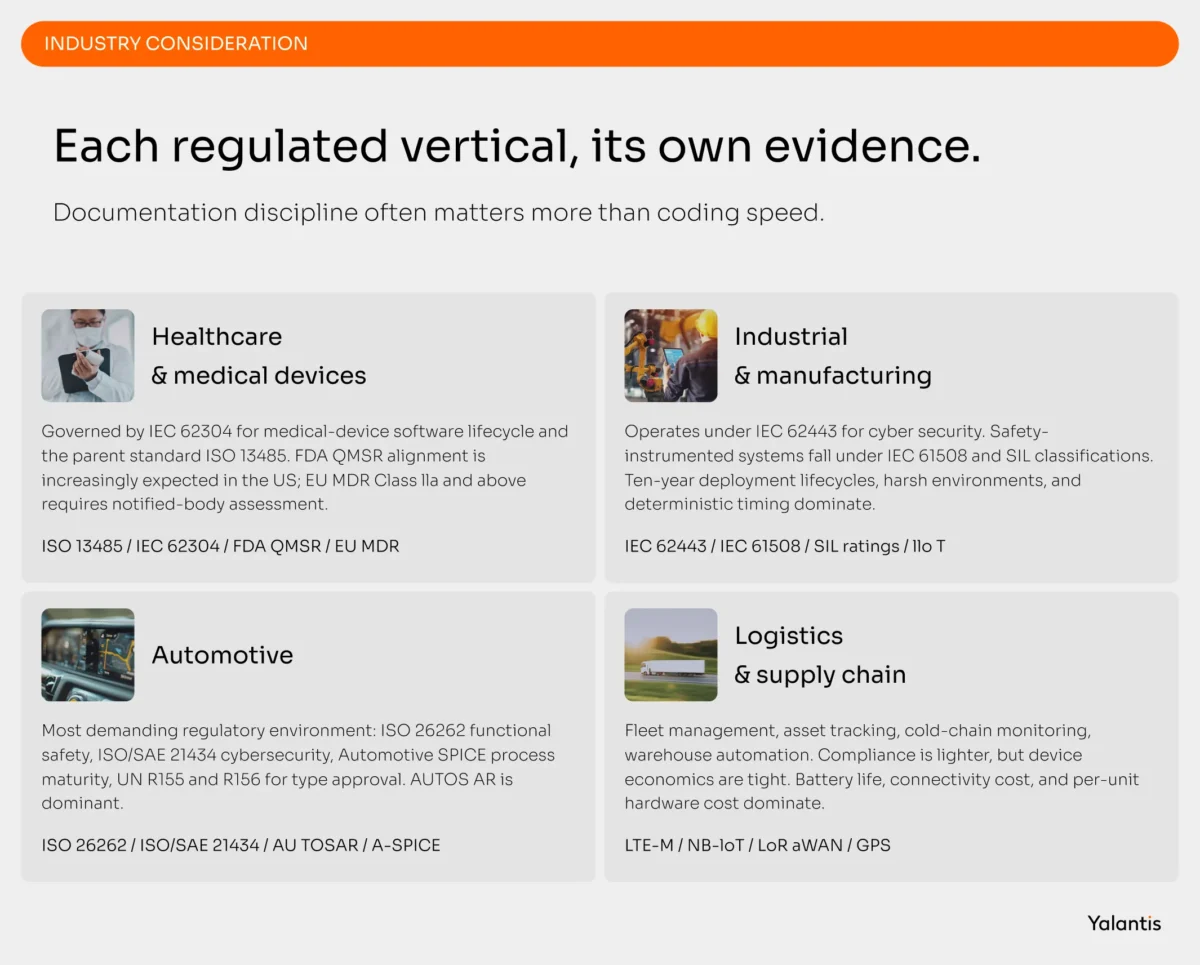
Each regulated vertical has its own standards and constraints. The vendor’s documentation discipline often matters more than coding speed.
Healthcare and medical devices
Medical device firmware is governed by IEC 62304 (medical device software lifecycle) and the parent quality system standard ISO 13485. In the US, FDA QMSR alignment is increasingly expected. In the EU, MDR Class IIa and above require notified body assessment. The vendor’s documentation discipline matters more than coding speed here; verification artifacts, risk analysis, and traceability matrices are the deliverables that gate market entry.
Industrial and manufacturing
Industrial embedded systems operate under IEC 62443 for cybersecurity, with safety-instrumented systems falling under IEC 61508 and SIL classifications. Operational technology (OT) constraints differ from IT: ten-year deployment lifecycles, harsh environmental conditions, deterministic timing requirements, and air-gapped networks. Vendors with documented IIoT case studies in industrial automation and predictive maintenance tend to perform better than IT-first vendors retooling for OT.
Automotive
Automotive embedded is the most demanding regulatory environment, with ISO 26262 functional safety, ISO/SAE 21434 cybersecurity, Automotive SPICE process maturity, and increasingly UN R155 and R156 for type approval. AUTOSAR is the dominant architectural framework. The vendor’s ability to participate in safety cases and produce evidence for type approval is more important than headcount.
Logistics and supply chain
Logistics IoT spans fleet management, asset tracking, cold-chain monitoring, and warehouse automation. Compliance demands are lighter than in healthcare or automotive, but device economics are tight: battery life, connectivity cost, and per-unit hardware cost typically dominate decisions. Vendors with documented cellular IoT (LTE-M, NB-IoT) and LoRaWAN experience are well-positioned here.
Why partner with Yalantis for embedded software development
Most companies build a connected product by stitching together multiple vendors, then spend months getting those pieces to work as one. Yalantis removes that problem by keeping the whole build under a single team, a full-cycle software development model from board to cloud. Its in-house hardware lab designs custom PCBs, including multilayer, HDI, and rigid-flex boards, and the same engineers write the firmware and embedded software that runs on them in C, C++, and Rust. That includes early commercial use of Rust for memory-safe code in safety-critical systems.
The single-team model carries through to compliance, where Yalantis holds ISO 9001, ISO 13485, and ISO 27001 and aligns delivery to standards like IEC 62304 and ISO 26262. Because the same people own the product from the circuit board up to the cloud, the compliance paperwork stays consistent at every step. When separate vendors each handle one layer, that paperwork rarely lines up, and getting certified drags on while the gaps get fixed. With one team behind the whole product, the evidence is ready from the start, so a regulated product reaches approval faster.
FAQ
How do I choose the right embedded software development company?
Start by defining whether your project requires custom hardware or only software running on existing devices. Then look for a partner whose certifications match your industry: ISO 13485 for medical devices, ISO 26262 for automotive, IEC 62443 for industrial. Confirm Clutch reviews include projects in your industry rather than only generic embedded work. Request a technical proposal that documents the development approach instead of relying on marketing material. Finally, evaluate engagement flexibility to ensure the vendor’s model can scale with your project.
What certifications matter for embedded development companies?
The baseline is ISO/IEC 27001 for information security. For regulated industries, additional certifications are effectively prerequisites. Medical device firmware requires ISO 13485 and operating practice aligned with IEC 62304. Automotive embedded work requires familiarity with ISO 26262 functional safety and ISO/SAE 21434 cybersecurity. Industrial systems require IEC 62443. For EU market entry, the Cyber Resilience Act (CRA) applies to connected products from 2026 onward. The credible vendors are those that produce certification artifacts on request. Verbal claims of compliance without supporting evidence are a red flag.
Should I hire a full-cycle vendor or specialists?
Full-cycle vendors reduce integration risk because one team owns the specification across hardware, firmware, and cloud. This matters most when building a new connected device from scratch, because the most expensive defects in embedded systems originate at hardware-software boundaries. Specialist vendors are more cost-efficient for well-bounded work: kernel module development, a single firmware feature, or a specific protocol stack implementation. For multi-year programs in regulated industries, a full-cycle partner with documented compliance evidence is almost always the better choice.
Is it better to outsource embedded development or build an in-house team?
The honest answer is that most companies need both. Embedded engineers, particularly senior firmware and hardware engineers, are scarce in most labor markets. Building an in-house team large enough to staff a multi-year program is feasible only for companies with strong engineering brands. Outsourced embedded partners give you immediate access to engineers who have shipped comparable products before. The hybrid model, where a small in-house team owns architecture and IP while a specialized partner provides delivery scale, is the pattern that works best for most mid-market and enterprise programs.
What does embedded development cost in 2026?
Embedded engineering rates split into three bands. Mid-market Eastern European vendors charge $50 to $99 per hour. Premium US and Western European consultancies charge $150 to $300 per hour. Indian large-enterprise vendors deliver in the $30 to $60 per hour range for offshore work. A typical end-to-end IoT product, including PCB design, firmware, mobile application, and cloud platform, ranges from $250,000 to over $1 million depending on certification requirements, hardware complexity, and connectivity stack. Programs targeting medical or automotive certification routinely add 25 to 40 percent to engineering hours over an unregulated baseline.
About the author